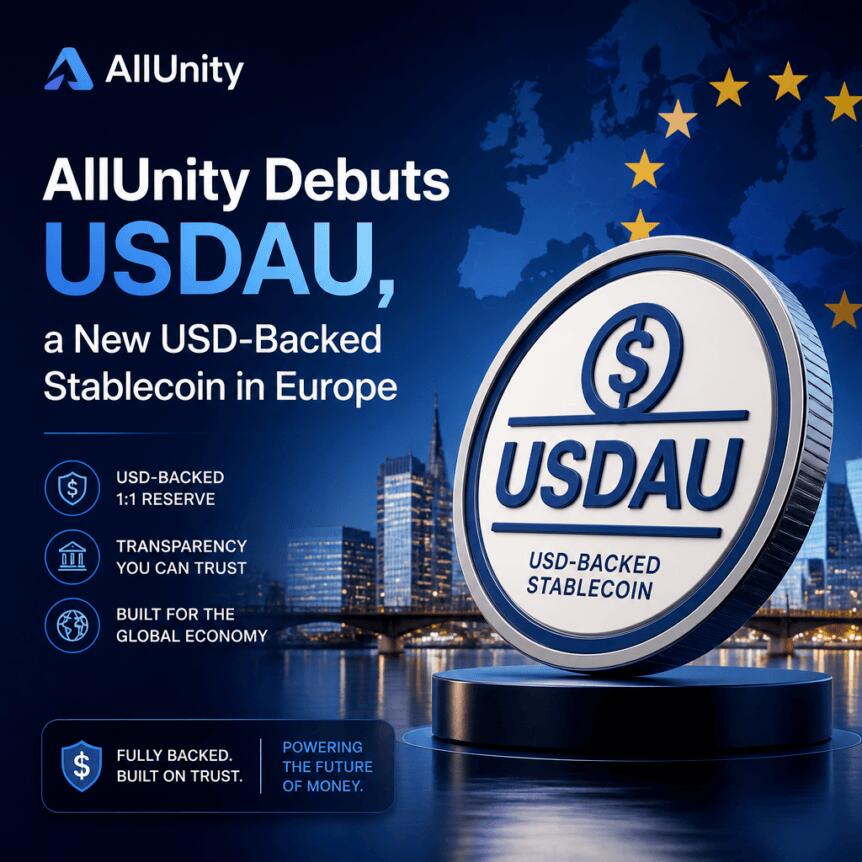
AllUnity has unveiled USDAU, its fourth fiat-backed stablecoin, designed to bring US dollar liquidity into a MiCA-regulated framework. The launch adds to an existing lineup that already includes euro, Swiss franc and Swedish krona tokens issued under the EU’s Markets in Crypto-Assets (MiCA) regime.
According to AllUnity’s announcement shared with Cointelegraph, USDAU is pegged 1:1 to the US dollar using segregated reserves. The company said the stablecoin will launch on multiple networks including Ethereum, Solana, Base, Tempo, Arc and Polygon.
Key takeaways
- AllUnity’s new USDAU stablecoin targets a 1:1 US dollar peg through segregated reserves, under EU MiCA regulation.
- The token will debut across Ethereum, Solana, Base, Tempo, Arc and Polygon, broadening access for developers and users.
- US dollar-pegged stablecoins dominate the market, with CoinGecko data cited in the report showing they represent more than 99% of global stablecoin capitalization.
- AllUnity’s CEO argues European regulators are focused less on the dollar itself and more on where liquidity sits—particularly outside-scope issuers without enforceable redemption and reserve transparency.
USDAU expands a MiCA-regulated stablecoin lineup
USDAU is positioned as AllUnity’s incremental step into the dollar market segment, complementing its earlier MiCA-compliant offerings. In its existing stablecoin suite, the company already issues EURAU (euro-backed), CHFAU (Swiss franc-backed) and SEKAU (Swedish krona-backed).
CoinGecko figures cited in the report put EURAU’s market capitalization at roughly $400,000 and CHFAU’s at about $45 million. While those figures do not necessarily reflect the full scale of demand for AllUnity’s fiat rails across jurisdictions, they provide a baseline for how the company’s earlier euro and franc products have started to take hold.
USDAU’s multi-chain rollout—spanning both established and newer ecosystems—also signals an intent to meet liquidity needs where users and payment flows already operate. For investors and builders, network choice matters because it affects integration effort, wallet support, and the routes stablecoins can take into lending, trading and tokenized finance.
Dollar dominance remains the defining stablecoin dynamic
AllUnity’s expansion comes at a time when the stablecoin market remains overwhelmingly concentrated in dollar exposure. The report notes that US dollar-pegged tokens account for more than 99% of the roughly $291 billion global stablecoin market by capitalization, citing CoinGecko’s stablecoin category data.
That dominance continues to shape the policy debate around stablecoins in Europe. In June, the European Central Bank warned that increased use of stablecoins in European tokenized finance could deepen dependence on the dollar and reduce the euro’s role.
For market participants, the implication is straightforward: even as regulators push for oversight, liquidity preferences and existing global settlement habits keep pulling users toward dollar instruments. The question for the next phase is whether MiCA-regulated issuance can meaningfully rebalance access and governance without requiring a wholesale shift away from dollar collateral.
AllUnity’s CEO frames the real issue as oversight and redemption
AllUnity CEO Alexander Höptner disputed the idea that Europe’s core concern is the dollar itself. In comments provided to Cointelegraph, he said Europe’s concern is instead about dollar liquidity flowing through offshore issuers that, in his framing, lack a European supervisor, enforceable redemption rights and visibility into reserves.
He argued that USDAU aims to place dollar liquidity inside Europe’s regulatory perimeter while still giving European companies the dollars they need for global trade and cross-border payments.
This perspective reframes the policy tension. Rather than treating stablecoin debate purely as a currency competition, Höptner suggests the primary risk is supervision and consumer protection—particularly around whether reserve backing is auditable and whether redemptions are contractually meaningful for users.
For traders, compliance-focused issuance can also matter indirectly. More predictable legal and operational structures may reduce friction for institutions evaluating stablecoin usage, especially when governance, transparency and custody arrangements come under scrutiny.
What to watch after the USDAU launch
USDAU’s debut across multiple chains raises practical questions that will likely determine traction: how quickly liquidity aggregates on different networks, how easily it can be integrated into trading and payment workflows, and whether reserve segregation and redemption practices remain consistently transparent as usage grows.
As European regulators continue weighing how stablecoins interact with tokenized finance, the next indicator to monitor is whether additional MiCA-regulated dollar issuance changes user behavior—or whether dollar dominance remains structurally driven by global liquidity routing.