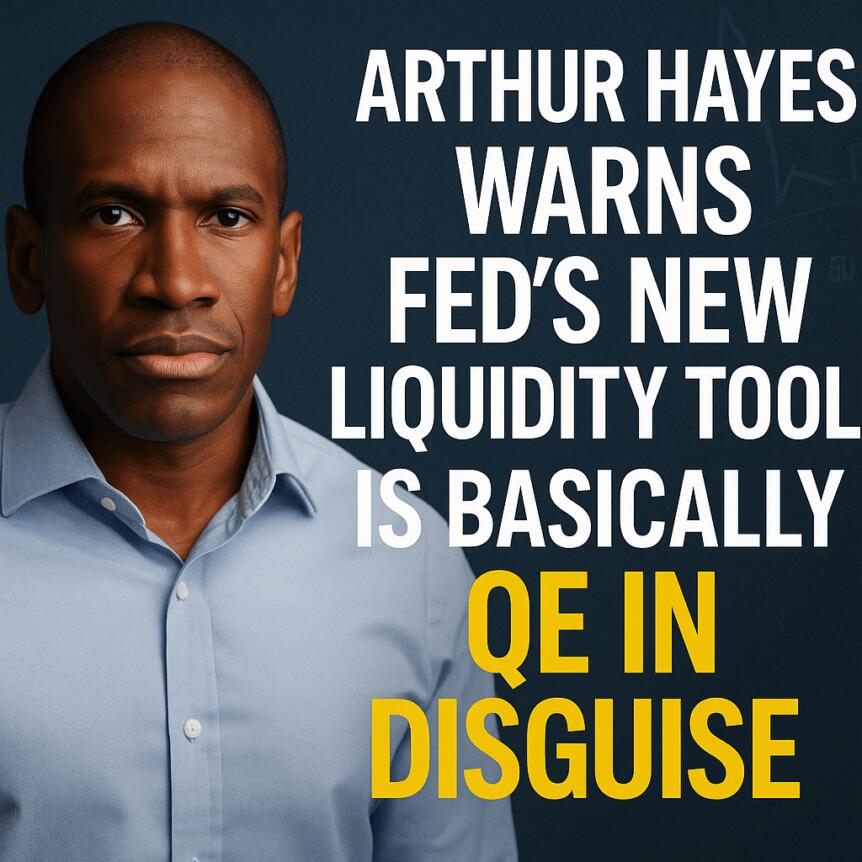
Crypto Expert Argues Fed’s New Program is a Form of Quantitative Easing
Arthur Hayes, co-founder and former CEO of the cryptocurrency exchange BitMEX, has highlighted concerns over the Federal Reserve’s latest monetary policy initiative, labeling it a disguised form of quantitative easing (QE). In a detailed Substack essay published on Friday, Hayes contends that the Fed’s “reserve management purchases” (RMP) program essentially functions as QE by facilitating government borrowing without the political baggage typically associated with outright asset purchases.
Hayes argues that the Fed’s strategy of buying short-term Treasury bills and recycling liquidity into the money markets effectively finances government spending. This approach, he suggests, allows officials to sidestep the political controversy of traditional QE while still increasing liquidity in the financial system. “The RMP is a thinly disguised way for the Fed to cash the government’s checks,” Hayes warns, emphasizing that such measures are highly inflationary from both a financial and real economy perspective.
“The RMP is a thinly disguised way for the Fed to cash the government’s checks. This is highly inflationary from both a financial and real goods/services perspective,” he wrote.
Hayes further states that such expansion of fiat liquidity tends to benefit scarce assets such as Bitcoin, gold, and silver. “I love QE because it means money printing, and thankfully I own financial assets like gold, gold/silver stocks, and Bitcoin that rise faster than the pace of fiat money creation,” he remarked. Nonetheless, he cautioned about the adverse effects of relentless money printing on the average person, including erosion of purchasing power, stagnant wages, and an increasing wealth gap favoring asset holders.
He emphasized that, for most of humanity, ongoing monetary debasement erodes dignity and productivity, undermining the link between energy inputs and economic outputs. “When the government intentionally debases the currency, it destroys that essential connection,” Hayes concluded.
Federal Reserve’s Recent Moves and Market Sentiment
On December 10, the Federal Open Market Committee (FOMC) announced a 25 basis point rate cut and commenced purchases of short-term Treasury securities, a move aimed at maintaining sufficient liquidity amid seasonal fluctuations such as tax payments. Fed Chair Jerome Powell stated that the purchases were “solely for the purpose of maintaining an ample supply of reserves,” distinguishing them from broader monetary policy shifts.
The initial plan involves around $40 billion in Treasury purchases per month, with the potential to sustain these levels for several months to stabilize short-term money markets. Despite these measures, analysts suggest that mixed signals from Powell may temper expectations of a sustained Bitcoin rally until the cycle of rate cuts resumes, potentially in 2026.
Bitcoin traded at approximately $92,695 on December 10 but has since settled around $87,300. Market consensus, as reflected on Polymarket, indicates a high probability (77%) of the Federal Reserve maintaining current rates in January, with only a 21% chance of a further 25 basis point cut, suggesting that significant policy shifts remain unlikely in the near term.

With Powell’s term set to expire in May 2026, political dynamics are shifting, with former President Trump advocating for more aggressive rate cuts. The upcoming Federal Reserve chair appointment is already drawing attention, with Kevin Hassett emerging as a frontrunner for the position. This landscape signals cautious market sentiment ahead of potential policy adjustments that could influence the broader crypto ecosystem.