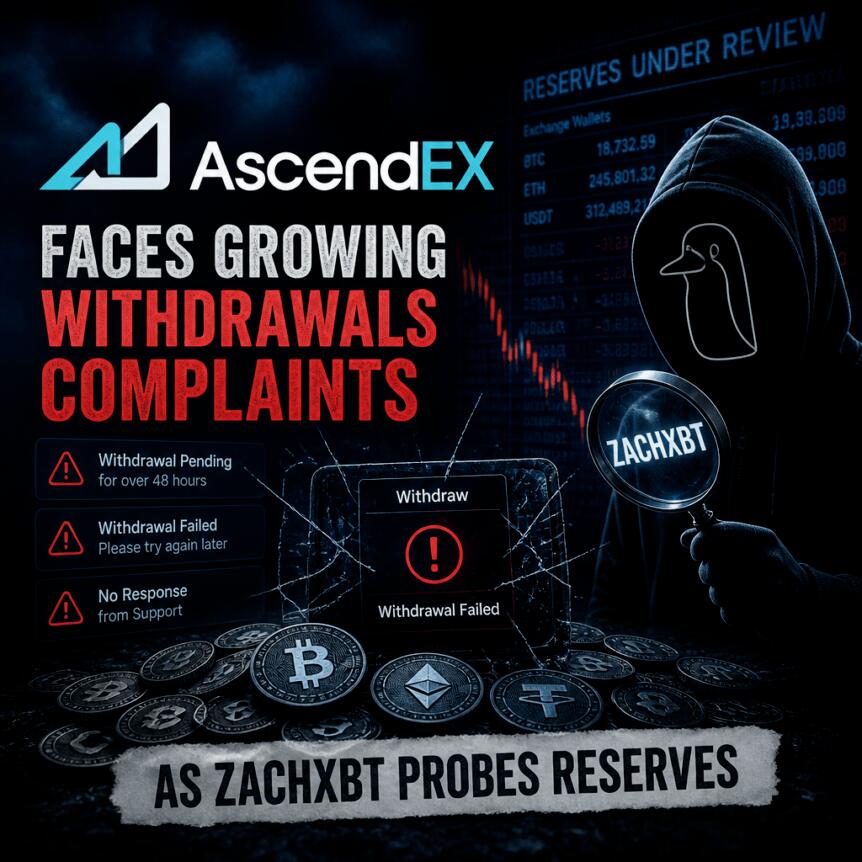
Cryptocurrency exchange AscendEX is facing mounting user complaints about delayed withdrawals, with blockchain investigator ZachXBT alleging the platform may be dealing with liquidity constraints. Multiple customers reported that withdrawal requests have remained stuck in an “initiating” state for days, prompting renewed scrutiny of the exchange’s ability to process outflows.
The situation has raised fresh questions about how AscendEX manages its hot-wallet reserves—assets exchanges typically keep readily accessible to meet customer withdrawal demands quickly, particularly for large-cap tokens and stablecoins.
Key takeaways
- Users say withdrawals on AscendEX have been stuck in an “initiating” state, with no clear resolution from customer support.
- ZachXBT claims AscendEX lacks large-cap reserves for tokens such as ETH, USDT, and SOL, pointing to potential liquidity problems.
- Arkham data reviewed by Cointelegraph indicates AscendEX-tagged wallets hold roughly $20.2 million in crypto, concentrated in smaller-cap assets.
- The exchange has not publicly addressed the specific complaints and reserve concerns at the time of publication.
Withdrawal delays trigger customer outcry
The first public reports came from an X account identified as Lorenzo Navarro Rodriguez, who said in a Tuesday post that a withdrawal of 4,196 USDT had remained stuck since June 10. The account also claimed that repeated inquiries to AscendEX support did not receive answers.
Following that initial post, at least five additional users replied over the next few days, describing similar withdrawal problems on the exchange. Together, these reports suggest a broader operational issue rather than an isolated stuck transaction.
For users, delayed withdrawals are not just an inconvenience. When an exchange cannot promptly source the assets needed for customer requests—especially stablecoins and major coins—withdrawal queues can build quickly and escalate into more severe liquidity stress.
ZachXBT links the complaints to alleged reserve shortfalls
On Friday, ZachXBT said in a Telegram post that AscendEX’s holdings may not be positioned to handle large-cap withdrawals. According to ZachXBT, the exchange appeared to lack substantial reserves in widely used assets including Ether (ETH), USDT, and Solana (SOL), which he characterized as a potential sign of “liquidity issues” on the platform.
ZachXBT also urged AscendEX to respond publicly to the withdrawal delays and to explain why its hot wallets appear to hold low liquidity. The implication is straightforward: if an exchange’s readily available reserves are skewed away from widely traded assets, processing withdrawals can become slower or fail depending on how the platform routes orders and manages inventory.
On-chain observations: reserves concentrated in smaller-cap tokens
Cointelegraph reported that Arkham data reviewed on Friday showed AscendEX-tagged wallets holding about $20.2 million in crypto. The same dataset indicated that the wallet holdings were concentrated in smaller-cap assets, rather than dominated by major cryptocurrencies or heavily used stablecoins.
In the Arkham view cited by Cointelegraph, AscendEX’s largest holding was UNITE, at around $10 million. Other notable holdings included REUR at approximately $5.24 million, ASD at about $2.9 million, and roughly $600,000 in Reservoir rUSD stablecoins, alongside additional smaller tokens.
Cointelegraph also stated it approached AscendEX for comment, but had not received a response before publication. Without a direct explanation from the exchange, customers and observers are left to connect user-reported withdrawal delays with the reserve composition seen in public on-chain analytics.
Why liquidity scrutiny intensified after FTX
Questions about exchange liquidity are particularly sensitive in the crypto industry following the collapse of FTX in 2022. During that period, customer withdrawal requests exposed a significant shortfall, culminating in insolvency and bankruptcy.
The FTX failure triggered a broader wave of withdrawal activity across exchanges, increased regulatory attention, and encouraged many platforms to publish proof-of-reserves materials as a way to reassure users. While proof-of-reserves efforts vary in quality and methodology, they reflect a fundamental expectation: customers want transparency that assets can be accessed when withdrawal demand rises.
In the current case, the combination of user reports about stalled withdrawals and external investigator claims about reserve composition creates a pressure point for AscendEX. The key issue for market participants is not simply whether an exchange holds assets in total, but whether it holds enough of the right assets—particularly those customers commonly withdraw—to meet outflows in a timely way.
Readers should watch for whether AscendEX acknowledges the specific withdrawal complaints, explains the underlying operational or liquidity mechanics, and provides clearer information about how its hot-wallet reserves are structured—especially for tokens such as ETH and USDT that users appear to be withdrawing amid the reported delays.