Tokenization of government bonds is moving from concept to a practical roadmap, with officials arguing it could reduce operational friction in issuance and settlement. Hyun Song Shin, governor of the Bank of Korea, highlighted at the European Central Bank (ECB) Forum on Central Banking in Sintra, Portugal, that tokenized bonds can make collateral verification easier and help streamline transaction reversals.
Shin framed government debt tokenization as a “big prize,” emphasizing that having the underlying asset and settlement flow tokenized could also reduce the likelihood of mistakes. His remarks also pointed to a broader effort to link multiple tokenized financial assets—central bank money and bank deposits included—on a single ledger as part of the Bank of Korea’s initiative around blockchain-based wholesale CBDC infrastructure.
Key takeaways
- Bank of Korea’s Hyun Song Shin said tokenized government bonds could simplify collateral checks, account crediting, and timed transaction reversals.
- US Treasury debt remains a major tokenized RWA segment, with RWA.xyz data placing it at $14.6 billion (about 46% of a reported $31.7 billion RWA market).
- The BIS argues tokenization can improve market efficiency by enabling conditional execution and potentially reducing settlement risk.
- BIS review of 39 tokenized bonds found “suggestive evidence” of tighter bid-ask spreads without clear evidence of higher issuance costs or worse yields.
Why tokenizing government bonds is seen as a “simplification” play
Shin’s comments focused on the mechanics of how tokenization changes day-to-day operations in bond markets. In a panel discussion at the ECB Forum on Central Banking, he suggested that a tokenized structure can make verification and settlement processes more reliable by keeping more of the workflow within a digital representation of the asset and its transfer.
According to Shin, tokenized bonds could allow institutions to verify collateral more easily, credit the asset provider’s account when conditions are met, and reverse transactions at the appropriate time. He added that the overall system can be “much less prone to mistakes” when “everything” in the process is tokenized—an argument that goes beyond faster settlement narratives and instead targets operational error reduction.
The governor’s remarks also place government bonds at the center of the tokenization agenda. “The big prize is tokenizing government bonds,” Shin said, indicating that sovereign issuance and custody are likely viewed as the clearest proving ground for broader adoption.
Tokenized Treasuries underscore the scale of real-world tokenization
While Shin’s remarks were forward-looking, the tokenized government bond category already appears substantial in current market estimates. Data cited from RWA.xyz indicates that US Treasury debt is the largest tokenized real-world asset segment, totaling $14.6 billion—about 46% of an overall $31.7 billion RWA market estimate provided in that dataset.
This matters because liquidity and settlement reliability are particularly important for sovereign debt, which is widely used by banks, funds, and other counterparties as collateral and a benchmark exposure. By pointing to Treasuries as a large share of today’s tokenized RWA landscape, the discussion implicitly suggests that technical and operational lessons learned in sovereign markets could be transferable to other instruments.
At the same time, Shin’s emphasis on reducing mistakes and improving control suggests that the next phase of tokenization may be driven as much by risk management and process governance as by purely market-structure improvements.
Bank of Korea’s “Project Hangang” aims to unify tokenized settlement layers
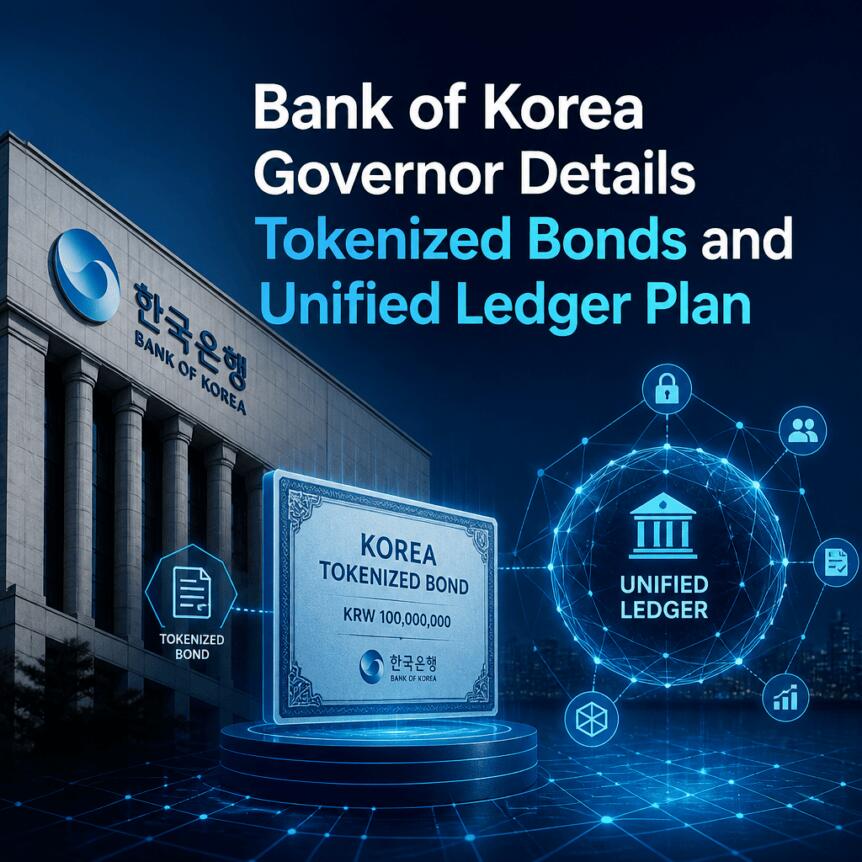
Shin also described plans to connect tokenized government bonds, wholesale central bank digital currencies, and tokenized commercial bank deposits on a unified ledger. He linked this to an extension of “Project Hangang,” a Bank of Korea-led pilot project testing a blockchain-based wholesale CBDC system.
The proposed unified ledger approach matters because it addresses a common architectural question in tokenization: how different tokenized components—assets, central bank money, and bank deposit claims—should interact. Investors and market participants care not only about faster settlement but about whether tokenized asset transfers can be executed atomically with the corresponding payment rail, reducing gaps between custody, payment, and settlement finality.
What remains less clear is the pace and scope of deployment beyond pilot environments. Shin’s remarks framed this as a direction for the extension of the existing program, but the specific timeline for moving from tests to production-scale infrastructure was not provided in the account.
BIS report highlights potential efficiency gains, with evidence from real tokenized bonds
The tokenization argument Shin made aligns with broader research from the Bank for International Settlements (BIS). In a July 2025 report, the BIS evaluated whether tokenization of government securities could improve market efficiency and support financial innovation—assuming regulatory and infrastructure hurdles are handled.
The BIS stressed that government securities are fundamental to the financial system, serving as savings instruments for households and firms and acting as collateral across transactions. It argued that tokenization may help because it enables “contingent execution of actions,” which the report said could enhance market efficiency, reduce settlement risk, broaden access for investors, and encourage new financial services.
The BIS report examined 39 tokenized bonds—24 corporate issuances and 15 government issuances. Based on the comparison against traditional, non-tokenized bonds, the BIS found “suggestive evidence” of lower bid-ask spreads. It also reported comparable issuance costs and yields, indicating that tokenization has not clearly forced issuers into materially higher financing costs (at least within the scope of the reviewed sample).
For market participants, the bid-ask spread observation is notable because it connects tokenization to liquidity conditions rather than only technology convenience. However, the language “suggestive evidence” also signals caution: the results are not presented as definitive proof that tokenization will always improve liquidity across markets, maturities, or jurisdictional setups.
What to watch next as tokenization shifts toward settlement design
Both Shin’s remarks and the BIS analysis point in the same direction: tokenization’s near-term value may be realized less through marketing and more through settlement design—conditional execution, improved collateral verification, and tighter integration between asset and payment rails. The next developments to monitor are whether pilots like Project Hangang move toward broader ledger interoperability and how regulators assess the infrastructure and governance needed for sovereign issuance at scale.