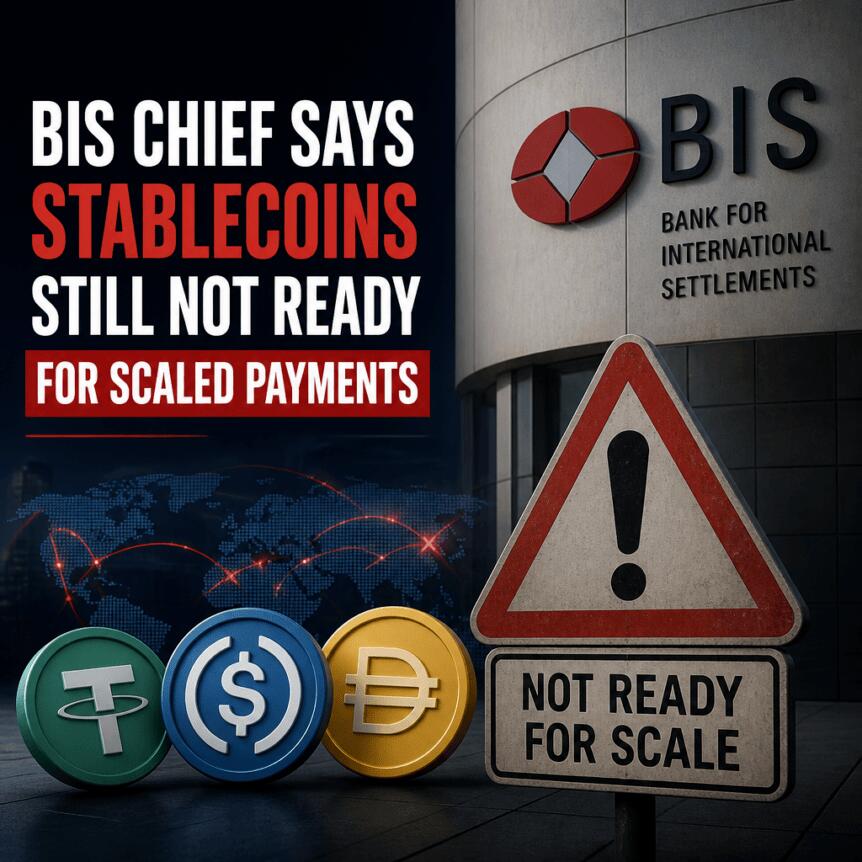
The Bank for International Settlements (BIS) is renewing its warnings about stablecoins, arguing that many of the tokens marketed as “everyday money” still lack credibility for payments at scale. Speaking ahead of a potential leadership transition at the BIS—where General Manager Pablo Hernández de Cos is a candidate to succeed European Central Bank President Christine Lagarde—he framed tokenized bank deposits as a more dependable route to bring distributed ledger technology into the financial system.
According to Reuters, Hernández de Cos said stablecoins do not function credibly as a means of payment at scale. Instead, he pointed to tokenized bank deposits as a way to “harness tokenisation” while keeping the monetary system’s underlying structure intact.
Key takeaways
- BIS leadership argues stablecoins struggle to operate as reliable payment instruments at scale, while tokenized bank deposits better preserve existing monetary foundations.
- Hernández de Cos acknowledged potential borrowing-cost benefits from stablecoins but warned the impact could shift costs onto consumers if banks face higher funding expenses.
- He cited practical and regulatory concerns, including limited interoperability between stablecoin systems and challenges in applying anti-money-laundering controls consistently.
- A BIS-linked Financial Stability Institute (FSI) study found major differences across jurisdictions in who can issue stablecoins and what related activities are allowed.
- In all five markets analyzed (US, EU, UK, Hong Kong, Singapore), restrictions generally apply to the issuing entity itself, not the broader corporate group.
BIS challenges the “stablecoin as payments” narrative
Hernández de Cos’ remarks build on a familiar BIS stance: stablecoins may be useful as technology, but they do not automatically meet the standards regulators expect from everyday money. Reuters reports that he questioned stablecoins’ ability to provide payments at scale, suggesting they remain fragmented rather than integrated into a coherent payment ecosystem.
To him, the critical distinction is structural. Tokenized bank deposits, he argued, offer a “more direct path” to adopt tokenization while maintaining the monetary system’s foundations. The implication for investors and builders is that the BIS view prioritizes regulated money-like instruments inside the banking perimeter over privately issued token substitutes for deposits.
Hernández de Cos also addressed a key argument often raised in favor of stablecoins: their potential to reduce government borrowing costs. Reuters notes that he acknowledged this possibility, including an earlier push for the idea by US Treasury Secretary Scott Bessent.
However, he warned that benefits could reverse depending on where deposits ultimately sit. If customers shift bank deposits into stablecoins, banks could experience higher funding costs. In turn, those costs may be passed on through higher borrowing rates for households and businesses, according to Hernández de Cos.
Interoperability and compliance remain unresolved
Beyond macro-financial considerations, the BIS general manager flagged operational hurdles. Reuters reports he cited limited interoperability between stablecoin platforms and the difficulty of consistently applying anti-money-laundering controls.
Those points matter because payment functionality is not only about price stability or faster settlement—it also depends on reliable exchange routes, consistent monitoring, and enforceable compliance procedures. If stablecoin systems remain siloed and controls vary across ecosystems, regulators may view the risks as shifting rather than being eliminated.
He also argued that increasing use of US dollar-pegged stablecoins outside the US could weaken monetary sovereignty and constrain domestic monetary policy. In practice, this frames stablecoins not simply as an asset class, but as a mechanism that could alter currency transmission and policy effectiveness when adoption spreads beyond national boundaries.
FSI study maps how rules differ for stablecoin issuers
Hernández de Cos’ critique comes alongside new research from the BIS-linked Financial Stability Institute (FSI). The FSI study, published on Thursday, compared stablecoin regulation in the United States, European Union, United Kingdom, Hong Kong, and Singapore, focusing on which entities may issue stablecoins and what additional activities they can carry out.
According to the FSI report, the jurisdictions diverge substantially. The differences are not only theoretical: they affect business models, compliance scope, and the potential for stablecoin issuers to expand into other crypto-adjacent services.
More restrictive approaches in the US and Singapore
The US and Singapore were found to take relatively restrictive stances toward non-bank issuers. Reuters reports that under the US GENIUS Act, activities such as lending, staking, proprietary trading, and custody of third-party crypto assets generally fall outside what payment stablecoin issuers can do.
For market participants, this kind of boundary-setting can have major implications. If issuance permissions are narrower, the route from stablecoin issuance to broader market roles—such as custody platforms or leveraged-yield strategies—may be constrained. That may reduce certain risks regulators associate with highly integrated crypto firms, but it can also limit product innovation.
Hong Kong, the UK, and the EU allow some additional activities
By contrast, the FSI study found that Hong Kong, the UK, and EU frameworks are less restrictive in allowing additional activities, though typically subject to separate authorization, regulatory consent, or other applicable permissions.
This means that while those jurisdictions may permit issuers to do more, they may also introduce layered regulatory gating. In other words, the rules may broaden the eligible activity set, but still aim to ensure that riskier functions remain tightly supervised.
Restrictions target issuers, not entire corporate groups
One of the more technically important findings in the FSI research is how limits are applied. Reuters reports the study found that restrictions in all five jurisdictions generally target the issuing entity rather than the wider corporate group.
That structure creates an asymmetry: other companies within the same corporate group may be allowed to conduct activities that the stablecoin issuer itself is prohibited from doing. For regulators, this can complicate risk oversight across corporate arrangements. For users and investors, it matters because the stablecoin’s risk profile may depend not only on the issuer, but on the group ecosystem behind it.
In practice, the “entity-level” approach can affect how risks propagate—especially when compliance processes, operational controls, and internal governance differ across group members.
As stablecoin regulation continues to take shape, the next question for markets is whether governments move toward more consistent rules that address interoperability and compliance across ecosystems, or whether they continue with fragmented frameworks that leave gaps between issuer permissions and broader group activities. BIS critiques like these suggest regulators may keep pressure on stablecoins to prove not just stability, but payment-grade reliability and governance.