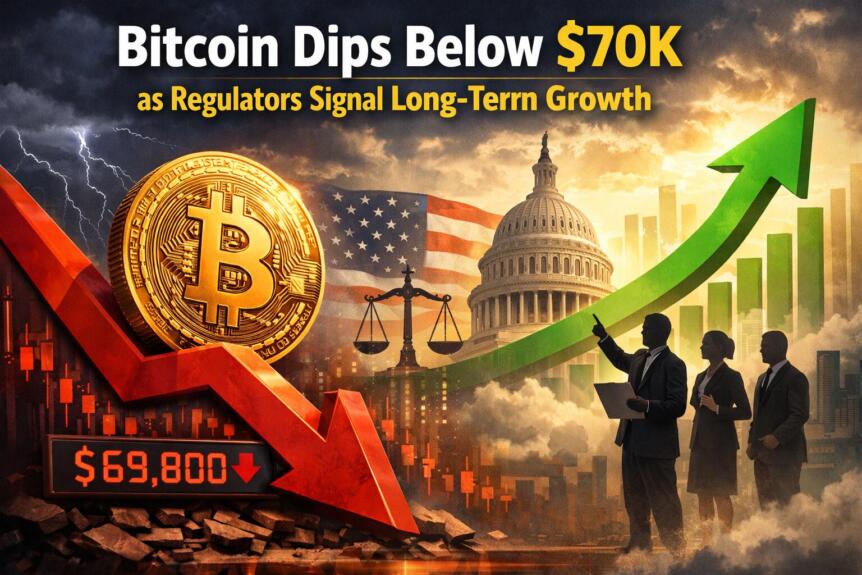
This release reports a shift in Bitcoin trading as macro momentum and evolving U.S. regulation intersect with market infrastructure updates. The price moved below $70,000 after a brief rally to about $76,000 last week, reflecting broader expectations for higher-for-longer interest rates and addressable inflation risks. At the same time, the issuing authorities outlined a framework that places major crypto assets under the Commodity Futures Trading Commission’s jurisdiction, while signaling the potential for faster spot ETF approvals. The document also notes licensing developments in DeFi and ongoing policy discussions that could shape near-term market activity and long-term confidence.
Key points
- Bitcoin traded below $70,000 after a peak of about $76,000 last week, with macro data and a hawkish Fed stance contributing to the move.
- A US regulatory framework designates major crypto assets as digital commodities under CFTC jurisdiction, alongside existing listing standards that may quicken spot ETF approvals.
- Advances on the CLARITY Act address stablecoin yield structures, signaling potential limits on passive yields while allowing returns tied to transactional activity.
- S&P Dow Jones Indices has licensed Trade[XYZ] to launch the first officially licensed S&P 500 perpetual derivative on the Hyperliquid blockchain, expanding access for non-US investors.
Why it matters
Taken together, the release frames near-term volatility as tied to macro conditions while underscoring how regulatory clarity could attract institutional participation over time. The digital-commodity designation and broader listing standards may speed spot ETF approvals, widening the pathway for mainstream exposure. Moves on the CLARITY Act and DeFi licensing signal potential shifts in how crypto markets are structured and accessed, particularly for non-US investors leveraging cross-market products. Investors and builders should watch regulatory updates, ETF timelines, and licensing milestones to gauge how policy progress may translate into market dynamics.
What to watch
- Regulatory: track progress and potential enactment of the CLARITY Act and its stablecoin yield framework.
- ETF timelines: monitor whether spot crypto ETF approvals accelerate in light of the new framework.
- Licensing milestones: observe developments around the S&P 500 perpetual derivative on Hyperliquid and related licensing deals.
Disclosure: The content below is a press release provided by the company or its PR representative. It is published for informational purposes.
Bitcoin Falls Below $70,000 Amid Macroeconomic Pressure; Regulatory Developments Signal Long-Term Growth Potential
Abu Dhabi, UAE – March 23, 2026: Bitcoin has retreated below the $70,000 mark following a recent peak of $76,000 last week, as macroeconomic headwinds weighed on investor sentiment. The decline was primarily driven by higher-than-expected US Producer Price Index (PPI) data, alongside a more hawkish tone from Federal Reserve Chair Jerome Powell, who highlighted rising oil prices as a potential inflationary risk.
Markets are now increasingly pricing in a prolonged period of elevated interest rates, with expectations that the Federal Reserve could hold rates steady through 2027. Continued geopolitical tensions in the Middle East and sustained high oil prices could further fuel inflation, potentially prompting additional rate hikes—historically a negative backdrop for cryptoasset performance due to tightening financial conditions.
Despite short-term volatility, regulatory developments in the United States are providing a more constructive long-term outlook for the crypto sector.
The US Securities and Exchange Commission (SEC) and Commodity Futures Trading Commission (CFTC) have jointly introduced a comprehensive cryptoasset classification framework. Under this framework, major cryptoassets including Bitcoin, Ethereum, Solana, and XRP have been designated as digital commodities, placing them primarily under CFTC jurisdiction rather than the SEC.
This classification, alongside previously approved generic listing standards, is expected to accelerate the approval timeline for spot crypto ETFs. Such developments could unlock significant institutional inflows and support long-term price appreciation across the sector.
In parallel, progress is being made on the proposed CLARITY Act, with reports indicating that US lawmakers and the White House have reached a tentative agreement on stablecoin yield structures. The proposed framework would restrict passive yield generation while allowing returns tied to transactional activities such as payments and trading. If enacted, the legislation could represent a major milestone in establishing regulatory clarity and fostering growth within the crypto market.
In the decentralised finance (DeFi) space, S&P Dow Jones Indices has announced a landmark licensing agreement with Trade[XYZ], enabling the launch of the first officially licensed S&P 500 perpetual derivative contract on the Hyperliquid blockchain. This innovation allows non-US investors to gain 24/7 leveraged exposure to the S&P 500 via a decentralised platform, supported by real-time index data.
Following the announcement, Hyperliquid’s native token, $HYPE, rose 6% and is now up over 55% year-to-date, significantly outperforming major cryptoassets such as Bitcoin and Ethereum, which remain down over the same period. The performance reflects growing demand for decentralised infrastructure offering continuous access to both crypto and traditional financial markets.
Meanwhile, higher-risk assets such as memecoins—including $TRUMP, $PEPE, and $PENGU—were among the hardest hit during the recent market downturn, with declines of up to 20%, highlighting their elevated sensitivity to broader market movements.

Simon Peters, Crypto Analyst at eToro, commented: “While macroeconomic pressures have driven short-term volatility in crypto markets, the evolving regulatory landscape in the US represents a significant step forward. Greater clarity around asset classification and market structure could pave the way for increased institutional participation and long-term growth in the sector.”