Bitcoin spent the Thursday Wall Street open hovering just above the $64,000 area, trapped in a narrow range as traders digested fresh macro signals pointing to renewed inflation pressure and weaker labour conditions. At the same time, market hopes around energy logistics in the Middle East cooled after Iranian officials played down assumptions that the Strait of Hormuz would quickly reopen.
The result for BTC has been a familiar kind of indecision: despite cross-asset movements elsewhere—such as gold firming and equities printing record highs—crypto has not delivered the decisive breakdown or breakout many analysts were waiting for. Instead, several monitoring desks described the current action as more “stalled” than truly capitulative.
Key takeaways
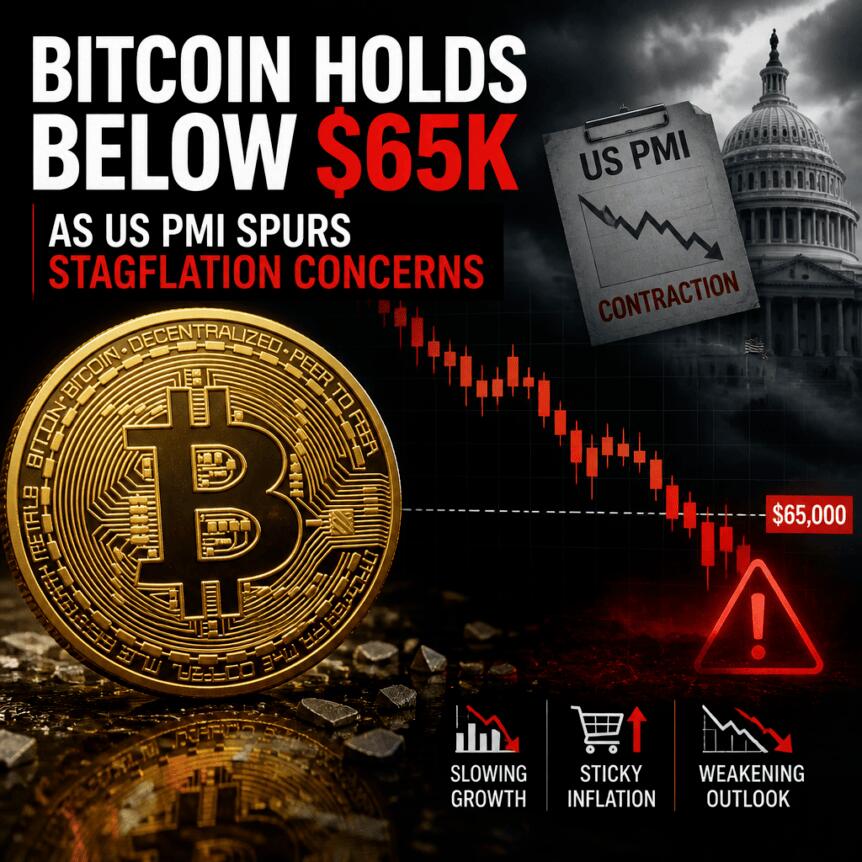
- BTC remained below $65,000 near the US open, down roughly 0.5% on the day, as geopolitical expectations around the Strait of Hormuz eased.
- US services PMI and employment data point to “stagflation” risk, with prices paid rising while employment conditions deteriorate.
- Glassnode characterised the current market as “boredom rather than capitulation,” suggesting conditions may be building for a turn but are not complete.
- Bitfinex Research argued that a “genuine breakdown” has not yet appeared, because a stronger macro trigger and volume-supported follow-through are still missing.
Iran’s caution blunts Strait of Hormuz rebound hopes
On the charts, BTC/USD hovered above $64,000 during the Wall Street open, with TradingView data showing the pair down about 0.5% at that point. US stock indices also opened roughly flat, indicating that broader risk appetite was not sharply moving on the day’s developments.
A key narrative for commodity traders—whether the Strait of Hormuz would reopen—failed to translate into meaningful volatility for Bitcoin. Anticipation had centred on a reported Iran–Oman understanding that could resume the route for international shipping, but Iran’s messaging introduced uncertainty about how quickly or fully any reopening could occur.
In comments carried by CNN, Iran’s Deputy Foreign Minister Kazem Gharibabadi said: “This understanding does not, in itself, mean that the Strait of Hormuz will reopen,” as quoted by the state-run Islamic Republic News Agency (IRNA). That clarification matters because energy-route risk is one of the channels that can feed into inflation expectations—an issue now resonating through the US macro data backdrop.
Oil was broadly steady as these geopolitical signals played out. WTI crude was little changed at around $76 per barrel, after dipping to three-week lows of about $74.30 the day before. Even with the energy market not collapsing, the lack of escalation suggested traders weren’t receiving a strong impetus to reprice macro risk aggressively at the open.
US services data revive stagflation fears
While the Middle East headlines failed to generate a clear impulse, the economic calendar offered a more direct storyline. Trading resource The Kobeissi Letter pointed to the latest US Institute for Supply Management (ISM) Services PMI and employment data released on Wednesday.
According to the figures highlighted by Kobeissi, July’s services PMI rose by 0.1 point to 54.1, while employment fell by 3.6 points to 47.4—the lowest reading since March. The divergence between output sentiment and labour conditions was paired with a notable jump in the prices paid index: +2.6 points to 70.3, near its highest level since October 2022.
Kobeissi also contextualised the inflation signal, noting that prices paid has trended higher for more than two years and is up about 16.9 points since March 2024. The central interpretation was that “the economy is increasingly under pressure from both rising prices and a weakening labor market,” and that the odds of stagflation were therefore “intensifying” based on the combined readings. The post was shared on X, where the same analyst discussed the data and its implications.
For crypto investors, this matters because a stagflation-style regime—where prices remain elevated while growth or hiring weakens—can complicate the usual interest-rate narrative and heighten uncertainty in liquidity conditions. Bitcoin’s role as a “macro proxy” is often debated, but when rates expectations and risk premiums shift, BTC frequently feels the drag even if inflation prints don’t immediately produce a clear direction for the asset.
Bitcoin shows “boredom,” not capitulation
Despite the macro noise, onchain and market analytics suggested the current BTC range has the characteristics of a pause rather than a flush. Glassnode described BTC/USD as showing “boredom rather than capitulation,” framing the lack of sustained downside momentum as an incomplete stress signal.
Glassnode’s commentary, shared in an analysis posted on X, also highlighted that BTC has been largely unresponsive while gold hit its highest level in six weeks and the S&P 500 moved to all-time highs. That combination—traditional safe-haven strength alongside continued equity confidence—can leave risk assets without a single, clean macro “directional” impulse, encouraging consolidation rather than trend.
In its one-line summary, Glassnode characterised the market regime as “a compressed, under-owned market that global risk appetite has left behind,” adding that “bottom conditions assembling but incomplete.” The distinction is important: it implies that bearish conditions may be developing, but the market still lacks the final ingredient that would typically mark a decisive turning point.
This view sits alongside earlier comparisons that Cointelegraph had reported, where bear-market patterns were being examined for potential similarities in 2026. Those earlier reports focused on history repeating through gradual support erosion before a larger macro floor is reached. Glassnode’s “incomplete” framing, however, suggests the move many traders expect hasn’t fully played out yet.
Bitfinex: a true breakdown needs more force and volume
Bitfinex Research, the analytics arm of the Bitfinex exchange, echoed the idea that BTC has not yet offered the kind of breakdown confirmation traders associate with a decisive regime shift. In an update posted on the Bitfinex blog on Wednesday, it argued that while macro developments and Bitcoin’s underperformance versus the Nasdaq and S&P 500 point to underlying stress, the market still does not show what it called a “genuine breakdown.”
The analyst wrote that a true breakdown requires “something more forceful, followed by volume-supportive price action.” Put differently: without a stronger macro trigger and the type of follow-through that typically comes with rising participation on declines, the current range may continue to act like a holding pattern rather than a distribution event.
This is consistent with the day’s price behaviour, where BTC stayed confined and did not accelerate lower even as traders tracked inflation-and-labour signals and waited for additional geopolitical clarity. If the market is indeed under-owned and compressed, it may be positioned to move quickly once a trigger arrives—but until then, signals can remain fragmented across asset classes.
For traders and investors, the immediate watchpoints are therefore twofold: whether new macro data meaningfully worsen the inflation-growth tension, and whether BTC finally transitions from consolidation into a directional move with clear confirmation. As of the Wall Street open, both Bitfinex’s “more forceful” requirement and Glassnode’s “incomplete” bottom conditions were still not satisfied.
Going forward, the key question is whether the stagflation narrative gains stronger traction through subsequent data releases, and whether BTC’s range eventually resolves with volume and follow-through—either signaling a durable breakdown or forcing the market to reprice risk back upward.