Bitcoin traded with subdued volatility on Thursday as a rebound in US equities and a softer read on inflation reduced the pressure investors had placed on risk assets. In late US trading, BTC held near $64,500, largely steady from the prior day, after market attention shifted to June’s US Personal Consumption Expenditures (PCE) inflation release.
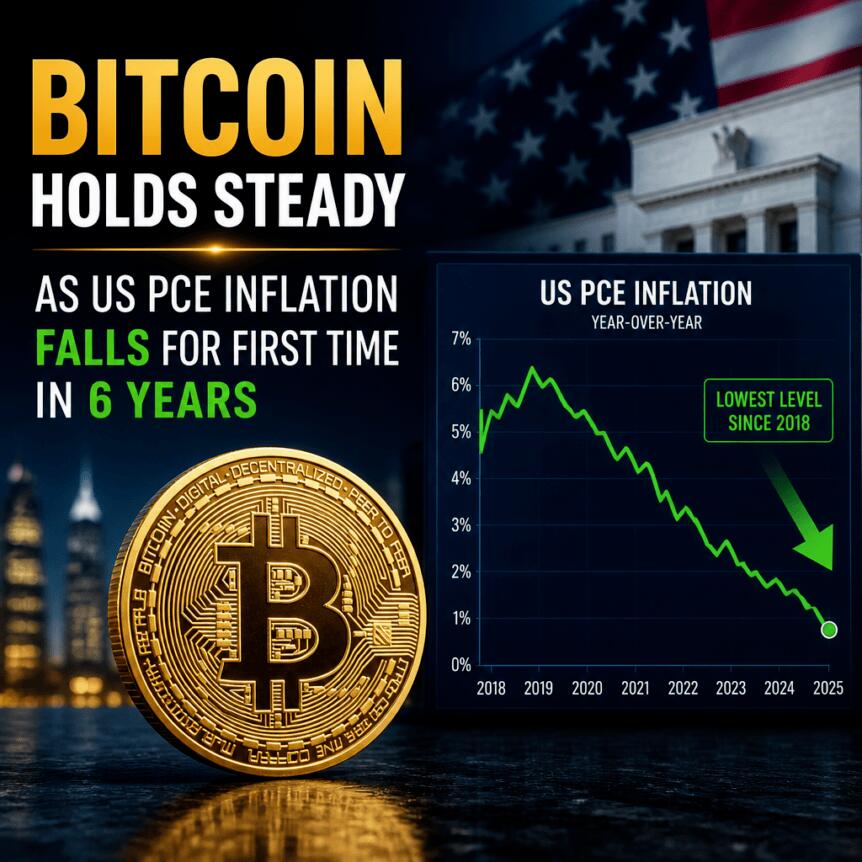
The PCE report showed inflation cooling to 3.7% year-on-year—matching expectations—while S&P 500 and Nasdaq Composite gains reflected a broader “risk-on” tone. Even so, commentators cautioned that the numbers still sit well above the Federal Reserve’s 2% target, keeping the longer-term debate about the inflation path alive.
Key takeaways
- Bitcoin largely shrugged off Thursday’s macro-driven volatility, holding around the $64,500 area as US stocks rebounded.
- June PCE inflation came in at 3.7% year-on-year, in line with forecasts, ending a short-term uptrend in the data.
- Despite the cooler print, inflation remains materially above the Fed’s 2% target, limiting “all clear” confidence.
- Bitwise CIO Matt Hougan argued that future interest-rate moves may be smaller—potentially reducing how strongly BTC reacts to rate headlines.
BTC stays range-bound as equities recover
Charting from TradingView showed BTC/USD action focusing around $64,500, with price behavior described as broadly unchanged versus the previous day. Earlier in the week, crypto had faced a headwind from a broad sell-off in semiconductor stocks, a move that spilled into other risk assets during US trading. That pressure eased on Thursday, helping keep Bitcoin from forcing a sharp reaction to the day’s macro catalyst.
At the time of writing, the S&P 500 was up about 1% and the Nasdaq Composite gained roughly 2.3%, reflecting improving sentiment across markets following the inflation data release.
PCE cools to 3.7%—but remains far above the Fed target
June’s PCE inflation print provided the day’s primary momentum. The year-on-year reading of 3.7% matched market expectations, while May’s figure had been 4.1%, which was described as the highest in three years. PCE is widely treated as the Federal Reserve’s preferred inflation measure because it is based on a broad basket of consumer spending and updates more quickly as consumer choices shift in response to prices. The Federal Reserve Bank of Cleveland describes this framing as a key advantage of the PCE approach.
In its release, the US Bureau of Economic Analysis (BEA) attributed the month’s increase in current-dollar PCE to higher spending—most notably services. The BEA said the $65.2 billion rise in current-dollar PCE reflected increases of $58.2 billion in spending on services and $7.0 billion in spending on goods.
Even with the cooling headline number—and the BEA noting a month-on-month decline—some market watchers treated the report as cautiously supportive rather than decisive. The Kobeissi Letter highlighted that the 3.7% rate was still the second-highest result since October 2024. The account also argued that inflation was running at nearly double the Fed’s 2.0% target.
Economist Steve Hanke also pushed back against complacency, describing inflation as a “genie the Fed just can’t put back in the bottle,” while emphasizing the mismatch between current inflation and the Fed’s goal.
Fed policy uncertainty persists—Bitwise expects weaker rate sensitivity
Beyond the inflation print, Thursday’s narrative also centered on interest-rate expectations. The Federal Reserve left rates unchanged at its latest meeting on Wednesday, with an emerging split among Federal Open Market Committee (FOMC) members over the appropriate policy path.
Matt Hougan, chief investment officer at Bitwise, argued that Bitcoin’s sensitivity to future rate announcements may be lower than what investors have historically experienced. On social media, Hougan pointed to the pattern of rate swings during Bitcoin’s history—ranging across very wide levels—and suggested that future changes may be more incremental. His comment referenced CME Group’s FedWatch Tool, which implies a smaller trajectory for rates over the coming year compared with prior cycles.
Hougan also tied his view to expectations around leadership. He stated that new Fed chair Kevin Warsh is likely to echo former chair Alan Greenspan in terms of the scale of policy moves, contrasting that with Jerome Powell. In addition, he referenced earlier signals from US President Donald Trump suggesting Warsh would take a more dovish stance on policy, a development that, if realized, could support risk-asset performance and reduce the market’s fear of abrupt tightening.
What investors should watch next
Bitcoin’s muted reaction to Thursday’s macro headlines suggests investors are still willing to hold through volatility when equities stabilize, but the debate over whether inflation is truly on a sustainable path remains unresolved. The next key factor will be whether incoming PCE reads continue to ease toward the Fed’s target and whether rate expectations—tracked via tools like CME FedWatch—continue to shift more gradually rather than re-pricing abrupt policy changes.