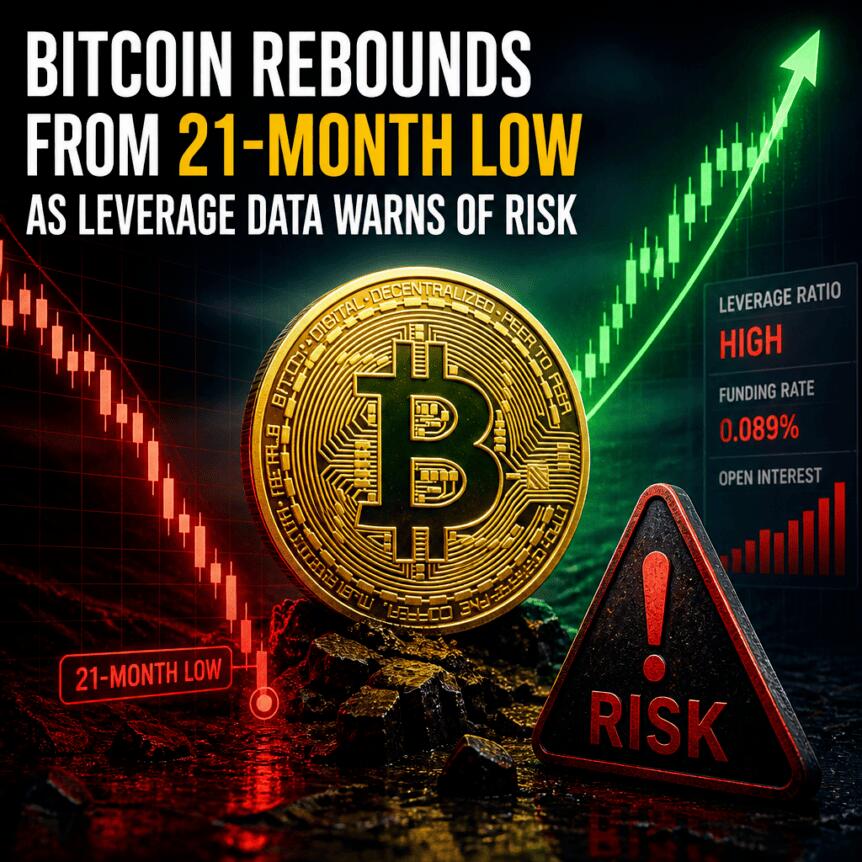
Bitcoin rebounded on Wednesday after tagging a 21-month low, with BTC rising as high as $60,200 and gaining roughly 2.7% over the past 24 hours from earlier losses. The bounce lifted major alternatives as well: Ether (ETH) rose about 3%, while Solana (SOL) climbed roughly 4.85%.
Still, the recovery is happening against a backdrop of persistent caution. According to the Crypto Fear & Greed Index maintained by Alternative.me, sentiment is around 11 out of 100—an “Extreme Fear” reading—suggesting many market participants remain nervous about what comes next. Even with today’s uptick, Bitcoin is still down about a third since the start of the year.
Key takeaways
- Bitcoin’s intraday bounce followed a fresh 21-month low near $57,737, but broader confidence remains weak with the Fear & Greed Index in “Extreme Fear.”
- US spot Bitcoin ETF flows have been net negative recently, including a reported $4.5 billion outflow in June—the largest since the funds launched—indicating cautious institutional positioning.
- On-chain data points to strength from long-term holders, with an estimated addition of roughly 270,000 BTC over the past two weeks.
- Funding rates have stayed positive for three straight days, implying leverage is still leaning toward long exposure even as price remains under pressure.
- Liquidation risk appears heaviest in the $57,000 to $60,500 band, meaning sustained moves beyond roughly $61,000 or below $56,000 could accelerate volatility.
Fear remains elevated even after the rebound
Market pricing today reflects a tug-of-war between dip-buyers and the fear of further downside. The latest sentiment readings underline that many traders are still operating defensively, despite Bitcoin’s recovery attempt from the yearly low area.
This matters because fear can shape how quickly the market absorbs negative news. When sentiment is extremely negative, rebounds often face selling pressure not just from those who missed the decline, but from participants who are using rallies to reduce risk. The result is a market that can rally sharply—then struggle to build follow-through.
ETF outflows versus long-term accumulation
One of the clearest contrasts in the data is between institutional product flows and on-chain holder behavior.
US spot Bitcoin exchange-traded funds (ETFs) have seen more money leaving than entering in recent weeks, including a reported total outflow of $4.5 billion in June, described as the largest since the funds began launching. That pattern typically suggests that, at least for now, some traditional investors are not convinced enough to add exposure during a drawdown.
At the same time, on-chain indicators show long-term holders accumulating. According to the on-chain data referenced in the analysis, long-term wallets added about 270,000 BTC over the past two weeks. In crypto market interpretation, that kind of accumulation is often read as evidence that bigger investors view the recent decline as an opportunity rather than a prompt to sell.
The tension between these two signals—net outflows from ETFs versus accumulation by long-term holders—helps explain why the market can bounce without fully transitioning into a sustained uptrend. Flows may stay cautious while deeper capital continues to build positions more quietly.
Funding rates stay positive as leverage crowds in
Another point to watch is leverage. The analysis highlights that Bitcoin’s funding rate has remained positive for three consecutive days. In practical terms, that means the prevailing derivatives positioning has continued to lean toward bets that prices will rise.
Positive funding while spot prices are weak can be a volatility risk. When one side of the market becomes overcrowded with leveraged longs, a further downside move can force liquidations that amplify the drop—especially if price breaks key support levels. Conversely, if the market stabilizes or turns upward while longs remain funded, the same mechanism can also support rallies through short-covering and stop-trigger effects.
As of now, the key point is that leverage appears active, but price confirmation has not yet clearly followed through in a way that would suggest the market has fully flipped from fear to conviction.
Liquidations cluster around current trading levels
Where liquidation risk sits is often central to understanding how quickly price can move during stressful periods. Using a three-exchange, three-day liquidation heatmap (as cited in the analysis, sourced from Hyblock), the highest concentration of leveraged positioning appears roughly between $57,000 and $60,500. That zone closely overlaps with the trading range Bitcoin has held since late June.
Above that area, the density of liquidation risk thins out noticeably between approximately $61,000 to $62,000. Below, a similar reduction appears around $55,000 to $56,000. This distribution suggests that a move breaking out of the present range could encounter less immediate “magnet” pressure from nearby liquidations—while a move that stays within or slightly beyond the clustered zone could lead to sharper, more abrupt price reactions.
In the near term, the analysis argues that most forced unwind potential sits close to current prices rather than far away. That is why decisive movement beyond roughly $61,000 to the upside—or below about $56,000 on the downside—could create room for accelerated liquidation-driven volatility.
Looking ahead to the next 24 hours, the outlook described here is neutral. A meaningful change would likely require stronger evidence that leveraged positioning is both rising and aligning with a rising spot price—an interaction the analysis notes has not clearly emerged yet.
Traders and investors should monitor whether ETF flow weakness persists alongside continued long-term accumulation, and whether derivatives conditions evolve—particularly funding rate direction and liquidation clustering—as these factors together will determine whether this bounce becomes a trend or fades back into range-bound action.