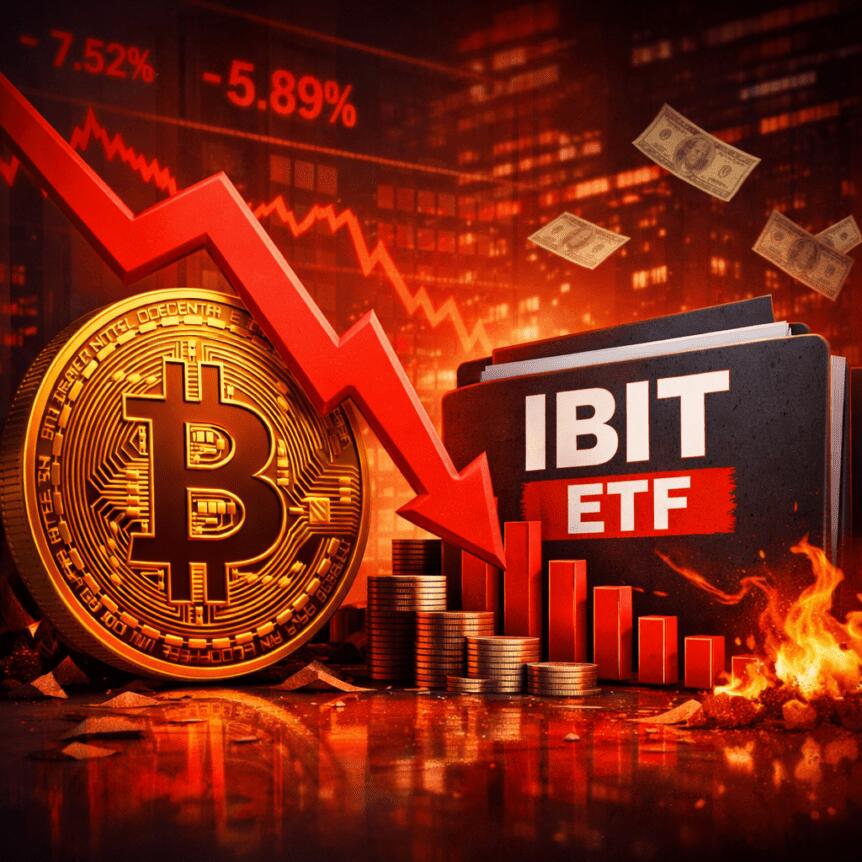
Bitcoin’s weekend retreat has amplified a sell-off in the largest spot crypto ETF, with investors in BlackRock’s iShares Bitcoin Trust (IBIT) confronting a challenging reset in the fund’s performance metrics. As BTC traded in the mid-$70,000s after a run to fresh highs earlier in the season, the aggregate, dollar-weighted returns for IBIT slipped into negative territory by late January. The dislocation underscores how quickly price moves feed through to ETF-based exposure and how the timing of inflows can dictate whether gains are preserved or erased. In this environment, even the earliest participants in the fund can face headwinds when the price trajectory turns south and outflows accelerate.
Key takeaways
- The aggregate, dollar-weighted returns for IBIT turned negative as of late January, even though some early investors may still be in profit.
- Bitcoin’s price drop into the mid-$70,000s coincided with eroding performance for the fund and a shift in investor sentiment around digital-asset exposure.
- IBIT achieved a notable milestone as the fastest BlackRock ETF to reach $70 billion in assets under management, highlighting its early, outsized popularity among mainstream investors.
- Crypto fund outflows intensified in the week ended Jan. 25, with about $1.1 billion exiting Bitcoin funds and total crypto fund outflows around $1.73 billion, driven primarily by U.S. investors.
- On the broader side, gold has ongoing strength, and while Bitcoin remains a candidate for a “debasement” hedge, flow dynamics have not replicated gold’s sustained inflows.
Tickers mentioned: $BTC, $IBIT
Sentiment: Bearish
Price impact: Negative. The combined effect of a sharp price pullback and outflows into crypto funds has pushed dollar-weighted returns into negative territory for IBIT.
Trading idea (Not Financial Advice): Hold. The near-term backdrop is conflicted by caution on risk assets and ongoing ETF flow dynamics, suggesting patience while assessing macro momentum and on-chain signals.
Market context: The pullback in crypto investment products mirrors a broader risk-off tone in financial markets, with investors re-evaluating exposure as price momentum cools and rate-cut prospects shift.
Why it matters
IBIT’s trajectory matters because it acts as a litmus test for the mainstream adoption of crypto assets through regulated vehicles. The fund’s rapid ascent to $70 billion in assets under management underscored a surge of institutional interest in a familiar, regulated wrapper for exposure to Bitcoin. Yet the recent decline in net asset value (NAV) and the turn in dollar-weighted returns illuminate how sensitive ETF performance is to both price action and flow dynamics. If the price continues to lag or if inflows fail to keep pace with selling pressure, the prospect of sustained outflows could weigh on liquidity and bid-ask spreads for the vehicle.
The broader fund-flow landscape compounds the significance. CoinShares reported a week of outsized redemptions across crypto funds, with roughly $1.1 billion leaving Bitcoin products in the week to Jan. 25 and total crypto fund outflows of $1.73 billion—the largest weekly retreat since mid-November. The concentration of these withdrawals in the United States signals a shift in regional appetite and risk tolerance, potentially foreshadowing a broader reassessment of crypto exposure among U.S. investors as macro headlines evolve. The trend aligns with commentary that waning expectations for near-term rate cuts, negative price momentum, and a perception that digital assets have not yet meaningfully participated in inflation hedging narratives are driving selling pressure.
While the field remains hopeful that digital assets can fulfill a “debasement trade” thesis—as a fixed-supply store of value—Bitcoin has not yet drawn the same breadth of inflows as a traditional hedge like gold, even after a recent pullback. Gold has persisted in an uptrend, recently trading at record highs above $5,400 per troy ounce, highlighting divergent risk-on/risk-off dynamics across asset classes. The juxtaposition of crypto fund outflows with gold’s strength underscores the evolving risk sentiment and the evolving role of regulated vehicles in enabling real-money participation in this space.
What to watch next
- Next CoinShares fund-flow update for the week following Jan. 25 to gauge whether outflow momentum persists or abates.
- Movement in IBIT’s NAV and any shifts in assets under management as Bitcoin’s price tests key levels around the $70,000 region.
- Updated performance signals from Yahoo Finance on IBIT’s NAV and fee structure, which can influence investor perceptions of value during a downside phase.
- Any regulation-driven commentary or policy signals that could affect crypto ETF flows, particularly in the United States, where outflows have been concentrated.
Sources & verification
- Bob Elliott’s tweet and chart showing aggregate, dollar-weighted returns turning negative as of late January: https://x.com/BobEUnlimited/status/2017944185140134033
- IBIT’s milestone as the fastest BlackRock ETF to $70 billion in assets under management: https://cointelegraph.com/news/blackrock-bitcoin-etf-fastest-70-billion-assets-under-management
- Fees data indicating IBIT generated about $25 million more in fees than the next-closest ETF: https://cointelegraph.com/news/blackrock-s-most-profitable-etf-is-now-a-hair-away-from-100b
- Yahoo Finance data showing IBIT NAV decline and related performance: https://finance.yahoo.com/quote/IBIT/performance/
- CoinShares weekly fund-flow data for the week ending Jan. 26: https://coinshares.com/us/insights/research-data/fund-flows-26-01-26/
Market reaction and key details
Bitcoin (CRYPTO: BTC) rallied into late 2023 and into the first half of 2024 on a wave of institutional interest and macro uncertainty. Yet the most recent weekend move renewed focus on how ETF instruments translate price action into tradable performance. The iShares Bitcoin Trust, IBIT, has been at the center of that discussion, acting as a barometer of how well regulated wrappers capture and reflect evolving investor sentiment toward digital assets. The first-quarter picture shows a divergence: while the technology and infrastructure around crypto custody and settlement have matured, investor appetite for risk assets through exchange-traded vehicles remains highly contingent on price momentum and macro cues.
The first major signal comes from the price action itself. BTC’s retreat into the mid-$70,000s has translated into a dampened NAV trajectory for IBIT, consistent with the broader Bitcoin sell-off. The fund’s dollar-weighted returns—an indicator that takes into account when money actually flows into or out of the vehicle—have moved into negative territory for the period, a development highlighted by investor-relations chatter and independent observations. The narrative is not purely about price; it’s about how inflows at higher price points can amplify drawdown when the market reverses, erasing a portion of the gains accrued since launch.
Historical context helps frame the current environment. IBIT’s early popularity was underscored by its outsized assets under management, leading the charge as the fastest BlackRock ETF to reach $70 billion in AUM. That milestone was documented alongside broader profitability metrics for BlackRock’s crypto lineup, including reports indicating the fund’s fence is generally higher on fee generation than its peers. Taken together, these data points reveal a strong initial reception that is now navigating a more cautious, price-driven reality. The latest asset- and performance metrics align with a broader pattern of crypto investment products facing retrenchment as prices pull back and investment prospects shift in response to evolving macro and regulatory signals.
From a market-structure perspective, the flow dynamics are telling. CoinShares data show that the week-to-date outflows from Bitcoin-focused funds were sizeable, contributing to a total weekly withdrawal tally across crypto funds that reached the largest post-November cadence. The explanation offered by the research firm points to a combination of diminished near-term rate-cut expectations, negative price momentum, and a sentiment shift away from assets that have not demonstrated robust participation in inflation-hedging narratives. While Bitcoin is still widely discussed as a potential store of value due to its capped supply, the immediate reaction in funds confirms that the path from narrative to real-world flows remains fragile, particularly in a U.S.-focused investor base that has shouldered much of the outflow weight.
Beyond the crypto-native discussion, the broader commodity regime provides another frame. Gold has continued its own bull run and reached record or near-record levels in recent weeks, illustrating a classic “risk-off vs. risk-on” dynamic where traditional safe-haven assets and digital assets pull in different directions depending on the macro mood. The ongoing debate around whether Bitcoin can qualify as a durable inflation hedge—versus a risk-on risk-off play within a diversified portfolio—continues to unfold in real-time as ETF inflows and investor expectations evolve. The current moment is a reminder that the crypto market remains susceptible to cyclical shifts in risk appetite, even as structural elements like fixed supply and improved infrastructure persist as long-term attractions.
What to watch next
- Next CoinShares fund-flow update to confirm whether the outflow trend accelerates, stabilizes, or reverses.
- IBIT NAV and AUM movements as Bitcoin prices test next resistance levels near the $70k mark.
- Regulatory and policy developments that could influence the appetite for crypto ETFs, particularly in the U.S.