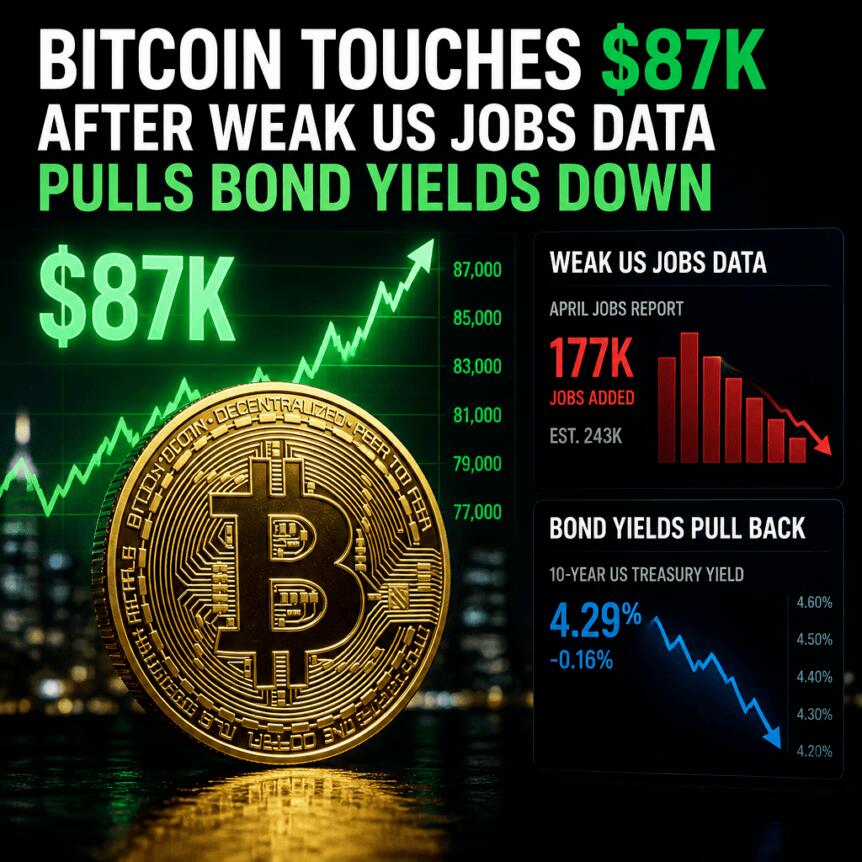
Bitcoin briefly surged above $87,000 on Friday, reaching a peak around $87,229 on Bitstamp before stalling near recent multi-month levels. The move followed a notable miss in US labor-market data, which pushed expectations for further Federal Reserve rate hikes further out and drove US bond yields lower.
While the latest jobs print helped reignite risk-on conditions—US stocks rose early in the session—Bitcoin’s advance did not immediately translate into fresh, sustained highs. Traders pointed to overhead liquidity and tightening resistance around the mid-to-high $87,000 area as investors weighed whether the “yield relief” rally would have legs.
Key takeaways
- Bitcoin tapped roughly $87,200 on Friday, but failed to convincingly extend its push beyond nearby multi-month highs.
- September nonfarm payrolls increased by 29,000, below expectations of 84,000, with August and July both revised downward.
- Markets scaled back hawkish rate-hike odds: CME’s FedWatch Tool showed only an 18% chance of a 25-basis-point hike in October, down from 64% a week earlier.
- Falling Treasury yields—after a prior slip from recent peaks—acted as the dominant macro catalyst for BTC price action.
- Analysts cited a resistance band near the $87,300 area alongside order-book liquidity dynamics that may have capped momentum.
US jobs miss shifts rate expectations and lifts BTC
According to TradingView data cited in market coverage, BTC/USD rose to $87,229 on Bitstamp, approaching new eight-month highs before cooling. The catalyst was the September nonfarm payrolls release, which showed employment growth of just 29,000 versus an 84,000 expectation.
The report also included revisions that worsened the picture compared with previously reported figures. August jobs were revised down from 162,000 to 133,000, while July was also adjusted lower—changes that contributed to the broader “less hawkish” interpretation.
As the data hit, US equity benchmarks moved higher at the open. The S&P 500 gained about 1%, while the Nasdaq Composite rose roughly 1.8%, reflecting traders’ reduced conviction that the Federal Reserve would need aggressive additional tightening.
In a post on X, trading resource The Kobeissi Letter characterized the jobs print as the third weakest report of 2026. While that framing is commentary, it aligns with the key numbers in the release that markets used to reprice policy expectations.
FedWatch probabilities drop as bond yields extend their decline
Rate-hike expectations shifted quickly. CME Group’s FedWatch Tool indicated an 18% probability of a 0.25% rate hike at the October meeting—down sharply from 64% a week earlier. That repricing matters for crypto because Bitcoin, like other risk assets, often responds to changes in real-yield expectations and liquidity conditions.
Consistent with that view, US bond yields fell for a second consecutive day. At the time of writing, the 30-year Treasury yield was around 5.573% and the 10-year around 5.2%.
Just days earlier, both curves had reached fresh multi-decade highs following data that helped markets “look through” softer August Personal Consumption Expenditures (PCE). This backdrop—softening labor data after a period of yield strength—helped create a narrative of “relief” in the bond market, which in turn supported Bitcoin’s intraday breakout attempts.
Why Bitcoin stalled near $87,000 despite the macro tailwind
Even with yields moving lower, Bitcoin’s surge did not immediately produce a clean breakout above the multi-month levels seen during September. At the time of writing, BTC had slipped back below $86,000 after failing to push meaningfully beyond the $87,200–plus region.
Earlier reporting highlighted that Bitcoin’s upward momentum had been constrained by overhead supply visible on exchange order books. In particular, Cointelegraph previously noted successive walls of ask liquidity limiting upside, with a latest resistance band around $87,300 forming as traders continued to defend the area.
That dynamic helps explain why a macro-driven move—triggered here by the jobs miss and the resulting yield declines—still met friction at key technical and liquidity levels. For traders, the immediate question becomes whether Bitcoin can absorb that supply and convert the current bounce into a sustained trend, rather than repeatedly reverting after a liquidity tap.
QCP and traders point to “yield relief” as the clearest trigger
In a new analysis, trading firm QCP Capital argued that BTC/USD should benefit from the softer labor-market print as bond yields continue to fall. The firm described a “Treasury relief rally” as the cleanest upside catalyst for Bitcoin, noting that the asset has already shown resilience during periods when real rates surged—a scenario that had also pressured gold.
Separately, trader Aksel Kibar suggested that a supportive level around $82,800 had already been established on the daily chart. If that level holds, it would suggest the current move is not just a one-off spike but part of a broader structure building around the next major support zone.
Together, these views frame Friday’s price action as a tug-of-war between a macro tailwind (declining yields after weaker labor data) and micro-level resistance (order-book and liquidation/liquidity patterns around the high-$87,000 range). Investors watching Bitcoin’s next steps will likely focus on whether yield momentum persists and whether the $87,300 area can be cleared with increasing liquidity rather than fading.
Going forward, traders should watch how quickly Fed-rate probabilities change again as more data lands—and, crucially, whether Treasury yields continue their downward path. If bonds stabilize or reverse higher, Bitcoin may struggle to hold the gains; if yields keep falling, the market may test resistance levels again with improved odds of a sustained breakout.