

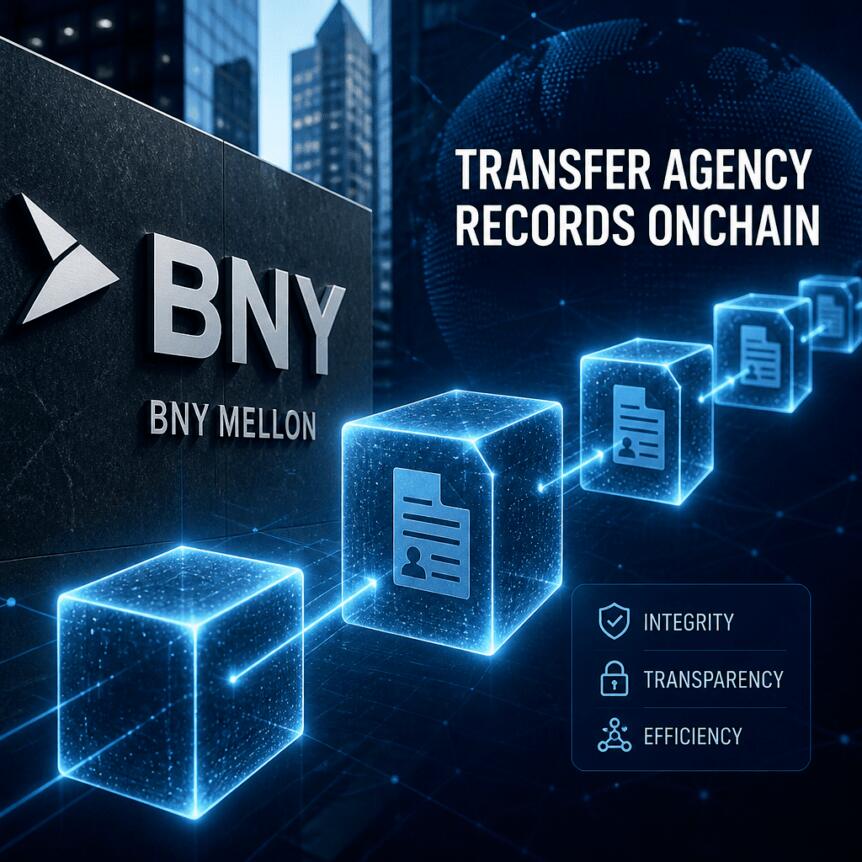
BNY, one of the world’s largest custodian banks, is preparing to move a core piece of fund infrastructure—transfer agency recordkeeping—onto a blockchain. The bank plans to launch a blockchain-based version of its transfer agency business that maintains fund ownership records and processes investor activity, a step aimed at reducing the reconciliation work that typically sits behind fund transactions.
According to a report from the Financial Times, BNY’s initiative will modernize “the books and records” that support transactions across investment funds by placing them onchain. The development builds on BNY’s ongoing push into digital assets and follows its progress in Europe under the EU’s Markets in Crypto-Assets (MiCA) framework, as the bank positions itself for the next stage of institutional tokenization.
Key takeaways
- BNY is launching a blockchain-based transfer agency platform to record fund ownership and track investor transactions onchain.
- Transfer agents play an essential “books and records” role for funds, traditionally relying on multiple databases and frequent reconciliation.
- Early reported users include Baillie Gifford, alongside expectations that BlackRock and BNY Dreyfus-related businesses may use the service for upcoming tokenized funds.
- BNY reportedly plans to run traditional transfer agency operations alongside the new digital offering.
- The blockchain network for the platform has not been disclosed, leaving an important implementation detail unclear.
Why transfer agency recordkeeping is a big deal
Transfer agency services are the operational backbone behind fund ownership. Transfer agents maintain official records of who holds shares in investment funds and handle activities such as updating ownership, processing subscriptions and redemptions, and supporting communication between funds and investors. While these tasks are largely invisible to most investors, they are fundamental to how markets verify who owns what.
Traditionally, ownership information is spread across systems used by fund managers, custodians, and other market participants. That structure can lead to heavy reconciliation requirements—when records in different databases need to be aligned after transactions—especially as trading and fund activity increase across geographies and platforms.
By moving the recordkeeping function to a shared onchain data layer, BNY is effectively targeting that coordination problem. The Financial Times report frames the bank’s goal as bringing a common source of truth for parties involved in a fund’s tokenized lifecycle, potentially lowering the operational friction that comes with maintaining parallel records.
BNY’s planned onchain transfer agency and its scale
As described in the Financial Times report, BNY’s blockchain-based transfer agency will be integrated into its existing transfer agency services rather than replacing them. The bank is expected to maintain its traditional operations alongside the new digital platform.
The article also attributes specific scale to BNY’s broader transfer agency footprint. According to the report, BNY’s transfer agent services cover roughly $8.6 trillion in assets across 7.6 million accounts. Separately, the bank reportedly oversees more than $59 trillion in assets under custody and administration—figures that underline why this shift matters: even incremental improvements to back-office processes can have outsized impact when volume and complexity are high.
BNY has not publicly confirmed which blockchain network will support the new platform. The bank did not respond to a request for comment submitted by Cointelegraph by the time of publication of the original report.
Early customers reportedly include Baillie Gifford
BNY’s onchain recordkeeping is expected to be used for tokenized fund products from early adopters. The Financial Times report names Edinburgh-based asset manager Baillie Gifford as an early user. The firm plans to use the platform for what it described as the first “fully native” UK-regulated tokenized fund.
The same report also notes that BlackRock and BNY Dreyfus money market fund and cash management business are expected to use the service for upcoming tokenized funds. For investors and market watchers, that matters because these firms represent different parts of the institutional ecosystem—asset managers and custody-related infrastructure—suggesting BNY’s push is aimed at interoperability across roles rather than a siloed experiment.
Baillie Gifford, which has roughly $261 billion in assets under management according to information on its website, highlighted the operational logic behind onchain records. The Financial Times report attributes comments to Theo Golden, Baillie Gifford’s head of digital assets, who described the value of blockchain as a shared record-keeping source between participants and emphasized that it functions as a source of truth when parties deal with the asset.
How this fits into the wider tokenization push
This effort aligns with a broader institutional trend: moving from isolated tokenization demos toward operationally robust frameworks that can support real fund activity. Tokenized products still require traditional market processes—issuance, redemption, and ownership verification—but onchain recordkeeping can reduce the need for separate systems to maintain parallel “truths.” The core promise is not simply that assets are tokenized, but that the operational plumbing stays synchronized as transactions move across participants.
BNY’s move also comes as institutional digital asset strategies continue to mature alongside clearer regulatory frameworks in key jurisdictions. The Financial Times report links the initiative to BNY’s broader digital asset expansion, including its European regulatory progress under MiCA, as the bank positions itself to serve tokenized financial products at scale.
That said, one critical uncertainty remains for readers: the implementation layer. With BNY yet to disclose the blockchain network underlying the platform, observers will want to watch how the bank addresses questions such as data access, operational governance, and integration with existing fund and custody workflows—factors that often determine whether tokenization can move smoothly from pilot programs to routine usage.
For now, the key signal is that a major custodian is treating transfer agency recordkeeping as an onchain function rather than a peripheral add-on. As BNY’s platform gains early customers and tokenized fund launches accelerate, market participants should focus on whether onchain records truly streamline reconciliations across participants—and what network and integration decisions ultimately determine performance and adoption.


