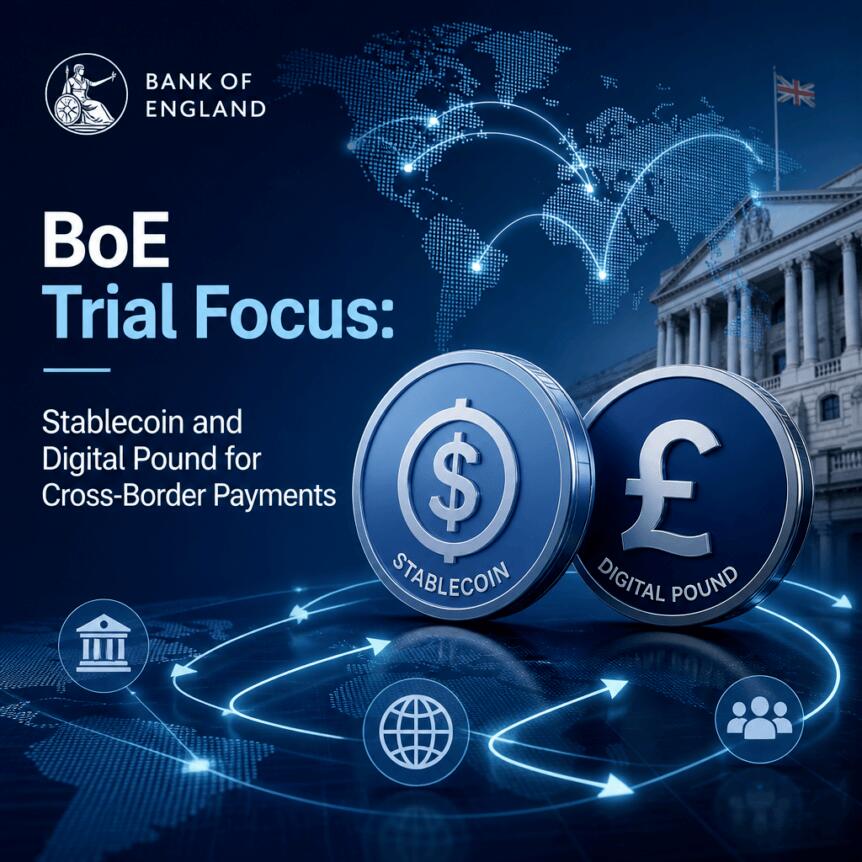
The Bank of England’s Digital Pound Lab is running a trade-finance experiment designed to test whether stablecoins and a potential digital British pound could work together inside the same cross-border payment flow.
In a project announced on Wednesday, NOBO Finance, Dun & Bradstreet and Polygon Labs said the trial links an exporter’s advance delivered via a stablecoin rail with a UK importer’s settlement using simulated digital pounds. The focus is on the practical mechanics of payments timing—particularly the point at which trade finance is released and how long settlement takes.
Key takeaways
- The Digital Pound Lab trial pairs a stablecoin payment to an exporter with simulated digital pound settlement by a UK importer in a single cross-border workflow.
- NOBO Finance, Dun & Bradstreet and Polygon Labs are combining payments testing with a separate effort to generate reusable credit profiles for small businesses.
- The project is explicitly using simulated systems: the Bank of England has not committed to issuing a digital pound and the lab uses no real customers or money.
- The work targets a long-standing trade finance problem where exporters may wait days after shipment to receive payment, tying up working capital.
- The broader initiative aligns with ongoing UK regulatory development for stablecoins and tokenized settlement models.
Trade finance, simulated digital pounds, and stablecoin rails
The Bank of England’s Digital Pound Lab experiment is centered on trade finance—an area where cash flow can be constrained by settlement delays between shipping goods and receiving payment. According to the announcement from NOBO Finance, Dun & Bradstreet and Polygon Labs, the test scenario involves an exporter receiving an advance through a stablecoin-based payment flow while a UK importer completes settlement using simulated digital pounds.
The companies did not describe the trial as a live market product; instead, it is positioned as an experiment within the lab’s research environment. The Bank of England has also emphasized that lab experiments designed by participants should not be treated as signals about future policy or as endorsements of any specific firm or technology.
For exporters—especially smaller businesses—payment timing can determine how much working capital is locked up. When funds arrive days after shipment, firms can face higher financing costs or reduced ability to take on new orders. By testing whether different digital payment components can operate in the same cross-border route, the lab project aims to assess whether tokenized settlement could reduce friction that slows trade.
Reusable credit profiles for small businesses
Beyond payments plumbing, the initiative includes a separate workstream aimed at helping small businesses access credit more efficiently. The plan, as described by the participating companies, is to create reusable credit profiles by combining transaction data, open-finance information and commercial risk data from Dun & Bradstreet.
Polygon Labs is providing the smart contract infrastructure for this part of the project. The practical idea is straightforward: instead of rebuilding risk assessments from scratch for each transaction, the system would attempt to turn available data into a standardized credit profile that could be reused in future trade finance arrangements.
If that approach works as intended, it could reduce the operational cost and time involved in underwriting and credit checks—an issue that often weighs more heavily on smaller firms than on larger counterparties with more established financing relationships.
Why this matters amid UK stablecoin and tokenization rulemaking
The trade-focused lab experiment lands as UK authorities continue building the regulatory structure for stablecoins and preparing the financial system for tokenized assets. In June, the Bank of England published draft rules for sterling-denominated stablecoins it considers systemic to the UK’s financial stability.
That proposal, according to the Bank of England, would allow systemic stablecoin issuers to hold up to 70% of their reserves in interest-bearing government debt. It also introduces a temporary issuance cap of 40 billion pounds (about $52.8 billion) per systemic stablecoin, replacing earlier suggestions that would have limited holdings at the level of individual participants and businesses. The Bank of England has said it aims to finalize those rules by the end of 2026, ahead of a planned 2027 rollout.
Under the framework, stablecoins deemed systemic—because their use could pose risks significant enough to affect financial stability—would fall under the Bank of England’s regime. Non-systemic stablecoins would remain under the Financial Conduct Authority’s oversight.
Meanwhile, tokenization is also being tested through updates to legacy settlement infrastructure. In May, the Bank of England proposed moving its Real-Time Gross Settlement (RTGS) and CHAPS systems toward near-24/7 operation, including weekends and extended daily hours, partly to support cross-border payments and new settlement models as tokenization develops.
Additionally, the Bank of England approved HSBC’s Orion platform to operate in the UK’s Digital Securities Sandbox. That sandbox is expected to support digital bond issuance, including the country’s planned Digital Gilt Instrument—another sign that regulators are exploring how tokenized assets might integrate with existing market infrastructure.
What to watch next in the Digital Pound Lab
Because the Digital Pound Lab trial uses no real money or customers and the central bank has not committed to issuing a digital pound, the near-term value for market participants is primarily methodological: seeing whether a stablecoin rail and a simulated digital pound can coordinate inside a realistic cross-border trade workflow. The next step is whether the lab’s findings inform practical designs for interoperability, settlement timing, and how credit and compliance data could be translated into reusable structures for small businesses.