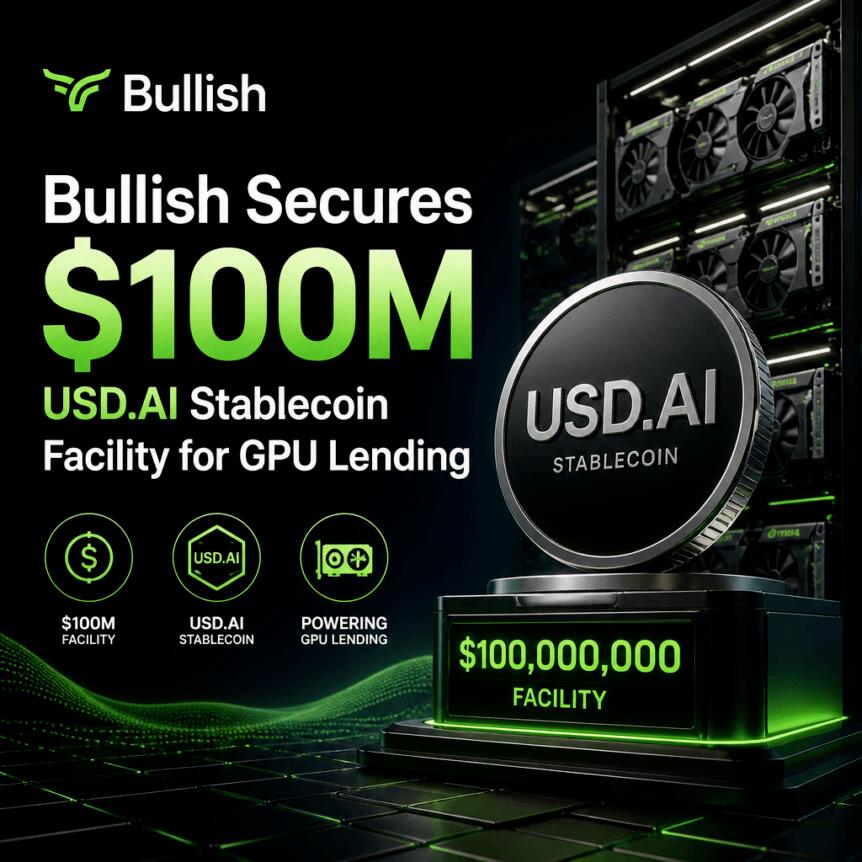
Bullish, an institutional crypto exchange and market infrastructure operator, has agreed to extend a $100 million stablecoin-backed debt facility to USD.AI to fund loans secured by GPU hardware. The companies said the financing will support onchain lending to AI infrastructure operators, with collateral tied to the computing equipment rather than the borrowers’ broader corporate balance sheets.
The move reinforces USD.AI’s strategy of turning stablecoin liquidity into GPU infrastructure credit, while giving Bullish an additional pathway to deepen liquidity around GPU-backed tokenized debt through a dedicated trading and market-making effort.
Key takeaways
- Bullish is providing a $100 million stablecoin-based debt facility to USD.AI for GPU-secured lending.
- USD.AI’s loans are collateralized by the underlying GPU hardware, not general corporate assets.
- Bullish plans to list USD.AI’s sUSDai across multiple trading pairs and run a market-making program to support liquidity.
- The facility builds on USD.AI’s recent GPU-backed financing activity, including loans tied to Nvidia B300 and B200 GPU configurations.
Stablecoin credit aimed at GPU-backed collateral
Under the announced arrangement, USD.AI will deploy the facility by extending financing to AI infrastructure operators whose repayment claims are secured by the GPUs themselves. The structure is designed to reduce reliance on general corporate collateral by anchoring loan exposure to specific, identifiable computing hardware.
USD.AI is an onchain financing platform built by Permian Labs. It positions itself as an intermediary between stablecoin liquidity and the funding needs of the GPU infrastructure sector, where capacity purchases and deployments often require large upfront capital outlays.
Bullish plans token support and tighter secondary liquidity
Bullish said it intends to list USD.AI’s sUSDai token across multiple trading pairs. It also plans to back the token with a dedicated market-making program, aiming to improve secondary liquidity and strengthen price discovery for debt products linked to GPU collateral.
For market participants, the practical significance is that tokenized, asset-backed credit can become easier to access and hedge when trading venues and market makers provide consistent bid-ask liquidity. Bullish’s involvement suggests it wants this GPU-backed financing stack to be more than a primary-deal story, with ongoing tradability playing a larger role.
Growing GPU financing footprint
This $100 million facility expands USD.AI’s GPU-linked lending business. In June, USD.AI announced a $98.1 million loan backed by 2,304 Nvidia B300 GPUs. Around the same time, it also disclosed that a $34 million loan backed by 768 Nvidia B200 GPUs had been fully funded.
Taken together, those earlier announcements highlight a pattern: USD.AI’s lending is tied to identifiable GPU batches and configurations, and its ability to complete funding rounds indicates demand for this style of AI infrastructure credit. With Bullish adding a larger stablecoin debt line, investors and operators may expect USD.AI to scale the volume of GPU-secured financing more quickly, assuming ongoing collateral sourcing and operational rollout can keep pace.
Previous Bullish investment adds continuity
The deal also follows earlier capital support from Bullish Capital. According to the companies, Bullish Capital made a $4 million investment into USD.AI in September 2025—described by Bullish as its first investment since going public.
That continuity matters because it suggests Bullish is not treating the current facility as a one-off product test. Instead, the firm appears to be expanding an existing relationship into a larger operational role—using stablecoin-backed debt infrastructure alongside trading and liquidity initiatives.
More broadly, the arrangement underscores a growing intersection between digital asset market infrastructure and AI hardware financing, where stablecoins and onchain credit mechanics can potentially shorten the path from liquidity to real-world infrastructure commitments.
Investors should watch how sUSDai trading develops after listing and whether Bullish’s market-making program meaningfully improves liquidity depth over time. Equally important will be how USD.AI manages loan origination, GPU collateral custody, and the operational mechanics of hardware-backed repayment as deal sizes scale under this new facility.