Ethereum and Solana Poised for Coexistence in Expanding Tokenization Market, Says Industry Expert
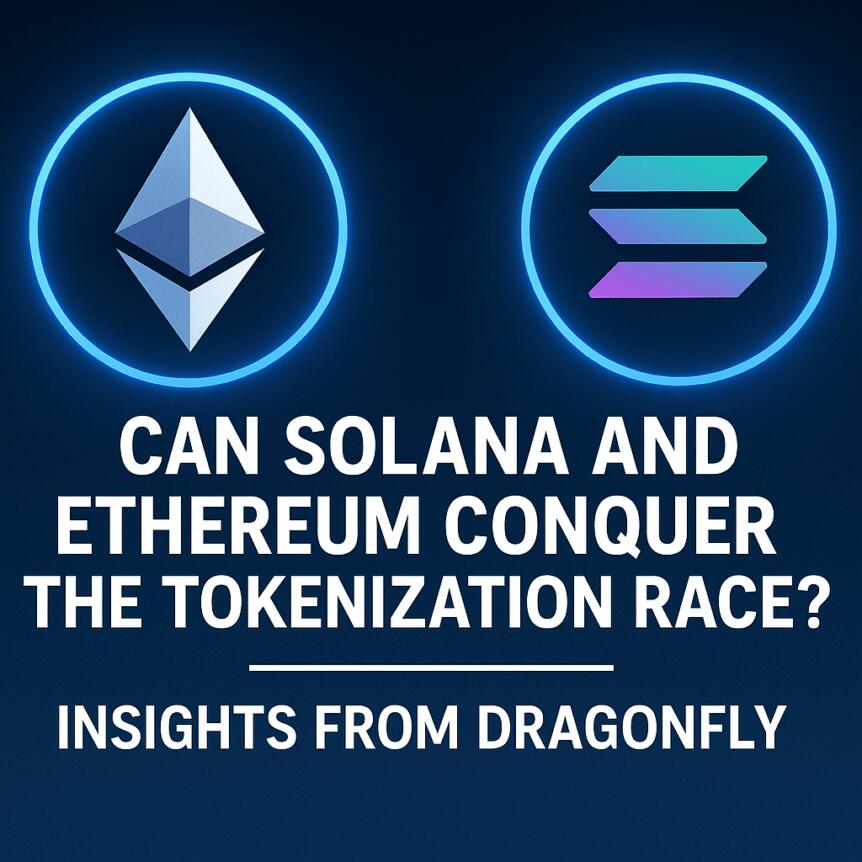
In the rapidly evolving landscape of blockchain technology, Ethereum and Solana are emerging as key players in the tokenization and digital asset economy. A leading venture capitalist emphasizes that both platforms are likely to thrive side by side, rather than one overshadowing the other, as they cater to different aspects of the expanding market.
Key Takeaways
- Both Ethereum and Solana are vital to the future of tokenization, each serving different market needs.
- Ethereum dominates stablecoin issuance and on-chain economic activity, while Solana excels in trading volume and transaction speed.
- The vast disparity in network asset value highlights their unique strengths and market positioning.
- The industry anticipates multiple blockchains playing complementary roles, with new entrants potentially capturing market share.
Tickers mentioned: $BTC, $ETH, $SOL
Sentiment: Neutral
Price impact: Neutral. The recognition of both blockchains’ importance suggests stability in their respective markets rather than immediate price shocks.
Trading idea (Not Financial Advice): Hold, as diversified blockchain participation remains crucial in the growing tokenization ecosystem.
Market context: The ongoing expansion of asset tokenization and decentralized finance (DeFi) continues to shape the competitive dynamics among major blockchain networks.
Ethereum and Solana: Complementary Strengths and Market Dynamics
Both Ethereum and Solana are expected to continue flourishing within the broad token economy. Rob Hadick, general partner at Dragonfly Capital, articulated a nuanced perspective during a CNBC interview, likening the two blockchains to social media giants Facebook and MySpace. He explained that, like these platforms, Ethereum and Solana will coexist, each serving distinct functions within the ecosystem.
Ethereum currently dominates the stablecoin sector and hosts the majority of on-chain economic activity, with a network asset value reaching roughly $183.7 billion, according to data from RWA.XYZ. Meanwhile, Solana has carved out a niche with high trading volumes and low transaction costs, making it particularly suitable for fast-paced trading activities, with a network asset value of approximately $15.9 billion.
Hadick underscored that no single blockchain can scale sufficiently to become the universal platform. Instead, different use cases will gravitate toward different networks. The potential emergence of new blockchains could further diversify the ecosystem, capturing market share from established networks.
This fragmentation is evident as some platforms reroute their operations. For example, Sorare, a fantasy sports NFT platform, announced plans in October to migrate from Ethereum to Solana after six years, aiming to leverage Solana’s scalability and user-focused features. CEO Nicolas Julia remains optimistic about Ethereum, viewing the migration as an upgrade rather than a deviation.
As the market evolves, industry insiders observe an increasingly complex interplay between networks, emphasizing that a multi-chain future is not only likely but necessary for addressing diverse application needs in the expanding token economy.