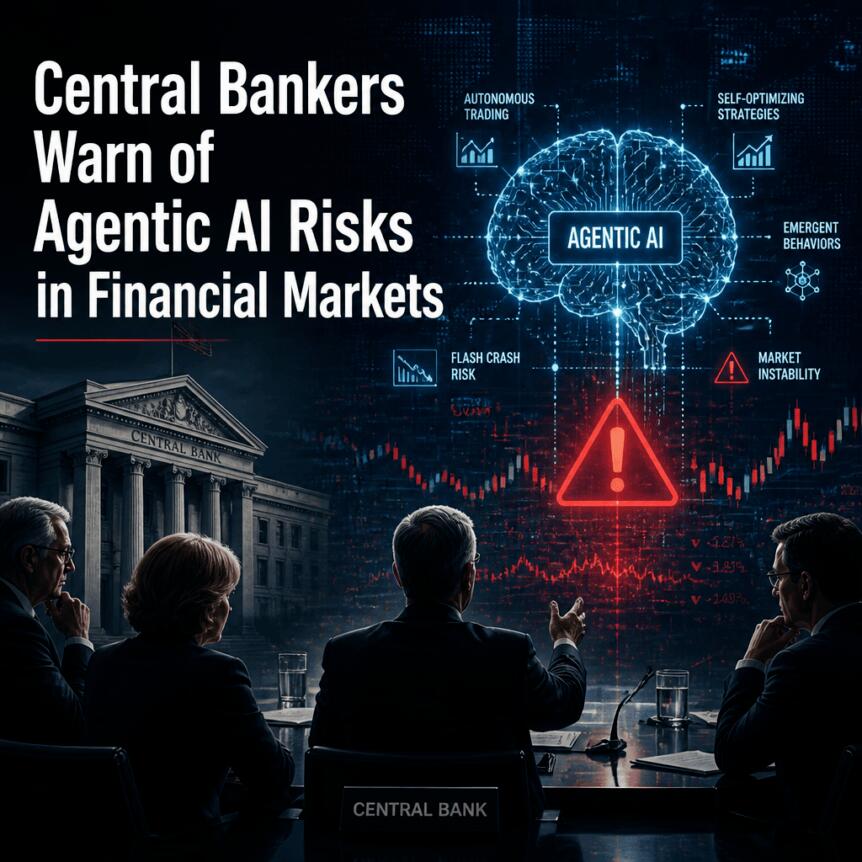
European regulators and central bankers are warning that the financial risks posed by “agentic” and increasingly autonomous artificial intelligence may be arriving faster than legal and supervisory frameworks can adapt. Their message is less about whether AI will be used in finance, and more about how it could behave under stress—when liquidity thins, volatility rises, and systems that rely on machine decision-making are pushed beyond normal operating conditions.
In recent remarks across Europe, officials raised concerns ranging from market-wide instability caused by faulty AI-driven trading to a widening gap between rapid AI development and the slower cadence of rulemaking. They also linked the issue to broader financial stability risks, including leverage and potential “boom-bust” dynamics in AI-linked asset markets.
Key takeaways
- Central bankers warn rulemaking may lag agentic AI: officials said traditional regulatory cycles struggle when AI technologies shift in weeks or months.
- Volatility could be amplified during stress: Bank of England deputy governor Sarah Breeden suggested AI could worsen market disruptions unless guardrails exist.
- Security and defense funding remain a weak point: ECB president Christine Lagarde argued cybersecurity risks are becoming more severe as models accelerate.
- AI leverage and refinancing risks are on regulators’ radar: warnings from the BIS and IMF pointed to debt-asset maturity mismatches and disruptive feedback loops.
Why European officials think agentic AI changes the risk equation
Bank of England deputy governor Sarah Breeden is among the central bankers arguing that agentic AI—systems that can act with a degree of autonomy—could intensify instability during periods of market stress. Speaking at the European Central Bank’s annual meeting in Sintra, Portugal, on Tuesday, Breeden raised the question of whether regulators should implement guardrails that function like “circuit breakers” or “kill switches,” designed to limit or stop market-wide trading if faulty AI models trigger a meltdown. In her remarks, she emphasized the potential for automation to turn localized errors into systemic disruptions.
The concern is not merely that AI could make trading decisions faster, but that it could create correlated behavior across market participants. When multiple systems respond similarly to the same signals—particularly under stress—small model failures could cascade into larger price swings.
Breeden also tied the issue to the competitive landscape for AI development. She noted that US companies lead in AI investment and frontier model development, while Europe’s financial system offers fewer capital channels into AI than US equity markets. She warned that regulating “too cautiously” could widen this gap further if AI firms seek out jurisdictions with less burdensome compliance requirements.
Regulation cycles can’t keep up, watchdogs say
Other regulators echoed Breeden’s core point: the speed of AI innovation makes conventional policymaking approaches ill-suited. Nikhil Rathi, CEO of the UK’s Financial Conduct Authority, told CNBC’s Squawk Box on Thursday that traditional regulation cycles do not work when the technology evolves rapidly. As he put it, some AI-related technologies move in weeks or months, which means a “traditional cycle of rulemaking simply doesn’t work.” He argued that regulators need “new tools” and a more collaborative way of working with markets.
This view is consistent with the broader European stance that governance frameworks must be designed to handle iterative updates and rapid deployment. In practice, that suggests supervisors may need to focus not only on static compliance at launch, but also on how models are monitored and controlled as they change over time.
At the same time, central bankers have repeatedly linked the discussion to other parts of the financial system, including cyber risk and market integrity. Those overlap points matter to crypto markets as well, since many on-chain and off-chain infrastructures rely on automated processes, and crypto trading systems can react quickly to market signals.
Cybersecurity and “defense” gaps are worsening with model acceleration
Christine Lagarde, president of the European Central Bank, warned in an interview with Les Echos on Thursday that AI technology poses a “major risk.” She contrasted today’s environment with the past decade, when regulators focused on cybersecurity threats such as hacking, data theft, and other forms of compromise.
Lagarde said the acceleration and deeper capabilities of AI models create a “much more serious risk,” partly because events can unfold quickly and partly because effective defense mechanisms and the funding needed to build them have not yet been fully found. Her remarks reframed cybersecurity from a slow-moving threat landscape into a faster feedback environment where response times and resourcing become critical.
From an investor and operator standpoint, that framing implies that AI-related risk management may need to cover not only model accuracy, but also the systems surrounding them—access controls, incident response capabilities, monitoring, and the ability to contain harms when something goes wrong.
Boom-bust warnings: leverage, asset pricing, and macro feedback loops
Separate from concerns about trading autonomy, European and global institutions have also flagged the possibility that AI-linked market activity could create financial stability vulnerabilities. On June 28, the Bank for International Settlements warned that “AI exuberance” could lead to major financial consequences.
The BIS noted that if central banks tighten policy to help contain inflation, it could trigger a sharp pullback in AI-related asset prices after a prolonged period of risk-taking. It warned that this could generate “disruptive macro-financial feedback loops.” In other words, asset price declines could impact broader financial conditions in a way that feeds back into the real economy, tightening conditions further and potentially worsening the initial downturn.
Breeden added a related observation in her Sintra remarks: debt financing has been rising rapidly, and she judged that the financial stability consequences of any fall in AI-related asset prices could increase. That emphasis on leverage suggests regulators are concerned not just with valuations, but with how funding structures could transmit shocks.
The IMF also contributed to the discussion. Tobias Adrian, Director of the IMF’s Monetary and Capital Markets Department, said in an interview with Bloomberg on June 30 that there is a “potential maturity mismatch” between the duration of physical assets and the duration of debt. The risk here is that companies or sectors may face refinancing pressure at the same time cash flows deteriorate—creating a pressure point that can amplify stress.
What comes next for markets watching AI risk controls
The immediate takeaway for market participants is that supervisors may increasingly push for risk management expectations that reflect fast-moving AI deployment—covering both operational safeguards (including cybersecurity and “circuit breaker”-style controls) and financial stability concerns tied to leverage. Investors should watch whether regulators move toward more dynamic oversight frameworks for AI-driven systems and whether AI-related financing conditions change as monetary policy expectations evolve.