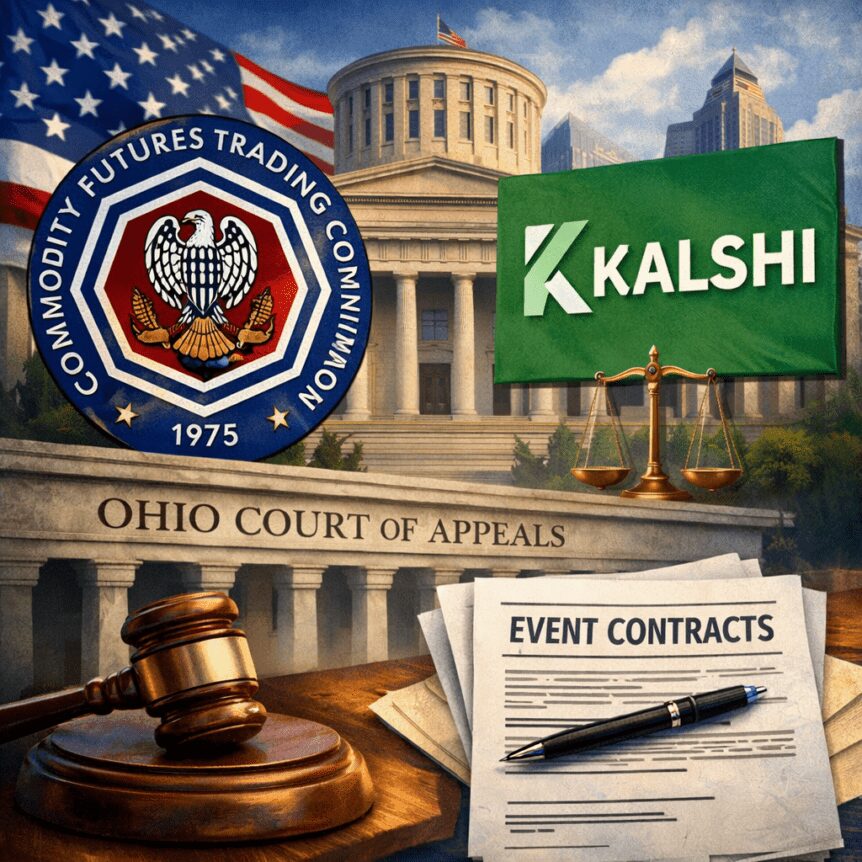
The U.S. Commodity Futures Trading Commission has urged the Sixth Circuit Court of Appeals to affirm federal reach over prediction markets in a dispute centered on Kalshi and the state of Ohio. In an amicus brief filed on behalf of the agency, the CFTC argues that Ohio’s attempt to curb Kalshi’s sports-event contracts represents a jurisdictional overreach that threatens the CFTC’s longstanding oversight of event-based markets traded on designated contract markets (DCMs).
The dispute began when Ohio authorities told Kalshi last year to halt its sports-event contracts in the state, labeling them unlicensed sports gambling. Kalshi subsequently sued the Ohio Casino Control Commission and the state attorney general in an effort to obtain a federal court order blocking state action. A federal district court in Ohio denied Kalshi’s request in March, prompting an appeal to the Sixth Circuit.
“The federal district court in Ohio took an improperly narrow view of the Commission’s jurisdiction, and we are asking the Court of Appeals to correct that error,” CFTC Chairman Mike Selig stated. “As I’ve said repeatedly, the CFTC will not allow overzealous state governments to undermine the agency’s longstanding authority over these markets.”
The amicus filing signals the CFTC’s willingness to mobilize federal authority to shield prediction markets from potential state encroachments. The agency contends that Ohio’s actions would disrupt the regulatory framework surrounding event contracts, which the CFTC views as swaps or binary options traded on DCMs under federal supervision. The brief argues that the Ohio jurisdictional overreach could imperil the CFTC’s authority over similar contracts beyond sports-related events.
The Kalshi-Ohio case is part of a broader legal riddle about how far states may go in regulating federally overseen prediction markets. The decision has practical consequences for major platforms in the space, including Kalshi and Polymarket, as well as other CFTC-regulated venues such as Crypto.com, Robinhood, and Coinbase. The outcome could influence how state regulators interact with federally designated markets and may shape future licensing and enforcement strategies for market operators.
The CFTC’s latest amicus brief is the agency’s second supporting a prediction-market contender. In February, the CFTC filed a brief in the Ninth Circuit in a separate matter supporting Crypto.com in a Nevada regulatory dispute. The agency’s posture suggests a broader pattern of federal protection for prediction markets against state attempts to apply divergent regulatory theories to activity that falls under federal market regulation.
Key takeaways
- The Sixth Circuit is asked to endorse the CFTC’s view that federal jurisdiction over event contracts cannot be overridden by state actions, preserving the CFTC’s authority over prediction markets traded on DCMs.
- The legal clash centers on Kalshi’s ability to offer sports-event contracts within Ohio and whether state regulators can bar federally regulated markets within their borders.
- The CFTC’s amicus brief marks the agency’s second public backing of a prediction-market platform, following a prior filing in the Ninth Circuit on Crypto.com’s Nevada-related regulatory matter.
- The dispute sits within a wider pattern of states challenging federal regulation of prediction markets, including recent suits and cease-and-desist actions involving Wisconsin, New York, Arizona, Connecticut, and Illinois.
- Analysts and compliance teams should monitor how the appellate court interprets federal over state power in the prediction-market space, given potential licensing, cross-border operations, and regulatory alignment considerations for platform operators.
Context and legal significance
The core question in Kalshi’s Ohio case is whether state authorities may regulate or restrict “event contracts” that the CFTC treats as part of its federal mandate to oversee swaps and binary options trading on designated contract markets. The CFTC contends that allowing state intervention would “imperil” the agency’s exclusive jurisdiction over these contracts and thereby threaten the integrity of a nationwide regulatory regime designed to oversee formalized risk-transfer markets. The agency’s posture underscores the Biden-era enforcement emphasis on preserving federal preemption in financial-market regulation, particularly as prediction markets gain more institutional traction and visitor interest from mainstream platforms.
Ohio’s stance—describing Kalshi’s offerings as unlicensed sports gambling—reflects a broader tension between state gambling laws and federal market oversight. Critics of aggressive state enforcement argue that a patchwork of state interpretations could complicate compliance for national platforms, forcing operators to navigate divergent rules that may conflict with federal standards. Proponents of state action, however, contend that consumer protection and revenue considerations justify local oversight. The Sixth Circuit’s eventual ruling could clarify how courts balance these competing interests, with implications for both licensing regimes and enforcement authorities across the United States.
Regulatory landscape and cross-cutting implications
The Ohio episode is one thread in a miscellany of legal actions that collectively test the boundaries of federal market regulation. The CFTC’s suits against Wisconsin, New York, Arizona, Connecticut, and Illinois—where regulators targeted various prediction-market ventures or the operators themselves—illustrate a sustained effort to guard the federal framework from state-by-state constriction. In the Ohio matter, the question is not merely whether Kalshi violated state rules, but whether the state could assert jurisdiction over activity that the CFTC administers on a nationwide basis.
From a policy perspective, the dispute has significance for platforms that operate or plan to operate prediction markets in multiple jurisdictions. Kalshi, Polymarket, and Crypto.com are among the players tied to the CFTC-regulated DCM framework, and the outcome could affect licensing pathways, registration requirements, and the scope of permissible event-contract offerings. For institutions, these developments intersect with AML/KYC considerations, risk controls, and ongoing compliance with a federal standard that preempts inconsistent state actions.
Beyond the U.S. federal-state dynamic, observers note potential cross-border ramifications. European markets sit under a different regulatory architecture, with MiCA (Markets in Crypto-Assets) shaping licensing and supervision for crypto-asset-related activities. While MiCA operates in a separate jurisdiction, the Kalshi-Ohio dispute highlights the ongoing friction between provincial or national regulatory prerogatives and centralized, federally coordinated market oversight—a theme that may inform cross-border platform strategies and regulatory dialogue in the years ahead.
Institutional impact and compliance considerations
For exchanges and platform operators, the case underscores the importance of robust licensing strategies and clear delineation of the jurisdictional boundaries governing event-based contracts. Compliance teams should monitor evolving appellate rulings, as decisions at the Sixth Circuit level could recalibrate expectations for state interactions with federally regulated markets. Risk and legal teams may need to review internal controls around product offerings to ensure alignment with the prevailing interpretation of what constitutes a DCM-traded event contract and how those contracts are classified for regulatory purposes.
From a governance perspective, the CFTC’s involvement in amicus filings indicates a willingness to engage in strategic litigation that defines the perimeter of federal authority over prediction markets. Institutions should prepare for continued regulatory contestation across districts and circuits, with potential implications for licensing, enforcement risk, and the scalability of platform operations in the United States.
For market participants, the ongoing discourse reinforces the importance of transparent compliance programs, clear product disclosures, and consistent enforcement narratives. In parallel, the case may influence how state regulators assess related gaming and gambling statutes in relation to federally regulated financial-market activities, potentially prompting harmonization efforts or renewed legislative dialogue at both state and federal levels.
Closing perspective
The Kalshi-Ohio matter remains a focal point in the evolving interface between state regulatory prerogatives and federal market oversight. While the Sixth Circuit weighs the CFTC’s jurisdictional claim, observers should watch for how the appellate court interprets the balance of powers and what that portends for the broader ecosystem of prediction-market platforms. The outcome will not only shape licensing and enforcement norms but could also influence cross-border regulatory alignment and the strategic posture of institutional market participants in this rapidly developing sector.