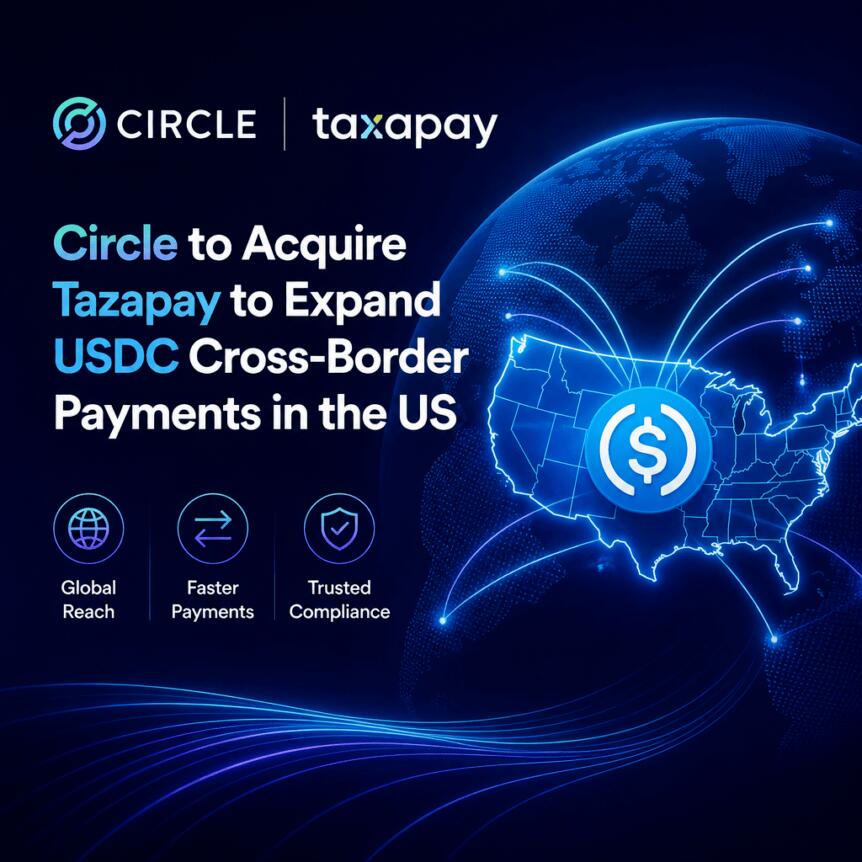
Circle has agreed to acquire Singapore-based cross-border payments platform Tazapay in a $400 million all-stock deal expected to close in 2027, the companies announced. The acquisition is structured as a Class A common stock purchase, with the final price subject to adjustments tied to Tazapay’s debt, transaction expenses, and cash levels, according to a filing with the US Securities and Exchange Commission.
The transaction will also depend on customary closing conditions and approval from the Monetary Authority of Singapore, Circle said in its Tuesday announcement. Circle previously invested in Tazapay through Circle Ventures, including during the startup’s August 2025 Series B round.
Key takeaways
- Circle is buying Tazapay for $400 million in an all-stock transaction expected to close in 2027.
- The SEC filing says the deal price will be adjusted for Tazapay’s debt, transaction expenses, and cash.
- Tazapay reports more than $25 billion in annualized payment volume and services over 60 banking and fintech partners.
- Circle says stablecoins make up about 60% of Tazapay’s transaction volume, supporting its cross-border routing ambitions.
- Circle says Tazapay customers should not see disruption to services, APIs, pricing, or support.
A $400 million all-stock acquisition aimed at faster global rails
Under the agreed terms, Circle will pay for Tazapay using Class A common stock. The SEC filing also states the purchase price is not fixed: it will be adjusted based on Tazapay’s debt, transaction expenses, and cash at closing.
Circle said the deal would require regulatory and procedural steps before completion, including approvals from the Monetary Authority of Singapore and other standard closing conditions. The company did not indicate any expected earlier-than-2027 timeline in the announcement.
Tazapay’s scale in Asia-Pacific and emerging markets
Tazapay positions itself as an infrastructure provider for cross-border payments, with a focus on local payout rails across many destinations. According to information Circle shared, Tazapay has more than $25 billion in annualized payment volume and serves more than 60 banking and fintech partners.
In August 2025, Tazapay told Newswire that its annualized payment volume was more than $10 billion, suggesting meaningful growth over time as the company expanded its network and partner footprint. The company also said it supports payout rails covering more than 100 markets.
Tracxn data cited in the coverage indicates Tazapay has raised $57.9 million across five funding rounds. Circle’s involvement through Circle Ventures included participation in the August 2025 Series B round, linking the corporate strategy behind the investment to the later acquisition.
Stablecoin-linked volume and the push for 24/7 routing
Stablecoins account for about 60% of Tazapay’s transaction volume, according to Circle. That share matters for Circle’s stated direction: the company is working to integrate stablecoin-based payment rails into mainstream cross-border flows.
Circle said the acquisition will expand its ability to route payments to and from Asia-Pacific and emerging markets. In comments attached to the announcement, Circle’s Irfan Ganchi, senior vice president of payments, described the goal of increasing Circle’s capability to originate and terminate payments globally “near-instant and 24/7” and said the effort is a step toward making USDC the default payment rail for cross-border commerce.
Tazapay has also been described as a design partner for the Circle Payments Network since 2025. Circle said that role, plus Tazapay’s existing infrastructure, is central to how it plans to scale routing capabilities after the acquisition.
What remains unchanged for customers and partners
Circle said Tazapay customers should see no disruption to their services, APIs, pricing, or support. For users and developers building on payment infrastructure, this kind of continuity promise is often as important as the acquisition headline—because it affects integration stability and operational risk during a transition period.
While the companies did not outline a post-close roadmap in the details provided, the focus on uninterrupted customer experience suggests the integration approach will be managed to avoid breaking changes. Circle’s statement also implicitly indicates that the product and developer-facing interfaces are expected to remain stable until closing, which is still set for 2027.
In the market, Circle’s NYSE-traded shares were down more than 2% in Tuesday’s premarket activity, according to Yahoo Finance, at last look. The move reflects how investors often react to larger corporate actions even when timelines extend into the future.
Why the deal matters for cross-border payments
The acquisition highlights a broader competitive theme in stablecoin-enabled finance: infrastructure providers are looking to secure distribution and routing where payment speeds and availability are crucial. By bringing Tazapay’s network—along with its reported stablecoin-heavy flow mix—into its own stack, Circle is effectively positioning itself to compete in the middle layer between banks, fintech apps, and on-chain settlement.
It also matters that the transaction is all-stock and subject to adjustments. For shareholders, the structure adds exposure to equity valuation and closing conditions; for Tazapay, the deal preserves involvement in a larger payments ecosystem rather than a purely cash exit. Circle’s requirement for Monetary Authority of Singapore approval underscores that cross-border payment infrastructure can carry regulatory weight even when stablecoins are a key component of the operating model.
As the deal works through approvals and closing conditions, readers should watch for additional detail on integration plans for the Circle Payments Network and how Circle intends to maintain continuity for Tazapay’s partners. The key uncertainty remains the timeline and the final share-based purchase price mechanics once the debt, expense, and cash adjustments are locked in ahead of the 2027 close.