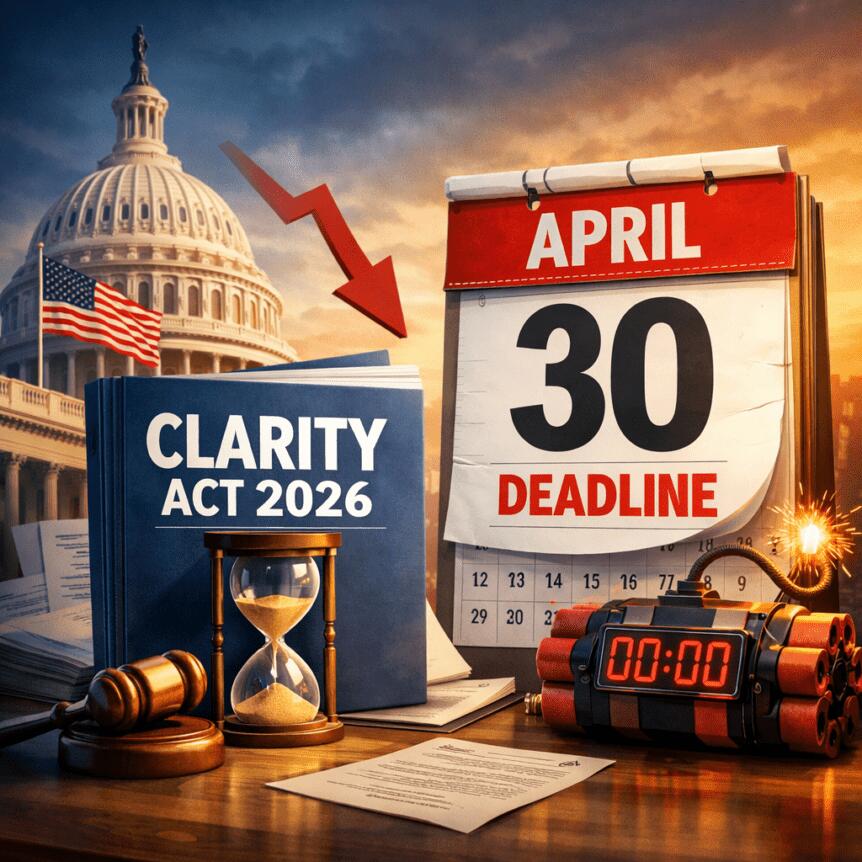
The push for a clearer regulatory framework around digital assets in the United States remains one of the thorniest policy debates in Washington, with a fast-approaching deadline that could determine whether key crypto legislation advances in the near term. The US CLARITY Act, designed to bring regulatory clarity to exchanges, wallets and developers, faces a narrow window to secure traction. A crypto executive warned that if the bill does not move through committee by the end of April, the odds of its passage in 2026 look markedly worse. The clock is ticking as lawmakers weigh competing priorities and a crowded calendar in both chambers.
Key takeaways
- The CLARITY Act has a tight timetable: committee advancement by the end of April is framed as a prerequisite for any chance of floor action in 2026, according to industry observers.
- Senate leadership has signaled appetite to prioritize other measures, such as the SAVE Act, before considering crypto market structure legislation, complicating the CLARITY Act’s path.
- Stablecoin rewards stand out as a major hurdle, but observers warn they may not be the final obstacle; the bill could face concerns over DeFi, developer protections and the scope of regulatory authority.
- While some lawmakers have been optimistic about an April timeline, independent analysts have warned that a delayed vote could push enactment further into the decade, potentially into 2027 or beyond.
- Public commentary from political leaders underscores a broader need for compromise, with lawmakers and industry participants acknowledging concessions are likely on both sides.
Sentiment: Neutral
Market context: The regulatory spotlight on crypto remains intense as U.S. policymakers balance investor protection, financial stability and innovation incentives amid a shifting macro and regulatory backdrop.
Why it matters
The debate over the CLARITY Act crystallizes the broader tension between fostering innovation in the crypto sector and imposing safeguards that could stabilize a fragmented market. The central question for many stakeholders is whether a coherent, principles-based framework can be achieved without stifling experimentation, especially in areas like DeFi and wallet infrastructure where developers argue that current rules are vague or uneven in their application. Advocates say a well-defined set of rules would reduce uncertainty for exchanges, custodians and developers, potentially attracting more legitimate players into the U.S. crypto ecosystem. Opponents, however, warn that rushed legislation could impose overly broad or ambiguous standards that hamper innovation or push activities offshore.
The dialogue around stablecoins—sometimes framed as the bill’s linchpin—highlights the delicate balance lawmakers seek between consumer protection, financial-market stability and the speed at which new technologies evolve. Critics worry that focusing too narrowly on yield practices of stablecoins could miss larger questions about how stableassets interact with traditional banking rails and what protections should apply to on-chain protocols and developers. In the broader arc, the conversation signals a broader shift in how policymakers envisage regulatory authority across on-chain and off-chain activities, from scripting and DeFi governance to KYC/AML compliance for crypto service providers.
Within the policymaking process, internal dynamics also matter. For instance, a key Democrat on the Senate Banking Committee indicated that compromises will be necessary as both crypto advocates and banking interests push for favorable terms. The reality, many observers say, is that lawmakers will walk away with some concessions from both sides, rather than a pristine, perfect bill. This moderation could be the only viable path to a workable framework that gains bipartisan support while addressing substantive risk concerns. In parallel, commentary from industry leaders underscores a pragmatic approach: the CLARITY Act may not be the final word on regulatory design, with evolving oversight, enforcement priorities and technology-neutral standards likely to shape subsequent iterations.
On the legislative calendar, optimism about an April passage has given way to caution as Senate leadership weighs competing bills and priorities. Notable voices in the debate have warned that the timing is everything: a late ballot or postponed committees could push key decisions beyond midterms into a new political reality, complicating any immediate enactment. The urgency is partly tethered to the fact that other measures—such as voter verification initiatives under the SAVE Act—may receive precedence, effectively delaying crypto-specific legislation even if inputs from the crypto industry are deemed constructive.
Beyond the ideological divides, the policy conversation intersects with broader market dynamics. Investors and builders watch how regulators will interpret new authority in areas like stablecoins, on-chain governance and DeFi protocols. As discussions unfold, the industry continues to push for clarity about which actors would be regulated, what standards would apply, and how enforcement would be structured, all with an eye toward reducing the current patchwork of rules that many consider a drag on capital formation and innovation. The evolving dialogue suggests that even if a form of CLARITY bill emerges, its practical impact will depend on the specifics of the final text and the regulatory guardrails that accompany it.
One notable takeaway from industry commentators is that the debate over stablecoin yields may not be the definitive obstacle. While yield-related concerns dominate headlines, the bill’s proponents and opponents alike acknowledge that other contentious topics — including DeFi governance protections, developer liabilities, and the scope of regulatory authority — could surface once the immediate yield question is addressed. In short, passage hinges on a broader consensus about how a modern financial system can responsibly integrate programmable digital assets without creating systemic risk or stifling innovation.
A tweet from a prominent industry voice captured the urgency of the moment, underscoring the need for movement. The message, shared with the broader crypto community, signals that stall events could set the stage for a longer regulatory drag and a more uncertain roadmap for developers seeking clarity on permissible activities. The tweet and related discussions reflect a wider industry appetite for predictable rules, even as stakeholders acknowledge that any final framework will require careful calibration to satisfy both market participants and lawmakers.
On the political front, the rhetoric around crypto regulation remains varied. A senior Democrat on the Senate Banking Committee recently spoke about the need for compromise, noting that both crypto and banking lobbies will likely walk away with some dissatisfaction. The sentiment mirrors a broader pattern in which policymakers recognize that a workable framework will emerge only through negotiation, careful drafting and a willingness to adjust expectations on both sides of the aisle. The legibility of this compromise—how clearly it delineates responsibilities, protections and oversight—will greatly influence the sector’s trajectory in the coming years.
In parallel, some observers have floated more cautious timelines. While a handful of lawmakers previously suggested an April path, industry-facing research from investment banks has offered more conservative forecasts, predicting that market-structure legislation could slip into 2027 or even later, with enactment potentially delayed until 2029 if the political dynamics shift post-midterms. Such projections illustrate how the regulatory road map remains uncertain, even as the appetite for a formal, nationwide framework persists among many industry participants and policymakers alike.
Across the spectrum, the insistence on a credible regulatory approach—one that supports innovation while protecting investors—remains a central theme. The ongoing negotiations produce a mixed signal: steady calls for a clear regime juxtaposed with pragmatic caveats about timing, political capital and the potential need for additional adjustments beyond a single bill. That tension is likely to define the near-term landscape for the U.S. crypto industry, as stakeholders monitor committee votes, floor calendars and the evolving posture of the administration toward market structure proposals.
What to watch next
- Committee movement on the CLARITY Act by end-April and any statements detailing a concrete floor timeline in May.
- Interactions between crypto and banking lobbies shaping compromise terms ahead of any Senate action.
- Further discussions on stablecoins, DeFi protections and regulatory reach that could affect the final text.
- Public comments and lobbying activity around the SAVE Act and its scheduling relative to crypto legislation.
Sources & verification
- Alex Thorn, Galaxy Digital, comments on the April committee deadline and the 2026 passage odds, via X: https://x.com/intangiblecoins/status/2032853696824873429?s=20
- US Senate leadership and timing remarks on crypto market structure legislation and prioritization of the SAVE Act: https://cointelegraph.com/news/us-senate-thune-crypto-market-structure-april
- TD Cowen’s assessment that crypto market structure legislation may not pass until 2027 and could take effect in 2029: https://cointelegraph.com/news/us-crypto-market-structure-bill-delayed
- Public statements around stablecoin yields and regulatory hurdles, including comments from Senator Bernie Moreno: https://cointelegraph.com/news/crypto-us-clarity-act-coinbase-brian-armstrong-bernie-moreno
- President Donald Trump’s remarks criticizing banks for stalling the bill: https://cointelegraph.com/news/trump-takes-swipe-banks-over-stalled-crypto-bill
- Senator Angela Alsobrooks on the need for compromise in crypto-banking discussions: https://cointelegraph.com/news/crypto-banks-need-to-be-unhappy-crypto-bill-advance-senator
- Context and related analyses including industry perspectives on regulatory paths and market structure narratives: https://cointelegraph.com/editorial-policy
- Additional industry commentary from Sandeep Nailwal’s discussion post: https://x.com/sandeepnailwal/status/2032228011651842197?s=20
Regulatory clock tightens for the CLARITY Act and what it means for the market
The central dynamic in Washington is a race against time — and a race against competing agendas. The CLARITY Act is designed to provide a formal blueprint for how a wide range of crypto activities should be regulated, from centralized exchanges to wallets and on-chain developers. Yet the bill’s fate currently hinges on committee momentum and the willingness of lawmakers to balance the interests of a crypto industry that argues for clarity with the concerns of the traditional financial-oversight establishment that pushes for stronger guardrails.
Industry voices argue that clarity, even if imperfect, can catalyze investment and innovation by reducing the ambiguity that currently deters new entrants and strains compliance budgets. Proponents suggest that a well-structured framework could offer a predictable operating environment, enabling legitimate actors to navigate the regulatory landscape with greater confidence. Opponents, conversely, warn that hasty policy could overreach, potentially constraining experimentation or inadvertently stifling emerging technologies. In this context, every procedural milestone — committee votes, floor time, and regulatory clarifications — could meaningfully shift the market’s risk and liquidity dynamics.
The debate also intersects with broader macro factors affecting risk appetite in the crypto space. As policy discussions unfold, traders and investors monitor liquidity conditions, stance of regulators, and any shifts in capital flows tied to ETF and futures product developments. The regulatory frame could influence how institutional participants allocate capital to crypto strategies, how custodians structure risk controls, and how developers plan project roadmaps in a landscape that remains sensitive to political signals and regulatory expectations.
Ultimately, the CLARITY Act’s trajectory will be read through the lens of bipartisan compromise. If lawmakers arrive at a version that allocates clear responsibilities, certain consumer protections, and defined supervisory authority without crippling innovation, it could unlock a period of greater market engagement. If not, the sector may endure a continuation of policy ambiguity that encourages careful risk management but slows capital formation. The coming weeks will reveal whether the administration and Congress manage to align incentives, or whether the debate simply continues to propagate into future sessions and administration cycles.