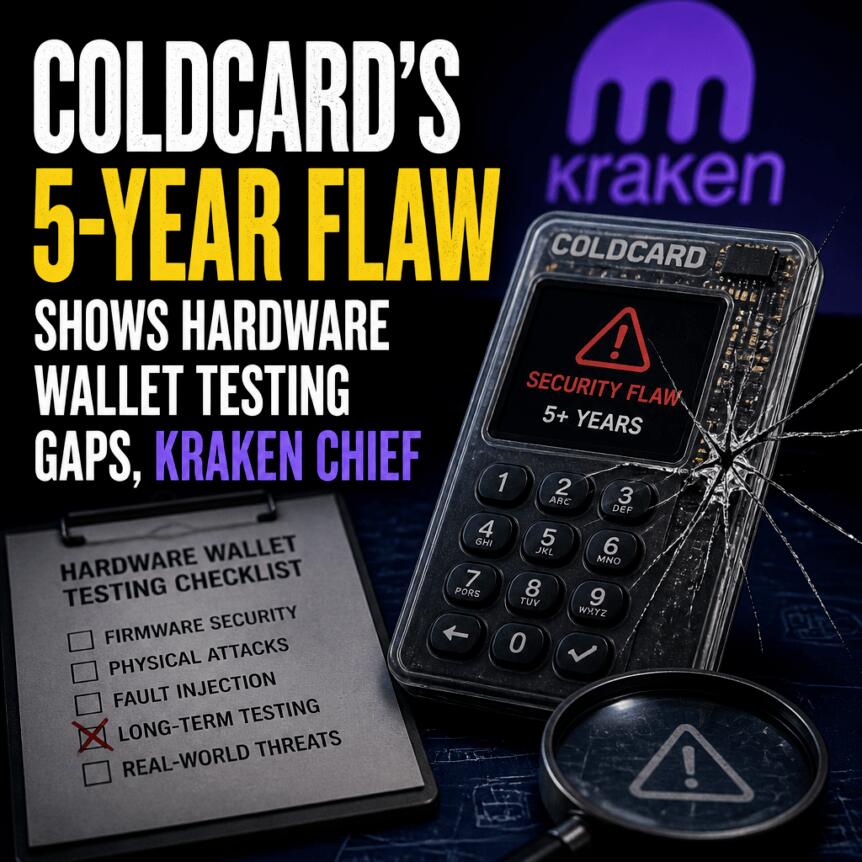
Coldcard’s five-year seed-generation issue has turned into a wider debate over how hardware wallets are independently verified, according to Kraken’s chief security officer Nick Percoco. In an X post on Sunday, Percoco said the incident should prompt makers of self-custody devices to require end-to-end checks that confirm the randomness source reviewed in testing is the same one actually executed by production firmware.
The comments arrive amid an ongoing exploit believed to target vulnerable Coldcard devices by abusing weak seed phrases. By Sunday, more than 4,500 addresses had reportedly been affected, with losses estimated at nearly $90 million in Bitcoin, according to Cointelegraph’s reporting linked in the original article.
Key takeaways
- Kraken’s Nick Percoco argues hardware wallet certification should include verification that the approved entropy path is what production firmware uses in practice.
- Coldcard’s RNG-related flaw allegedly persisted for years after a seed-generation change introduced an unintended reliance on a weaker generator.
- Percoco cited existing standards used in the broader security and payments industries—such as NIST SP 800-90B and BSI AIS-31—as models for what should be standard for crypto self-custody.
- Coinkite says affected firmware has been halted in shipments and that remaining units containing the vulnerable code were destroyed, while it advised users not to discard certain devices.
A hardware wallet “wake-up call” for entropy verification
Percoco’s central point is about trust boundaries. Hardware wallet users are asked to rely on a manufacturer’s implementation of the randomness function that ultimately underpins seed phrase generation—yet, he said, there is often no independent method to confirm that the verified randomness source is the one the device will actually call in production.
“Consumers are asked to trust a manufacturer’s implementation of the single most critical function in the system, with no independent verification that the approved entropy path is the one actually executing,” Percoco wrote in his Sunday post.
He described this gap as an industry-wide weakness rather than a one-off mistake, noting that while some certifications exist for hardware components and secure elements, they do not “systematically force end-to-end verification” of the entropy source through to production code execution.
Percoco contrasted the crypto self-custody space with practices in other sectors. He pointed to the payments industry’s use of independent lab testing for devices that collect sensitive inputs, and to government expectations in the US around cryptographic module validation and entropy source testing.
How the Coldcard flaw allegedly slipped through
According to the original reporting, the vulnerability traces back to a software change disclosed by Coinkite. The company said the relevant issue has existed since March 2021, when Coldcard altered its seed-generation process as it integrated a new cryptographic library.
The update, per Coinkite’s postmortem referenced in the article, unintentionally routed wallet creation to a weaker MicroPython generator already present in the codebase. Coinkite’s explanation indicated that Coldcard’s intended true random number generator (TRNG) code existed and could be present and functioning, but was not reliably the one used for the core randomness needed for seeds.
In other words, reviewers could verify that the TRNG code was present and worked—but, without a mechanism to ensure the device actually called that TRNG during seed generation, the system could still produce outcomes derived from a different generator than intended.
The practical consequence is that seed phrases generated under the affected conditions may become more predictable than they should be. That predictive weakness is widely viewed by the security community as especially dangerous in wallet designs because compromised seeds can enable theft without needing to break keys directly.
Attack fallout and what’s changing for users
The ongoing exploit believed to target weak seed phrases generated by affected Coldcard devices has already resulted in extensive on-chain activity. As of Sunday, Cointelegraph’s figures cited in the original article reported over 4,500 impacted addresses and losses approaching $90 million in Bitcoin.
Coldcard (Coinkite) said it has halted all device shipments since confirming the vulnerability on Thursday. It also stated it destroyed remaining units at its facilities that contained the affected firmware.
At the same time, the company advised users with affected devices not to dispose of them immediately, saying doing so might become “essential if funds are recovered.” The company also indicated its legal team would coordinate with law enforcement across multiple jurisdictions to support efforts identifying those responsible.
For affected owners, the new information underscores a key operational point: device handling decisions may need to be aligned with recovery processes rather than treated as purely disposal or cleanup tasks. While that doesn’t eliminate the security risk of continuing exposure, it suggests an active incident-response posture where retaining evidence or workable hardware could matter.
Standards exist—what’s missing is enforcement
Percoco’s critique points to a tension that many investors and builders may recognize: crypto security often emphasizes reviewing code paths and cryptographic primitives, but not always the end-to-end behavior under production conditions—especially the specific entropy source used at runtime.
He referenced NIST SP 800-90B, which sets requirements for designing, testing and validating physical true random number generators for cryptographic security, and BSI AIS-31, a similar standard from Germany’s Federal Office for Information Security. In his view, such frameworks make it more difficult for systems to “pass review” without proving that the approved randomness pathway is actually used for critical operations.
Whether regulators and certifiers will adapt those expectations to consumer self-custody products remains uncertain. However, the Coldcard case demonstrates why the distinction matters: even when a correct TRNG implementation exists in the codebase, the seed-generation workflow can still be compromised if production firmware routes randomness differently than what independent review assumes.
Next, investors and users should watch for two things: clarification from Coinkite on exactly how to identify which devices/firmware are affected and what remediation steps best reduce future risk, and whether independent testers or certifiers move toward stronger “entropy source at runtime” validation—an area Percoco argues should not remain optional in digital asset custody.