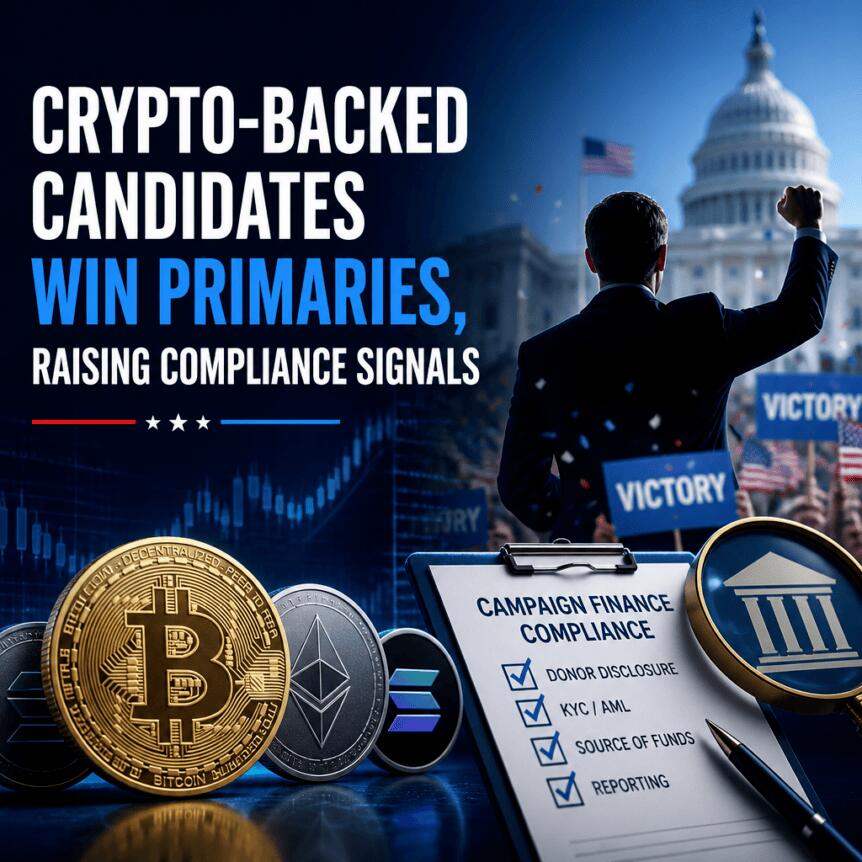
Crypto-aligned political action committees (PACs) helped fund several candidates across US House and Senate primaries held on Tuesday, with multiple backers securing nominations and positioning themselves for November general-election contests. The results highlight the growing role of digital-asset industry-aligned outside spending in US electoral processes, particularly in races where candidates’ views on crypto policy and regulation are expected to matter.
According to The New York Times, a combined total exceeding $8 million in media support—attributed by reporting to PACs including Fairshake and its affiliates—was directed toward candidates considered more likely to support digital-asset-friendly approaches in the next Congress. For compliance and institutional stakeholders, the practical implication is straightforward: political outcomes can shape the regulatory runway for stablecoin policy, exchange oversight, AML/KYC implementation, and enforcement priorities.
Key takeaways
- Fairshake and affiliated PACs reported more than $8 million in combined media expenditures supporting candidates in primaries across Utah, Maryland, and New York.
- In New York, Democrat Ritchie Torres won a primary for the 15th congressional district with 71.9% of the vote.
- In Utah, Republican Blake Moore won the 2nd district primary with 57.5% of the vote.
- Protect Progress, a Fairshake affiliate, reported $5.5 million in expenditures backing Adrian Boafo, who won Maryland’s 5th district Democratic primary with about 32%.
- Not all pro-crypto-aligned candidates won, underscoring that outside spending does not guarantee nomination outcomes.
Fairshake-backed wins and reported spending
Tuesday’s primary results included wins by candidates associated with positions that crypto-aligned donors reportedly view as favorable. Reporting indicates that the largest activity came from Fairshake and its affiliates, which have been linked by industry reporting to funding from major digital-asset firms such as Coinbase and Ripple Labs.
In New York, Democrat Ritchie Torres secured the nomination for the state’s 15th congressional district, capturing 71.9% of the vote. In Utah, Republican Blake Moore won the nomination for the 2nd district with 57.5% of the vote.
Maryland’s 5th district drew particular attention from Protect Progress, described as a Fairshake affiliate. Protect Progress reported $5.5 million in spending to support Adrian Boafo. Boafo won the Democratic primary with about 32% of the vote, defeating other candidates who opposed “spending from crypto billionaires,” according to the reporting.
Fairshake spokesperson Geoff Vetter said the PAC “went big and went early,” adding that its spending was intended to move Boafo from fifth place to the nomination. For institutions tracking policy risk, the immediate takeaway is less about campaign tactics and more about the fact that these PACs are deploying substantial resources into races that could influence legislative direction—especially in areas where Congress plays a central role alongside federal regulators.
Where crypto-aligned PACs fit in the US policy process
Crypto-aligned PACs have become a notable feature of the US political landscape as digital-asset regulation has intensified. Their spending is typically framed around advancing candidates perceived as more receptive to proposals affecting markets and compliance infrastructure, including the implementation of AML/KYC regimes, the future shape of broker-dealer and custody oversight, and the treatment of stablecoins across the banking and payments ecosystem.
Fairshake previously reported having “$150 million cash on hand” in June after spending in several US state primaries, as reported by Cointelegraph. The organization’s broader strategy—supporting candidates it characterizes as “pro-crypto”—suggests a long-running approach rather than isolated election-cycle expenditures.
Other crypto-aligned PACs reported spending on 2026 candidates as well. Reporting cited Fellowship, backed by Cantor Fitzgerald and Anchorage Digital, and the Blockchain Leadership Fund, described as a hybrid PAC backed by Anchorage and Chainlink Labs. These structures matter for compliance monitoring: different PAC types and backers can affect transparency timing, donor disclosure requirements, and how political spending intersects with lobbying and regulatory advocacy.
Unresolved questions: enforcement risk and electoral uncertainty
Tuesday’s outcomes also underscored that outside spending does not automatically determine results. In New York’s 12th district, Democrat Alex Bores lost the primary to Micah Lasher.
According to reporting, Bores faced criticism from Lasher during a June debate regarding whether Bores benefited from external support, including claimed funding by Ripple Labs co-founder Chris Larsen. While such allegations are common in political contests, they also reflect a recurring concern for institutions: the visibility of crypto-related political funding can heighten reputational and regulatory sensitivities, even when legal compliance requirements are met.
From a regulatory perspective, several practical uncertainties remain. Outside spending can influence legislative priorities, but it does not alter independent federal enforcement decisions. For regulated entities—exchanges, custodians, fintechs, and banks considering crypto integration—election outcomes may shift the direction of proposed bills, but implementation still depends on agency rulemaking, judicial interpretation, and enforcement posture. Cross-border firms face additional complexity, as US policy developments can interact with non-US frameworks such as the EU’s MiCA regime and other jurisdictional approaches to stablecoins, licensing, and market conduct.
What to watch next: Colorado and Arizona primaries
Attention is likely to move to upcoming primaries in Colorado and Arizona. Colorado is scheduled to hold its primary on June 30, while Arizona’s primary is set for July 21. As of Wednesday, reporting indicated Fairshake affiliates had not disclosed significant spending in those races.
Institutional observers may view this disclosure gap as informational rather than decisive. In earlier cycles, crypto-aligned PACs have invested heavily ahead of key contests. In 2024, Fairshake and its affiliates spent more than $10 million supporting Ruben Gallego’s Senate race in Arizona and $2.1 million for Democratic Representative Yadira Caraveo in Colorado’s 8th district. Gallego won, while Caraveo lost in the November 2024 election to Republican Gabe Evans.
For compliance and policy teams, the next phase to monitor is whether reported spending increases as the Colorado and Arizona primaries near, and whether candidates endorsed by these PACs introduce or align with legislative agendas relevant to digital-asset regulation, AML/KYC implementation, and stablecoin oversight. Electoral momentum may also affect how industry stakeholders plan lobbying and regulatory engagement during periods when Congress is poised to act.
Closing perspective: The Tuesday primaries reinforce that crypto-aligned outside groups can materially shape candidate slates in races with direct relevance to digital-asset policy. The key question for the next reporting cycle is whether similar levels of disclosed spending emerge in Colorado and Arizona, and how the resulting nominations may influence legislative negotiations and regulatory priorities ahead of the November election.