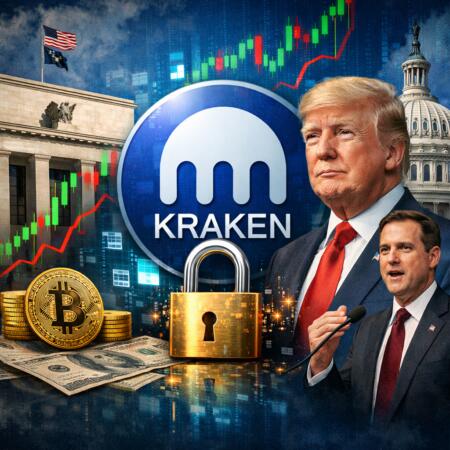
The digital asset landscape extended its bridge to traditional finance this week as Kraken secured direct access to the Federal Reserve’s payment rails. By winning a limited-purpose master account with the Federal Reserve Bank in Kansas City, Kraken is poised to move dollars with unprecedented directness, reducing the industry’s dependence on intermediary banks. The move signals continued maturation of crypto infrastructure even as the broader market endures headwinds from a months-long correction. Across the ecosystem, other steps—such as MARA Holdings clarifying its treasury stance and Fold strengthening its balance sheet—underscore a push toward greater financial resilience and institutional alignment.
Key takeaways
- Kraken obtained a limited-purpose master account with the Kansas City Federal Reserve, enabling direct use of the Fedwire system for real-time settlement of US dollar payments.
- The arrangement provides direct central-bank access for a crypto-native firm, with an initial one-year term and conditions tailored to Kraken’s risk profile.
- MARA Holdings clarified that recent disclosures about Bitcoin treasury management expand flexibility rather than signal an imminent sale.
- Fold eliminated $66.3 million in convertible debt and freed up 521 BTC collateral, strengthening its balance sheet ahead of a forthcoming Bitcoin rewards card launch.
- TD Securities and NYSE-related tokenization discussions suggest institutional appetite could grow if regulatory and infrastructure steps advance, including 24-hour trading and near-instant settlement for tokenized assets.
Tickers mentioned: $BTC
Market context: The Fed-access milestone sits within a broader drift toward blending crypto rails with traditional banking and settlement networks, as liquidity conditions tighten and investors seek clearer onramps, while tokenization and institutional-grade products loom as catalysts for wider participation.
Why it matters
Direct access to the Federal Reserve’s payment infrastructure represents a meaningful validation of crypto-market infrastructure, reducing reliance on correspondent banks and potentially lowering settlement frictions for USD-denominated crypto operations. Kraken’s ability to route payments through the Fedwire system—via a master account that is described as limited-purpose—could improve settlement transparency and speed for a crypto exchange, marking a shift from a peripheral billing role to a more integrated financial intermediary. This development aligns with a broader industry trajectory toward sanctioned access to public-sector rails, signaling regulators’ willingness to harmonize digital assets with mainstream financial systems without sacrificing risk controls. As Kraken frames the arrangement as a step toward becoming a directly connected financial institution, observers will watch how the arrangement evolves beyond the initial one-year term and what criteria accompany any renewal.
Concurrently, the crypto ecosystem has been wrestling with corporate treasury decisions that influence market sentiment. Bitcoin-focused MARA Holdings sought to reassure investors by clarifying that its recent disclosures about treasury management were designed to signal flexibility rather than an imminent liquidation of its BTC reserves. In a filing discussion, the company described an expanded treasury strategy that would allow BTC sales if market conditions warranted, alongside periodic BTC purchases. While some market observers had interpreted the filing as a potential for large-scale sales, company representatives stressed that the policy is designed to provide optionality while preserving long-term strategic goals. The situation underscores how treasury policies can become focal points for sentiment in a sector where balance-sheet discipline matters to institutional investors.
On the balance-sheet front, Fold made a material move to de-risk near-term pressure by retiring about 66 million in convertible debt, freeing up roughly 521 BTC that had served as collateral. The payoff reduces potential dilution from future equity issuance and strengthens the company’s leverage profile as Fold advances plans for a Bitcoin rewards card on the Visa network. Fold’s Nasdaq listing following a SPAC merger underscored the push to bring more Bitcoin-focused financial services into the public market, signaling how traditional markets are increasingly factoring crypto-native business models into their valuations and governance frameworks.
Beyond individual company dynamics, market participants are watching the NYSE’s tokenization framework and related commentary from traditional financial players. A TD Securities strategist flagged the potential for institutions to participate more broadly in tokenized equities and ETFs as the ecosystem develops. The NYSE has proposed tokenizing stocks and ETFs with 24-hour trading and near-instant settlement while preserving established market rules and custody arrangements. The envisioned architecture—where custody and settlement stay with the DTCC while trading adheres to NBBO standards—paints a pathway for deeper institutional engagement with blockchain-based market structures. Taken together, these developments illustrate how the line between crypto-native finance and conventional markets is steadily blurring, driven by infrastructure improvements, regulatory clarity, and a growing appetite from investors for more efficient settlement and access to digital assets.
What to watch next
- One-year term for Kraken’s Fed master account: monitor renewal discussions and any conditions tied to ongoing risk reviews.
- MARA’s 10-K updates: track disclosures on treasury policy and any stated triggers for BTC sales or purchases.
- Fold’s BTC rewards card timeline: watch for product milestones and any changes to its debt posture.
- NYSE tokenization progress: follow governance milestones, regulatory feedback, and any 24-hour trading pilots or settlement experiments.
- Broader institutional interest in tokenized equities and ETFs as infrastructure matures and custody solutions scale.
Sources & verification
- Kraken’s Fed master account and Fedwire access: https://cointelegraph.com/news/kraken-crypto-exchange-fed-master-account
- MARA Bitcoin sell-off claims and treasury strategy details: https://cointelegraph.com/news/mara-bitcoin-sell-off-claims-fact-check-treasury-strategy
- MARA Form 10-K and treasury policy expansion: https://cointelegraph.com/news/mining-companies-ai-hpc-mara-sell-bitcoin
- Fold debt payoff and BTC collateral release: https://cointelegraph.com/news/bitcoin-company-fold-pays-off-66m-debt-frees-up-btc-collateral
- NYSE tokenization framework and market impact: https://cointelegraph.com/news/nyse-tokenized-stocks-td-securities-market-impact
- NYSE tokenization of stocks and ETFs platform: https://cointelegraph.com/news/nyse-develops-blockchain-trading-platform-tokenized-stocks-etfs
- MDARC tweet status referenced in coverage: https://x.com/MARA/status/2028880550283350246
Kraken’s Fed access signals crypto infrastructure matures
The milestone for Kraken sits at the intersection of policy, technology, and market structure, illustrating how the crypto sector is gradually embedding into the core of the traditional financial system. A direct, Fed-backed rails connection can reduce the friction that once forced crypto firms to navigate a web of banking partners with varying risk appetites. While the arrangement remains in its early stages—with a one-year term and tailored risk controls—it provides a blueprint for future collaborations between digital-asset entities and central-bank infrastructure. As the ecosystem broadens its toolkit—from improved balance sheets to tokenized markets—the path toward more resilient, institutionally palatable crypto finance becomes clearer. The coming months will reveal how regulators, custodians, and market makers adapt to this deeper integration, and whether similar access becomes a more widespread feature for crypto firms seeking to scale operations in a regulated, transparent environment.