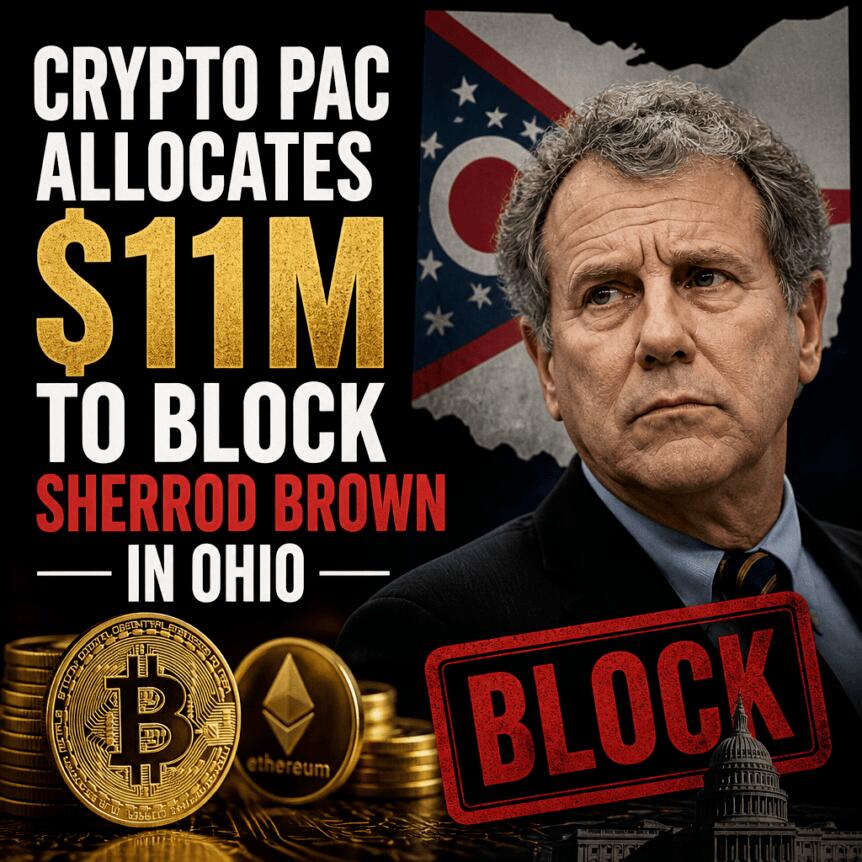
A crypto-industry aligned political action committee reported spending more than $11 million on ads in Ohio’s U.S. Senate race, backing Republican incumbent Jon Husted and opposing Democrat Sherrod Brown. The disclosure, filed with the Federal Election Commission (FEC), underlines how heavily digital-asset interests are using U.S. electoral spending to shape policy outcomes.
According to the Thursday FEC filing, Defend American Jobs PAC—affiliated with Fairshake, a group backed by Coinbase- and Ripple Labs-related interests—reported $11.4 million in media expenses supporting Husted and targeting Brown ahead of a potential return to the Senate. The ad buy appears connected to Fairshake’s earlier pledge to deploy $30 million in the Ohio contest as a way to prevent Brown from regaining a seat.
Key takeaways
- Defend American Jobs PAC reported $11.4 million in FEC media spending in the Ohio Senate race, backing Jon Husted and opposing Sherrod Brown.
- The spending comes through a Fairshake-affiliated structure backed by Coinbase- and Ripple Labs-related interests.
- Fairshake’s Ohio spending plan is described as aiming for $30 million, suggesting the $11.4 million figure may represent part of a larger campaign.
- Outside spending has already been substantial in Ohio—CoinShares data is not cited here—but FEC records from 2024 showed heavy crypto-aligned spending tied to Brown’s prior Senate race.
- The race also follows a political background shift: Husted was appointed to the seat by Ohio Gov. Mike DeWine after JD Vance moved to the vice presidency.
Defend American Jobs PAC discloses $11.4 million ad spend
The FEC filing for Defend American Jobs PAC shows reported media spending of $11.4 million supporting Husted and opposing Brown’s potential comeback. The PAC’s reporting, filed through the FEC’s system, frames the effort as part of a broader campaign strategy tied to Fairshake’s involvement.
Earlier coverage by Cointelegraph noted that Fairshake initially intended to spend $30 million in the Ohio Senate race, explicitly aiming to block Brown. In the filing described by Cointelegraph, the current $11.4 million ad buy suggests the effort is underway well ahead of the election and consistent with that larger commitment.
Why the Ohio Senate race matters for crypto policy
Brown is widely recognized as one of the more prominent critics of crypto-friendly legislation in Congress. Cointelegraph previously highlighted his opposition stance, noting his history as chair of the Senate Banking Committee. That committee role matters because it influences how financial regulation proposals—potentially including those affecting digital assets—move through the legislative process.
In remarks to Cointelegraph in an August 2025 inquiry—conducted after Brown launched his Senate run—Brown emphasized that cryptocurrency has become more embedded in the broader economy. He said, “Cryptocurrency is a part of America’s economy,” adding that his focus is on ensuring that wider use does not leave people at risk. While the comments did not signal endorsement, they reinforced that Brown views crypto’s growth as an issue that policymakers must manage rather than ignore.
From an investor and market perspective, the stakes of this contest are less about day-to-day price movements and more about committee influence and the direction of regulatory scrutiny. A senator’s voting record and oversight priorities can affect the pace of enforcement, the framing of stablecoin and exchange-related policy, and the practical regulatory path for firms operating in the U.S.
Crypto-aligned outside spending already surged in 2024
The Ohio Senate cycle also offers a useful benchmark: Cointelegraph reports that in 2024, the Brown–Bernie Moreno race generated more than $300 million in spending from outside groups, including Fairshake.
According to FEC records cited by Cointelegraph, the crypto-aligned PAC and its affiliates spent about $41 million in 2024 to oppose Brown and support Moreno. That race ultimately ended with Moreno winning the election by 50.2% of the vote to Brown’s 46.4%.
Husted’s candidacy adds continuity to the same broader political and regulatory contest. He was appointed to the Senate by Ohio Gov. Mike DeWine after JD Vance vacated the seat to become U.S. vice president in 2024. In other words, Ohio’s representation in Congress has changed personnel, but the underlying battle lines—particularly over how crypto should be regulated—remain active.
Broader crypto political support extends beyond the Senate
Cointelegraph also points to a parallel theme: crypto-related political involvement in Ohio extends to higher state races. In 2024, Vivek Ramaswamy, a Republican and co-founder of digital asset management firm Strive, previously campaigned for the U.S. presidency and spoke favorably about crypto and blockchain. He later announced plans to run for governor of Ohio and won the Republican nomination in May 2026.
Ramaswamy is set to face Democrat Amy Acton in November. As described in the reporting, Ramaswamy’s gubernatorial campaign received financial support from three co-founders of World Liberty Financial—Chase Herro, Zak Folkman, and Zachary Witkoff—each donating the maximum amount of $16,615. The PAC “V-PAC: Victors, Not Victims” is also described as having included donations totaling $20 million from Susquehanna International Group co-founder Jeff Yass, $6 million from NYDIG founder Ross Stevens, and $5,000 from the Bitcoin Voter Project, with committee information available through the FEC.
Taken together with the Senate spending disclosures, the implication for readers is that digital-asset interests are building a multi-race electoral presence—using both federal and state campaigns to reinforce policy preferences and influence regulatory outcomes.
As the Ohio races progress, the next items worth watching are how much more Fairshake-linked spending materializes beyond the $11.4 million currently disclosed, and whether the advertising themes shift in response to Brown’s message on managing risk while recognizing crypto’s growing role in the economy.