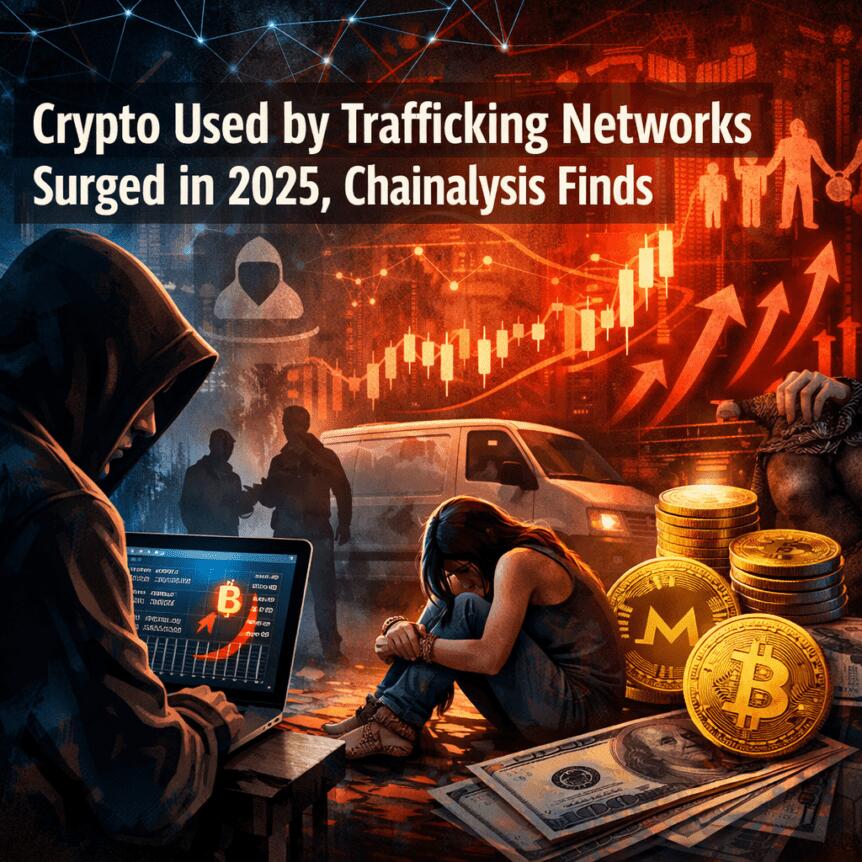
Chainalysis has released a detailed assessment showing a notable uptick in crypto flows tied to suspected human trafficking networks, with an 85% rise in 2025 and transaction volumes reaching hundreds of millions of dollars across identified services. The report highlights networks largely rooted in Southeast Asia and intertwined with scam compounds, online casinos, and Chinese-language money-laundering rings that have gained momentum as crypto adoption broadens. Notably, the study emphasizes that the choice of asset varies by service, with some operators leaning on stablecoins for cross-border payments. While the numbers are concerning, Chainalysis argues that the transparency of blockchains also creates actionable choke points for enforcement.
Among the opaque channels identified are Telegram-based services that facilitate international escorts, labor-placement schemes that allegedly coerce victims into work at scam compounds, prostitution networks, and vendors distributing material related to child sexual abuse. The research underscores that, in practice, payment methods diverge across illicit networks: international escort services and prostitution networks have shown a pronounced reliance on stablecoins, while other segments employ a broader mix of on- and off-ramp techniques. The report’s granular look at asset-type inflows and wallet behavior aims to give investigators and compliance teams new signals to pursue.
Chainalysis stresses that blockchain’s traceability can be a powerful tool for law enforcement. By identifying transaction patterns, monitoring compliance at exchanges, and pinpointing chokepoints in the ecosystem, authorities can disrupt bad actors in ways that cash or traditional remittance systems cannot. This is particularly relevant as illicit online marketplaces and money-laundering networks continue to adapt to shifting regulatory landscapes and evolving crypto offerings. The report also points readers to related work on the broader crypto-laundering landscape and how on-chain analytics are changing the enforcement playbook.
As a case in point, the firm notes several enforcement successes last year, including German authorities dismantling a child sexual exploitation platform, an operation that Chainalysis said was aided by blockchain analysis. The finding illustrates how coordinated usage of on-chain data can assist in tracing the flow of funds across multiple layers of a criminal network, from on-ramps to marketplaces to end-services. Chainalysis also emphasizes the need for ongoing vigilance by compliance teams and law enforcement to monitor for patterns such as high-frequency transfers to labor-placement entities, wallet clusters that operate across multiple illicit categories, and stablecoin conversion activity that appears routine rather than incidental.
Key takeaways
- 2025 crypto flows to suspected human trafficking networks surged by 85%, with total transaction volume reaching hundreds of millions of dollars across identified services.
- Southeast Asia emerges as a central hub for these networks, which are tied to scam compounds, online casinos, and Chinese-language money-laundering networks.
- Seemingly disparate services—Telegram-based international escorts, labor-placement agents, prostitution networks, and vendors supplying illicit content—rely on a mix of assets, with stablecoins favored for cross-border payments in several cases.
- Blockchain’s transparency is framed as a diagnostic and disruption tool: it can reveal transaction patterns, flag large or anomalous activity, and help block or slow illicit flows at exchanges and at online marketplaces.
- Law enforcement achievements, such as the German takedown of a child exploitation platform aided by blockchain forensics, demonstrate the practical leverage of on-chain analytics in complex investigations.
- The report calls for heightened monitoring by compliance teams—watching for regular, large-payments to labor-placement services, wallet clusters spanning illicit categories, and recurring stablecoin conversions—as part of a broader AML framework.
Market context: The findings sit against a backdrop of growing regulatory interest in on-chain analytics, the expanding use of stablecoins, and ongoing scrutiny of cross-border crypto payments. As governments and financial institutions seek robust AML controls, analytics firms and exchanges are increasingly integrating sophisticated tracing tools to deter illicit finance while balancing user privacy and legitimate use cases. The evolving regulatory environment underscores the value—and the limits—of blockchain transparency in addressing criminal finance without stifling legitimate innovation.
Why it matters
The report illustrates a fundamental tension in the crypto economy: the same technologies that enable rapid, borderless financial activity can also facilitate harm if left unchecked. For users and investors, the message is clear—transparency tools are becoming a standard part of risk assessment, and due diligence now increasingly hinges on on-chain behaviors and counterparties. For builders and product teams, the emphasis on compliance signals a growing demand for wallet- and exchange-level controls, better KYC/AML workflows, and clearer disclosures around illicit-risk indicators.
For policymakers, the analysis reinforces the need for clear guidelines on stablecoins and cross-border settlements, as these instruments appear in multiple illicit-use cases. The data also supports continued investment in cross-agency cooperation and international information sharing, given that many of these networks operate across different jurisdictions and platforms. At a technical level, the findings encourage further development of attribution methodologies that preserve user privacy while enabling lawful investigators to trace criminal flows. In short, the study adds to a growing body of evidence that on-chain data can augment traditional investigative methods, but it must be integrated within a broader, well-governed framework.
For the broader crypto ecosystem, the emphasis on chokepoints and wallet clusters highlights practical avenues for disruption: exchanges can improve real-time monitoring, on-chain analytics can be used to flag risky counterparties, and marketplaces can adopt stricter seller verification and payment-processing controls. The convergence of enforcement and technology is likely to shape how illicit activity is funded and how quickly it can be identified and neutralized, potentially reducing the latency between crime and detection in a space historically challenged by anonymity and speed.
What to watch next
- Follow-up updates from Chainalysis on 2026 data and trend analysis, including any revisions to the 2025 figures.
- Regulatory actions targeting stablecoins and cross-border crypto payments, particularly in Southeast Asia and Europe.
- Adoption of enhanced AML controls by exchanges and online marketplaces in response to on-chain‑driven findings.
- Investigations and public disclosures related to large wallet clusters that span multiple illicit services or jurisdictions.
- Further enforcement actions demonstrated or inspired by blockchain-forensic capabilities, such as high-profile takedowns and asset-tracing successes.
Sources & verification
- Chainalysis blog post: crypto-human-trafficking-2026
- Crypto-launderers turning away from centralized exchanges: Chainalysis coverage
- Blockchain forensics and asset tracking explainer
- Related investigative reporting on enforcement actions and policy context
Blockchain visibility and illicit finance: what the findings imply
Chainalysis’s report underscores how on-chain visibility can illuminate the pathways by which crypto assets are moved to support trafficking and exploitation. By charting flows into labor-placement operations, escort services, and adult services that rely on cross-border payments, investigators can identify recurring patterns that mark a network’s lifecycle—from onboarding to monetization. The emphasis on stablecoins in particular reflects how certain assets are chosen to minimize friction across borders, optimize settlement times, and obscure the origin and destination of funds in less-regulated corridors.
Yet the study also warns against overreliance on any single signal. Illicit actors adapt, and the same tools that reveal patterns can be misapplied if not paired with traditional investigative methods and robust governance. The combination of blockchain analytics with proactive compliance, inter-agency collaboration, and targeted enforcement represents a pragmatic approach to mitigating on-chain risks without dampening legitimate innovation in the crypto economy.