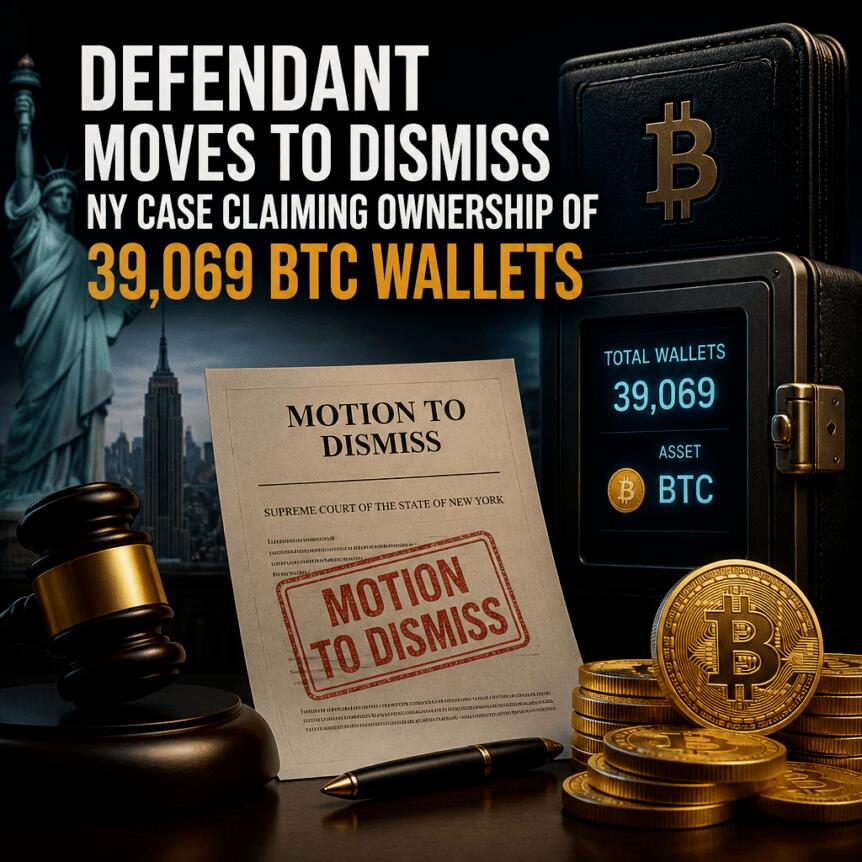
A pseudonymous defendant has asked a New York court to dismiss a lawsuit seeking ownership of 39,069 dormant Bitcoin addresses, arguing that Bitcoin addresses are simply public data and cannot be sued under the state’s jurisdictional rules.
In a motion filed Thursday, the defendant—using the name “John Doe 33”—contends that the plaintiff’s theory of “finding” and claiming abandoned property fails because a Bitcoin address is not a legal person or entity. The filing also challenges the effort to treat on-chain addresses as recoverable under New York lost-property law.
Key takeaways
- The motion argues that Bitcoin addresses are data strings that cannot be the subject of a lawsuit, rather than legal entities that courts can exercise jurisdiction over.
- The plaintiffs’ lost-property claim is framed as legally defective because the addresses were always publicly visible on the blockchain.
- Even if ownership were determined, recovering the Bitcoin would still require access to the corresponding private keys.
- Blockchain-linked reporting cited in the case suggests the defendant may control a long-dormant wallet holding roughly 5,000 BTC.
Why the court fight centers on “addresses” rather than keys
The lawsuit, filed in May by plaintiff “Noah Doe” along with two Wyoming-based LLCs identified as ABC Company and XYZ Company, targets what it describes as abandoned Bitcoin associated with 39,069 dormant addresses. The plaintiffs allege the Bitcoin tied to those addresses is abandoned property, which they reported to the New York Police Department before asserting claims under New York lost-property law.
In the motion to dismiss, John Doe 33 argues the complaint is legally defective for a threshold reason: Bitcoin addresses are not “persons” or legal entities and therefore cannot be sued. The filing further claims that the plaintiffs cannot establish that an address was “found,” as required by lost-property concepts, because the relevant address information has been publicly viewable on the blockchain since the coins were received.
For investors and builders, the procedural dispute matters because it goes beyond a single wallet list. It asks whether traditional legal frameworks for identifying owners and claiming property can map onto the blockchain’s structure—where addresses are public identifiers and control is enforced through private keys rather than through legal status.
The alleged “abandoned” wallets include famous names
The complaint lists 39,069 Bitcoin addresses that include wallets widely associated with well-known Bitcoin labels, such as addresses attributed to Bitcoin creator Satoshi Nakamoto and to the Mt. Gox hacker. The addresses collectively are reported—via an estimate attributed to Sani, founder of Bitcoin analytics platform Timechain Index—to hold roughly 3.7 million BTC, valued at about $234 billion at the time of that estimate.
That scale is a key reason the case has attracted attention. A ruling could influence how courts treat claims that attempt to convert blockchain identifiers into claimable “property” within existing state laws.
At the same time, the filing acknowledges a practical hurdle that remains independent of any jurisdictional debate: even if the court were to rule on ownership of the assets associated with the addresses, the plaintiffs would still need the private keys to move any Bitcoin. Without those keys, the Bitcoin remains inaccessible regardless of how a court characterizes ownership or abandonment.
Defendant says they control a long-dormant wallet
Separate from the legal arguments, the motion’s credibility is bolstered—at least in part—by blockchain data cited in public commentary. According to an X post on Friday by Alex Thorn, head of research at Galaxy Digital, blockchain information suggests John Doe 33 controls a wallet that received 5,000 BTC in April 2014 and has remained untouched for more than 12 years.
Thorn indicated the wallet’s current value is above $300 million at prevailing market prices, and he characterized the defendant as a “real holder” with meaningful standing rather than a bystander who could be targeted without any real ability to defend the claim.
Thorn also wrote that the filing helped avoid what had been described as a “near-certain” default judgment, while simultaneously challenging jurisdictional and statutory defects raised by the plaintiffs’ approach.
Dormancy data underscores why recovery questions persist
Beyond the specific defendants and plaintiffs, the broader question of what happens to lost or inaccessible Bitcoin continues to drive legal scrutiny. Bitbo data cited in the reporting indicates that about 3.5 million BTC, valued around $215 billion, have been dormant for at least 10 years, while another 6.6 million coins—worth roughly $406 billion—have been dormant for over five years.
Those figures highlight a persistent imbalance in how on-chain “time” translates to legal rights. Blockchain dormancy may signal lost control, but it does not automatically yield a mechanism for third parties to access private keys. This case, therefore, tests whether legal systems can bridge the gap between public address records and the cryptographic controls that govern ownership in practice.
For readers tracking regulation and legal precedent in crypto, the important development is not only who named which addresses, but how courts handle the mismatch between legal concepts like “found property” and the blockchain reality that addresses are public labels—while control is determined privately.
As the New York case progresses, the key questions to watch are whether the court agrees that addresses cannot be sued as entities, and—if the case survives procedural challenges—what standard it may apply to abandonment and recoverability when private keys are necessary to access any funds.