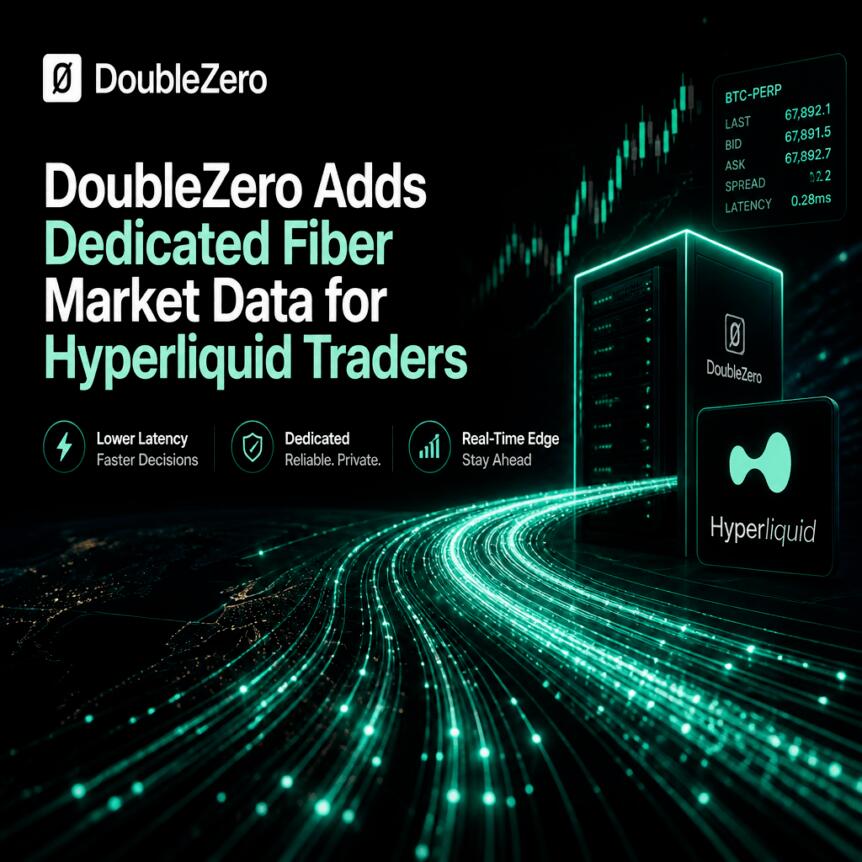
DoubleZero has launched a dedicated fiber-based market data feed for Hyperliquid, aiming to give professional trading firms a more reliable way to consume the decentralized exchange’s full order book. Instead of relying on Hyperliquid’s public APIs, participants can access an ordered, continuous stream of market data over a private network connection—an approach designed for market makers and quantitative desks that prioritize speed and consistency.
The feed covers Hyperliquid’s native perpetual futures markets and also markets run by trade[XYZ], which uses Hyperliquid’s infrastructure to offer perpetual contracts linked to assets including oil, gold, and silver. DoubleZero says the service was developed alongside validator operators and ecosystem partners such as Hyperion DeFi, MAVAN, and Kinetiq.
Key takeaways
- DoubleZero’s Hyperliquid feed delivers the full order book via a fiber network, avoiding the limitations of public API updates.
- The service supports Hyperliquid native perps and trade[XYZ]-hosted markets, including perpetuals tied to oil, gold, and silver.
- DoubleZero cites reduced update frequency and depth in Hyperliquid’s public APIs as a key reason firms may need a dedicated data stream.
- Hyperion DeFi CEO Hyunsu Jung frames the development as “onchain markets adopting” the professional market-data distribution model, not as a direct replacement for traditional exchange infrastructure.
A dedicated order book feed for onchain venues
For many professional traders, the challenge with onchain venues is not just execution—it’s the quality and cadence of market data. DoubleZero’s new offering is positioned as an alternative to stitching together order book views from public API responses or from running one’s own nodes.
In its announcement, DoubleZero said that firms previously seeking a complete picture of Hyperliquid’s order book had to aggregate public data themselves or operate Hyperliquid infrastructure. It also argued that changes to Hyperliquid’s public APIs have reduced both the frequency and the depth of the updates available through those endpoints.
The DoubleZero feed is designed to address that gap. According to DoubleZero, it provides a continuous, ordered stream of market data intended for market makers and quantitative and proprietary trading firms that depend on fast, consistent order book refreshes.
Built with ecosystem partners and validator operators
DoubleZero did not present the initiative as a solo effort. It said the Hyperliquid feed was built with input and support from validator operators and ecosystem partners in the broader onchain ecosystem, including Hyperion DeFi, MAVAN, and Kinetiq.
The feed’s scope is also broader than a single venue’s flagship product. In addition to Hyperliquid’s native perpetual futures markets, it includes perpetual markets operated by trade[XYZ]. Those contracts are linked to assets such as oil, gold, and silver—showing that the data pipeline is intended to serve professional participants operating across multiple perpetual offerings within the Hyperliquid ecosystem.
DoubleZero further said the infrastructure is part of its wider “Edge” market-data service, which is already available for other venues. The Hyperliquid feed is presented as the third location offered through that service, after Solana and prediction market operator Kalshi.
Closer to traditional exchange data distribution—without pretending it’s identical
Hyperion DeFi CEO Hyunsu Jung described the direction of travel as convergence in the market-data layer rather than the trading model. In comments to Cointelegraph, Jung compared DoubleZero’s fiber-based distribution to how traditional electronic exchanges deliver professional market data.
Jung explained that exchanges such as CME and Nasdaq distribute professional data through dedicated networks, enabling automated trading firms to receive a consistent, ordered stream with high speed. In that sense, he said, Hyperliquid data can now be consumed through a similar fundamental model: “publish once, distribute simultaneously over dedicated fiber.”
However, he stressed the important differences remain. Traditional exchanges allow firms to reduce latency by placing trading systems physically closer to the exchange infrastructure that processes orders. Hyperliquid’s execution happens onchain, which means placement advantages still operate at the level of physics and connectivity.
As Jung put it, the “convergence is not Hyperliquid becoming CME.” Instead, onchain markets are adopting market-data infrastructure patterns that professional traders already use. At the same time, he cautioned that the move does not eliminate latency differences—such as the advantage a firm in Tokyo may still hold over a firm in New York.
Why this matters for professional traders and market makers
Dedicated order book data feeds can be consequential for firms that treat the order book as the primary signal. When update cadence slows or when public endpoints provide less depth, traders face a trade-off: either accept higher uncertainty in their models or invest additional effort into alternative data paths.
DoubleZero’s positioning suggests the latter option is becoming more practical as onchain venues mature. By distributing ordered market data over fiber rather than through public API calls, the service aims to deliver the predictability that quantitative systems often require to manage strategies, risk controls, and routing decisions.
It also highlights a shift in how professional onchain participation may evolve. Instead of relying solely on “build your own stack” approaches—such as running nodes or aggregating public data—firms can increasingly buy into infrastructure layers designed specifically for low-latency, consistent streaming.
For investors and observers, the broader takeaway is that the competitive edge between trading venues may increasingly depend not only on smart contract execution or liquidity incentives, but on the surrounding operational tooling: data transport, ordering guarantees, and the practical latency realities of trading systems.
What readers should watch next is how widely this approach is adopted across onchain venues and whether additional venues follow the same pattern of dedicated, ordered distribution. Equally important is whether Hyperliquid’s public API changes continue to push more high-frequency and market-making activity toward fiber-based or provider-managed data channels.