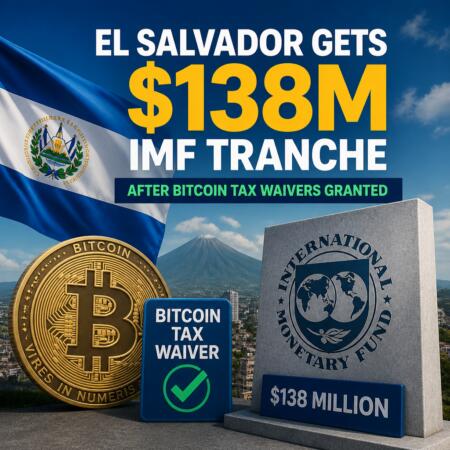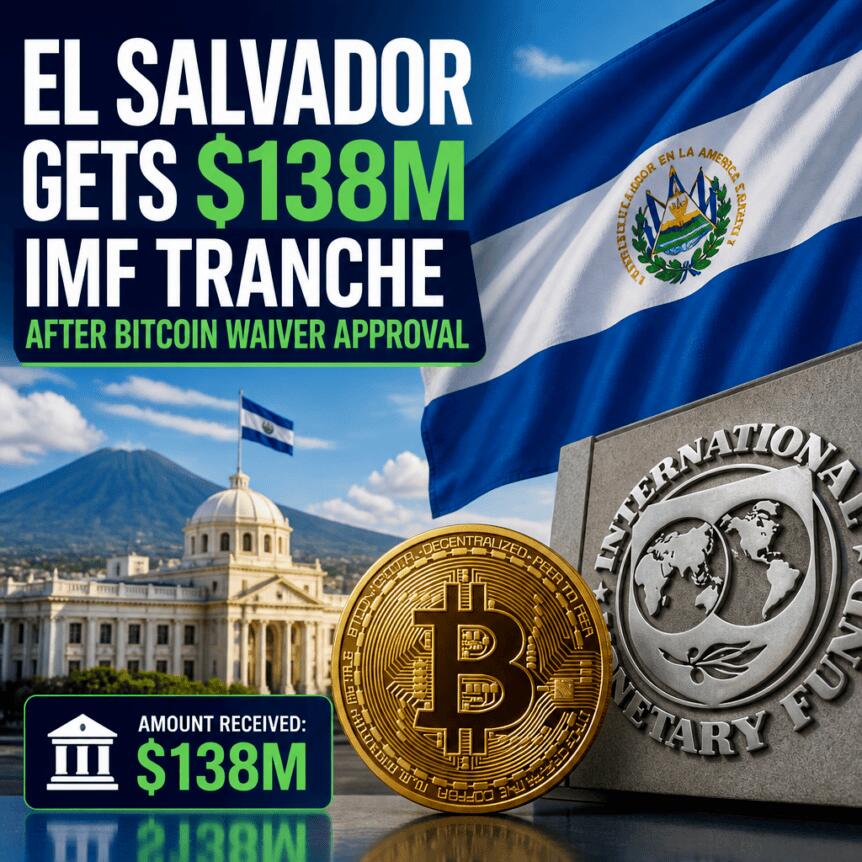
The International Monetary Fund has approved the immediate release of roughly $138 million to El Salvador under its $1.4 billion financing program, even though the country did not fully meet certain performance targets. The decision came after the IMF’s Executive Board completed the second and third reviews of El Salvador’s 40-month Extended Fund Facility (EFF) arrangement, according to an IMF press release published this week.
IMF officials said the disbursement was accompanied by waivers tied to “strong corrective measures and renewed commitments.” The IMF also reiterated that further Bitcoin accumulation will not be carried out beyond previously documented donations.
Key takeaways
- The IMF authorized an immediate $138 million disbursement after completing the 2nd and 3rd EFF reviews for El Salvador.
- Some performance criteria were missed, including those related to Bitcoin accumulation, but the IMF granted waivers.
- The IMF said progress continues on reforms covering the financial sector, fiscal transparency, and AML/CFT measures.
- The government’s majority ownership and operational control of the Chivo Bitcoin wallet has been transferred to a private operator, while the state retains minority and custodial responsibilities.
- The IMF stated no further Bitcoin accumulation is envisaged beyond documented donations.
IMF clears the next tranche despite missed targets
In its announcement, the IMF said the Executive Board concluded the second and third reviews of El Salvador’s 40-month EFF arrangement on Thursday. The approval allows the next tranche of financing—about $138 million—to be released immediately.
While the IMF indicated that not all performance criteria were met, it moved forward with the program using the standard mechanism available under such arrangements: waivers. The IMF said those waivers were granted based on corrective actions and updated commitments by the Salvadoran authorities.
Central to the IMF’s assessment was how El Salvador’s Bitcoin holdings had changed since earlier program milestones.
Bitcoin accumulation: waivers tied to donations and a stated cap
According to the IMF, some of the unmet criteria related to Bitcoin accumulation. However, the IMF also addressed the underlying question that has followed El Salvador since the program’s earlier review stages: where did the additional Bitcoin exposure come from?
Earlier coverage by Cointelegraph noted that, following the first review of the IMF program in June 2025, the country’s Bitcoin increase was not supported by public resources. The IMF later backed that position, stating that documents provided by Salvadoran authorities showed the accumulation originated from private donations rather than government-funded purchases.
In the current decision, the IMF reinforced that framing. It said there is “no further Bitcoin accumulation” expected beyond the donations already documented. For program observers, this matters because IMF financing is tied to measurable policy conditions; if holdings were built with state resources, it would raise compliance questions for a government seeking IMF support.
At the same time, the IMF’s statement leaves readers with a clear monitoring task: future changes to El Salvador’s Bitcoin balance will likely be judged against the “donations only” boundary the IMF has now set publicly.
Reforms outside crypto: financial sector, transparency, and AML/CFT
Beyond Bitcoin-related criteria, the IMF pointed to progress in broader policy areas tied to the EFF. In its release, it highlighted advancements in financial sector reforms, fiscal transparency efforts, and anti-money laundering and counter-terrorism financing (AML/CFT) reforms.
The IMF also cited governance steps around crypto-adjacent state operations—specifically, actions designed to clarify how Bitcoin-related activities are overseen.
Chivo wallet governance changes shift operational control
A significant part of the IMF’s rationale for moving forward involves institutional restructuring of El Salvador’s Chivo Bitcoin wallet. The IMF said majority ownership and operational control of the wallet were transferred to a private operator. At the same time, the government is described as retaining a minority stake and certain custodial responsibilities.
The policy intent—reflected in the IMF’s language—is to reduce the state’s direct involvement in Bitcoin-related activities. The IMF said El Salvador will continue efforts to “reduce the state’s involvement in Bitcoin-related activities, strengthen crypto‑asset regulation and governance, and enhance transparency regarding public-sector crypto‑asset holdings.”
For investors and program-watchers, this kind of governance shift is often treated as more than a technical tweak. It can affect how compliance is assessed, how responsibilities are allocated, and whether future crypto-related transactions could be interpreted as government-driven rather than privately originated.
Cointelegraph previously reported that, after an earlier program stage, questions renewed when El Salvador said in November 2025 it had acquired 1,090 BTC worth $100 million. The IMF’s more recent explanation—centered on private donations rather than government-financed purchases—aims to address why holdings increased without violating the terms as interpreted by the lender.
What to watch next for the EFF and El Salvador’s crypto policy
With the IMF now signaling that additional Bitcoin accumulation is not expected beyond documented donations, the next question is how consistently El Salvador can maintain that line while meeting the EFF’s broader reform benchmarks. Future IMF reviews will likely focus on both compliance around crypto holdings and whether governance changes around the Chivo wallet translate into measurable, durable controls.