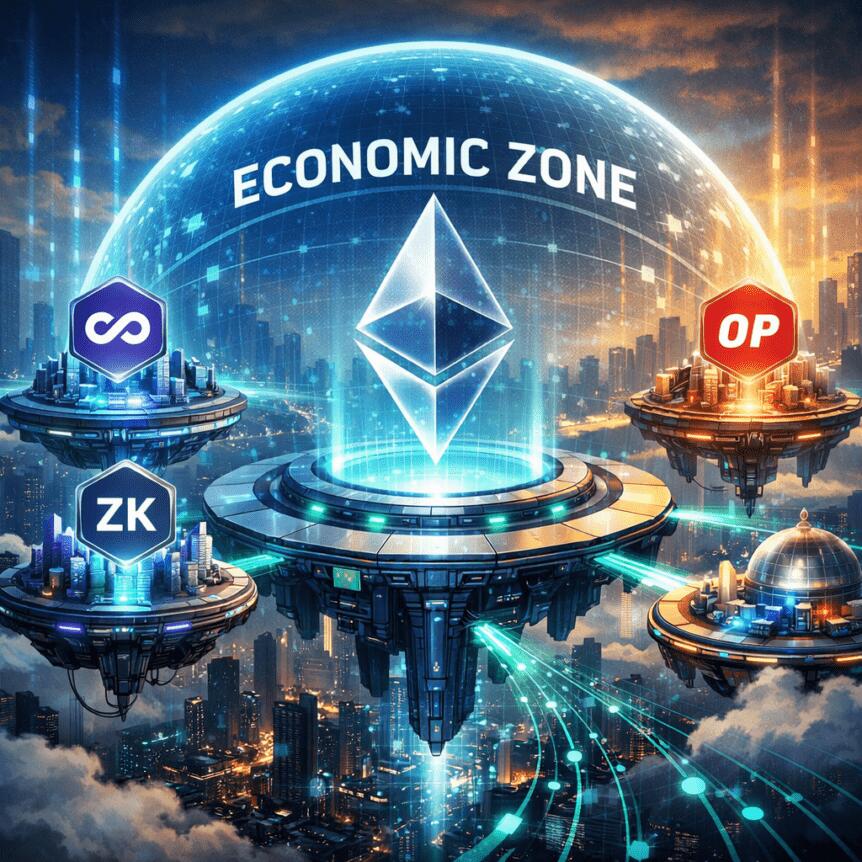
A new collaborative framework proposed by developers from Gnosis and Zisk, with support from the Ethereum Foundation, aims to knit Ethereum’s sprawling layer-2 ecosystem into a more cohesive execution fabric. The initiative, dubbed the Ethereum Economic Zone (EEZ), envisions cross-rollup interactions that would allow smart contracts on different rollups to run in lockstep with one another and settle back to Ethereum in a single transaction—without the need for traditional bridges.
Presented in an announcement shared with Cointelegraph, the EEZ would mitigate a central tension in Ethereum’s scaling approach: dozens of rollups have increased throughput, but liquidity, infrastructure, and user activity remain fragmented across separate networks. If realized, the framework could enable shared infrastructure across rollups and streamline settlement to Ethereum, reducing duplication and the burden of cross-chain transfers for developers and users alike.
The effort positions Ethereum researchers and a broader ecosystem behind a formal standard for interoperable rollups, with Gnosis and Zisk among the early contributors. The project also signals a broader push to move beyond isolated scaling layers toward a more unified execution layer architecture. Early participants include infrastructure providers and DeFi protocols exploring a common standard for interoperable rollups.
Key takeaways
- EEZ would allow cross-rollup smart-contract execution to occur synchronously, bypassing bridges and settlement bottlenecks.
- The proposal targets liquidity fragmentation by enabling shared infrastructure and cohesive interaction among rollups and Ethereum mainnet.
- The EEZ Alliance has been formed to coordinate standards and push adoption as Ethereum’s scaling landscape evolves.
- Gnosis and Zisk anchor the initiative, with involvement from Ethereum researchers and other industry actors; Jordi Baylina (Zisk) cites zero-knowledge proving expertise as a key component.
- Technical details and performance benchmarks are slated for release in the coming weeks as the framework moves from concept to design and potential deployment.
Interoperability in the spotlight as scaling debate intensifies
The EEZ proposal arrives amid a long-running discussion within the Ethereum community about the trade-offs of a rollup-centric scaling path. Rollups have pushed throughput higher than base Ethereum, but the field has grown into a tapestry of separate ecosystems, each with its own liquidity and user base. Data from L2BEAT indicates there are more than 20 active layer-2 networks with collectively close to $40 billion in total value locked, distributed across networks like Arbitrum, Base, and Optimism. The outcome has been a parallelized execution environment rather than a single, consolidated scaling layer.
Industry voices have recently highlighted concerns about the architecture of some L2s. Vitalik Buterin suggested in a February X post that the original vision for L2s and their role in Ethereum may require a rethink, pointing to potential weak points in centralized sequencers and trusted bridges. The ensuing discussion among L2 builders underscored a spectrum of views on whether scaling alone remains the priority or if interoperability and unified settlement should take a more central role in the network’s evolution.
Karl Floersch, co-founder of Optimism, has acknowledged the need for L2s to evolve beyond simple scaling mechanics, citing ongoing technical hurdles. Steven Goldfeder, co-founder of Offchain Labs (the team behind Arbitrum), emphasized that scaling remains a core function as rollups continue to handle higher transaction throughput than Ethereum itself. The EEZ concept could be seen as a response to these ongoing debates, offering a pathway to reduce cross-network friction while preserving the performance advantages of rollups.
What changes with EEZ—and what remains uncertain
If the EEZ framework progresses, it would potentially enable applications to share infrastructure across multiple rollups and settle their state to Ethereum in a coordinated fashion. This would reduce duplication of validators, data availability resources, and bridging overhead, while preserving rollups’ high throughput. The defining feature would be a synchronized execution model that subscribes to a common standard, enabling more seamless inter-rollup communication and a more unified user experience.
Several questions remain as the project moves from concept to design. How would a cross-rollup execution model handle security guarantees across diverse rollups with different trust assumptions? What governance and standardization processes would be needed to ensure broad acceptance across the ecosystem? And crucially, what would adoption look like in practice—how quickly would developers and users pivot to a shared framework, and what incentives would drive this transition?
Early work emphasizes collaboration among major ecosystem players, with the EEZ Alliance positioned to coordinate development, testing, and eventual rollout. While concrete technical specifications are not yet public, the timeline anticipates forthcoming detail on implementation strategies, performance benchmarks, and compatibility assurances across major rollups.
What to watch next
Developers expect a more detailed technical outline in the weeks ahead, accompanied by benchmarks illustrating how cross-rollup synchronization would perform under realistic workloads. The EEZ Alliance’s progress will also be a key indicator of whether the broader ecosystem is ready to adopt a shared standard that could reduce cross-network friction while maintaining or enhancing security, reliability, and user experience.
Investors and builders should monitor how the EEZ concept interacts with ongoing efforts to modularize Ethereum’s scaling stack, including cross-layer collaboration, data availability solutions, and zk-based tooling. The question of whether a unified cross-rollup framework can gain rapid traction remains open, but the proposal clearly signals a deliberate shift toward interoperability as a central pillar of Ethereum’s long-term scaling strategy.
As Ethereum’s scaling architecture continues to evolve, the next few quarters could reveal whether the EEZ Alliance becomes a conventional standard, or whether the path toward a truly cohesive rollup economy will require alternative approaches. For now, the industry is watching a select group of core contributors test a bold idea: how to turn multiple high-throughput networks into a single, more efficient ecosystem without surrendering the strengths that have driven their rapid growth.
Readers should stay tuned for technical disclosures and real-world experimentation that would demonstrate the practicality of cross-rollup synchronization and the feasibility of shared infrastructure across rollups—an outcome that could reshape how developers build and users interact with Ethereum’s scaling frontier.