Introduction
Farcaster co-founder Dan Romero moved to quell speculation around the project’s future after Neynar’s acquisition, emphasizing that the protocol is not shutting down and remains actively used. Farcaster, a decentralized social protocol that enables developers to build interoperable apps with users owning their identities and connections on-chain, has seen meaningful engagement as it undergoes strategic realignment with its new infrastructure partner.
Key Takeaways
- Farcaster remains operational and reports strong engagement, with hundreds of thousands of users and on-chain wallets continuing to grow.
- Neynar plans to steer Farcaster toward a more developer-centric trajectory, leveraging its long-standing infrastructure relationship with the protocol.
- Merkle Manufactory, the entity behind Farcaster’s development, is returning its total capital of $180 million to investors after five years of work.
- The broader decentralized social ecosystem is experiencing leadership shifts, with notable figures urging open, community-governed platforms and a move away from centralized information ecosystems.
Sentiment: Neutral
Price impact: Neutral. These governance and strategic shifts are unlikely to produce immediate price moves.
Trading idea (Not Financial Advice): Hold. The developments are about governance and platform strategy rather than near-term catalysts.
Market context: The episode fits into a wider pattern of consolidation and maturation among decentralized social protocols as developers, investors and users recalibrate expectations for sustainable, open ecosystems.
8. Rewritten article body
Farcaster co-founder Dan Romero addressed ongoing questions about the protocol’s future, stating that the decentralized social network is not exiting the scene despite Neynar’s purchase and ongoing leadership transition. Farcaster enables developers to build interoperable social applications where users retain ownership of their identities and social graphs on the blockchain instead of being confined to a single platform.
In a message to the community, Romero noted that Farcaster remains operating and continues to see meaningful usage, citing roughly 250,000 monthly active users in December and more than 100,000 funded wallets. He added that Neynar, a venture-backed infrastructure firm with deep ties to Farcaster, intends to steer the project toward a more developer-focused direction.
Merkle Manufactory, the development arm behind Farcaster, previously raised significant capital from notable venture backers. In July 2022, Merkle raised $30 million from a16z crypto, and in March 2022 Paradigm led a funding round that reportedly pushed Farcaster’s valuation beyond the $1 billion mark. Romero disclosed that Merkle’s total capital raised over its lifetime amounts to $180 million and that the company plans to return the full amount to investors. “As for Merkle, we’re planning to return the full $180 million raised back to investors,” he wrote, noting the decision comes after five years of development and a bid to act as prudent stewards of investor capital. There was no immediate comment from Merkle Manufactory on the plan.
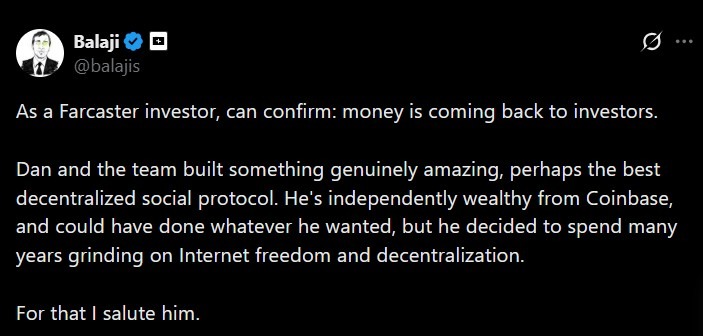
Investor Balaji Srinivasan weighed in on the development, confirming that investor funds are being returned and praising the team’s work toward decentralized social infrastructure. The public response underscored a broader sentiment that momentum behind open, on-chain social systems remains intact even as organizational structures shift.
The post also reiterated that Neynar would assume responsibility for maintaining Farcaster’s protocol contracts, code repositories, and consumer app, marking a leadership transition. Romero and several team members would step back from day-to-day operations as the new owner guides the project forward. Neynar has been closely tied to Farcaster’s ecosystem since its early days, operating as one of the first Farcaster clients and providing infrastructure that supports many developers building on the protocol.
Aave hands over Lens stewardship to Mask Network
Beyond Farcaster, Lens Protocol also underwent a leadership transition this week. The Aave team said it has handed over stewardship of Lens to Mask Network, allowing Aave to refocus on decentralized finance while remaining involved with Lens in a technical advisory capacity.
Meanwhile, Ethereum co-founder Vitalik Buterin reiterated his support for decentralized social media, urging builders and users to embrace open social platforms. “If we want a better society, we need better mass communication tools,” Buterin said, signaling a broader push toward open, community-governed online spaces rather than centralized information battlegrounds.