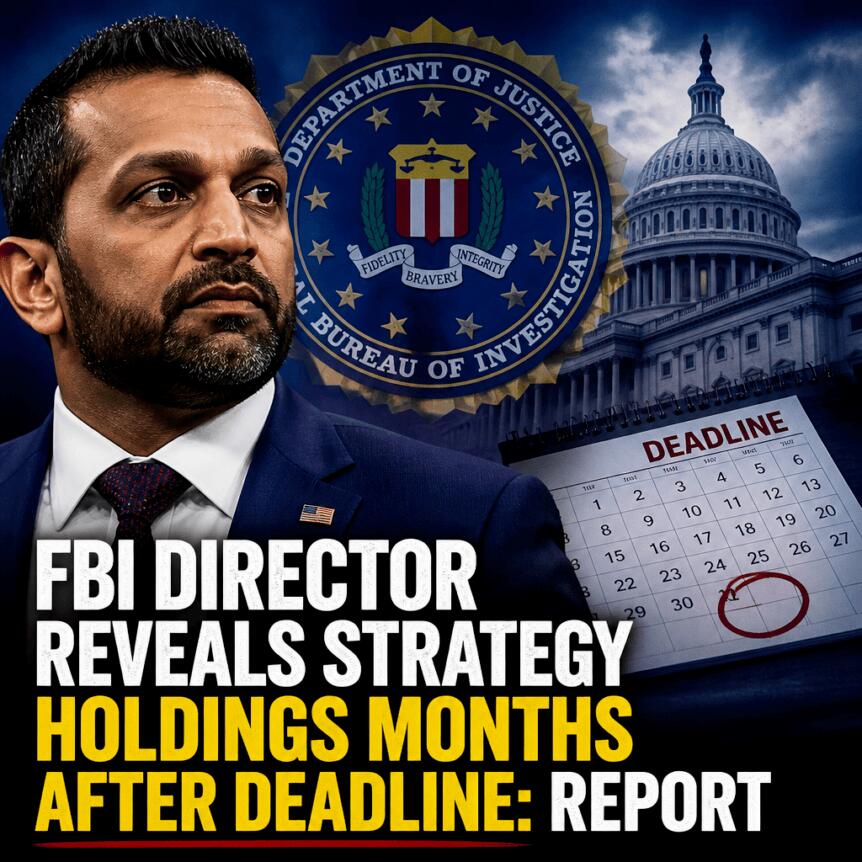
FBI Director Kash Patel has reportedly failed to disclose a Strategy (MSTR) stock purchase on time under the U.S. STOCK Act, prompting renewed attention to how government officials report crypto-adjacent investments and other financial holdings.
According to a report published Wednesday by the nonpartisan nonprofit news organization NOTUS, Patel “inadvertently omitted” a Strategy investment that was worth up to $250,000. NOTUS says the purchase was made on Nov. 21, 2025, but did not appear in Patel’s December 2025 financial disclosures filed under the STOCK Act.
Key takeaways
- NOTUS reports that FBI Director Kash Patel omitted a Strategy (MSTR) purchase from required December 2025 disclosures.
- Under the STOCK Act, covered officials generally must disclose reportable trades within 45 days of execution.
- Patel later filed an amended report on May 26, stating the Strategy holding was “inadvertently omitted” and that he believes no current conflict exists.
- The case feeds into broader congressional criticism of weak penalties for STOCK Act violations.
- Capitol Trades data cited by NOTUS also points to other officials reporting Strategy-related holdings late.
What NOTUS says Patel got wrong—and how he corrected it
NOTUS’s report centers on a specific compliance lapse tied to the STOCK Act, a law designed to curb conflicts of interest by requiring timely disclosure of certain financial transactions by members of Congress and other covered officials.
NOTUS says Patel purchased Strategy shares on Nov. 21, 2025. The trade was not included in Patel’s December 2025 disclosure filing, even though the law requires disclosure of financial transactions above a certain threshold within a set window—NOTUS notes that transactions exceeding $1,000 must generally be reported no later than 45 days after execution.
Rather than leaving the omission unaddressed, Patel filed an amended report on May 26, according to NOTUS. The filing described the Strategy holdings as “inadvertently omitted,” and stated that there is “no current conflict exists” involving the investment.
Strategy—formerly known as MicroStrategy—is a U.S.-registered government contractor, a detail that NOTUS highlights as a potential flashpoint for conflict-of-interest concerns when senior officials hold positions in firms with government contracting ties.
Why the STOCK Act debate is resurfacing
Signed in 2012, the STOCK Act has faced repeated scrutiny from lawmakers and watchdog advocates who argue that enforcement and penalties do not meaningfully deter late or incomplete reporting.
NOTUS points to criticisms that first-time violations can result in relatively limited consequences—citing that the law provides for a $200 fine for first offenders. The same criticism notes that these penalties fall well short of the large amounts sometimes at stake in financial disclosures.
In other words, even when omissions are corrected after the fact, critics argue the system may not impose strong enough repercussions to ensure compliance from the start. Patel’s amended filing—paired with the relatively modest penalty structure described by NOTUS—adds another data point to the broader oversight conversation.
Strategy disclosures: not an isolated pattern
Patel’s case appears within a wider pattern of late reporting involving Strategy investments, at least based on the examples NOTUS cites.
NOTUS also references Capitol Trades, a website that tracks politicians’ investment activity. The report says Representative Shri Thanedar “waited” until August 2025 to report a Strategy investment made in June 2024, which Capitol Trades lists as a range between $15,001 and $50,000.
While the underlying details differ by individual and timeframe, the common thread is that Strategy-related holdings can end up reported outside the law’s intended window. For traders, compliance officers, and policy watchers, timing matters because disclosures are meant to reduce the informational advantage that comes from acting on nonpublic knowledge and then reporting after the fact.
Crypto income disclosures in the background
Patel’s reported late correction comes as U.S. political attention to crypto-linked income and reporting remains intense.
The NOTUS report is framed alongside President Donald Trump’s publication of financial records showing his cryptocurrency ventures generated more than $1.4 billion in income in 2025—more than income reported from his real estate businesses, according to a link cited by NOTUS from earlier coverage by Cointelegraph.
That reporting has also fueled political disputes about whether crypto activities, including memecoin-related developments and other crypto platforms described in the cited coverage, create conflicts between official duties and private financial interests.
Although Patel’s situation involves the STOCK Act rather than presidential financial disclosure reporting, it sits in the same ecosystem of public accountability questions: who discloses what, when, and whether the disclosure regime is stringent enough to maintain trust.
Going forward, the key question for observers is how strictly oversight bodies evaluate the “inadvertently omitted” explanation in Patel’s amended filing, and whether the broader push for stronger STOCK Act penalties gains momentum. Readers should also watch for further examples of timing-related omissions in high-profile crypto-adjacent holdings, since the credibility of the disclosure system ultimately depends on consistent enforcement—not just post-hoc corrections.