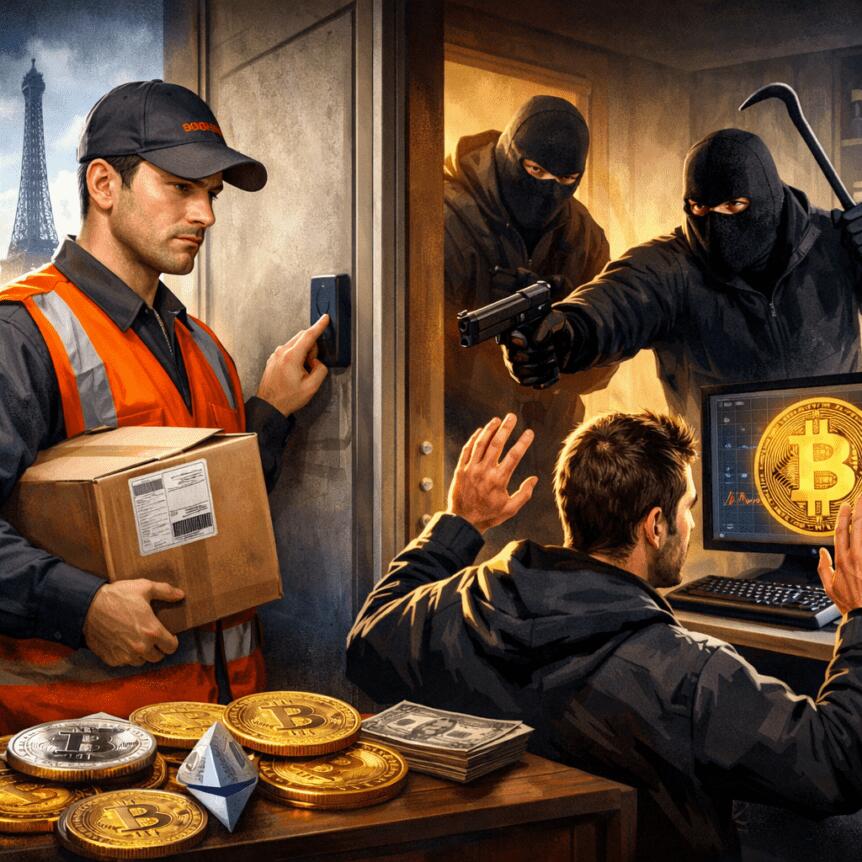
A man posing as a delivery driver allegedly extorted a crypto investor at gunpoint in a Montpellier suburb, in what local media described as the first crypto-motivated home invasion in the Hérault region. According to Actu.fr, the suspect gained access to the family home in Saint-Jean-de-Védas on April 11, pulled out a handgun and forced the parents and their children into a room before the father overpowered him during a struggle in which a shot was fired. No one was injured. French authorities from the Montpellier research section of the Gendarmerie later identified and arrested a 25-year-old man, who has been charged and remanded in custody while investigators determine whether he acted alone.
The incident comes amid a broader wave of “wrench” attacks, where criminals threaten or use violence to compel crypto holders to hand over funds or seed phrases, bypassing digital safeguards. France has emerged as a hotspot for these assaults, which have become a growing feature of crypto crime as investigated by local and national media. Actu.fr’s coverage is part of a wider pattern that has drawn attention to the way attackers target people based on their apparent crypto holdings and addresses.
Key takeaways
- The Saint-Jean-de-Védas incident marks what local outlets describe as the first crypto-motivated home invasion in the Hérault region, underscoring a new, physical danger vector for crypto holders.
- France features prominently in wrench-attack statistics, with thousands of incidents reported globally and France reported as the country with the highest number of cases in a given period, according to industry tallies.
- Criminals are increasingly suspected of leveraging leaked customer data and other information to build target lists of crypto users, intensifying the risk of home invasions and coercive theft.
- Security leaks at crypto companies—most notably Ledger’s exposure linked to its payment partner Global-e—have amplified concerns about attacker access to identities and physical addresses tied to crypto ownership.
- Policy and prevention responses are underway, with officials launching targeted programs for crypto holders and coordinating with interior authorities to harden defenses against wrench attacks.
Wrench attacks: France at the center of a growing threat
Across languages and borders, wrench attacks have become a focal point for crypto crime, shifting from purely digital exploits to violent, doorstep coercion. France has been singled out in multiple reports as experiencing a high concentration of such incidents. Industry tallies show a sharp rise in 2025, with global wrench-attack cases reaching 72 in a single year and rising by about 75% from the previous period, a trend that coincided with millions of dollars in confirmed losses. France was cited as recording the highest number of incidents for any single country in that period.
Observers have suggested that the attackers’ access to information—such as where crypto holders live or hold assets—may be facilitated by data leaks and the online footprint of victims. A French technology outlet noted that police and cybersecurity professionals increasingly suspect some gangs are compiling target lists from leaked customer data, creating a dangerous new axis of risk for individuals and families in the crypto space.
In the wake of these developments, French authorities have highlighted the shift in crypto crime—from cyber intrusions to physically coercive crime. At events like Paris Blockchain Week, officials signaled a multi-pronged response, including the launch of a prevention platform for crypto holders and ongoing collaboration with the Interior Ministry on broader protective measures.
From fake raids to ransom plots: a chilling pattern
France’s wrench-attack narrative has evolved to include a range of tactics, from fake police raids to outright kidnappings for ransom. In February, police arrested six suspects in a case involving the abduction of a magistrate and her mother as part of a plot to extort crypto from the magistrate’s partner, a digital-asset entrepreneur. A subsequent case in March detailed assailants posing as officers who forced a French couple to transfer nearly $1 million in Bitcoin under threat of violence. These episodes illustrate how attackers blend intimidation, disguise, and financial coercion to extract crypto assets directly from victims.
Authorities and industry observers stress that the risk landscape is changing. The emergence of physical intimidation as a bankable vector for crypto theft has spurred calls for enhanced security practices among holders, investors, and builders of crypto ecosystems alike. Measures discussed in policy circles include better public awareness, safer storage practices, and more robust protocols for safeguarding seed phrases and private keys.
Policy response and what readers should watch next
Officials are pursuing a coordinated set of responses to the wrench-attack wave. The government has signaled its intention to bolster protections for crypto holders, including preventive platforms and closer cooperation with the Interior Ministry. For investors and users, the developments underscore the importance of hardening personal security around private keys and seed data, adopting multi-signature and hardware-wallet approaches, and maintaining privacy hygiene to reduce exposure to targeted crimes.
Ongoing investigations will determine whether this week’s Montpellier incident was part of a wider network or a lone act, and how the evolving threat landscape will shape regulatory and security measures in the months ahead. As authorities work to close gaps between digital vulnerabilities and physical risk, readers should stay alert to updates from local police briefings and reputable crypto security advisories.
Looking forward, the conversation will likely center on how to translate policy and policing developments into practical protections for holders and businesses — including education campaigns, improved data-security standards for crypto firms, and tools that reduce the attractiveness of seed-phrase leakage to criminal actors.