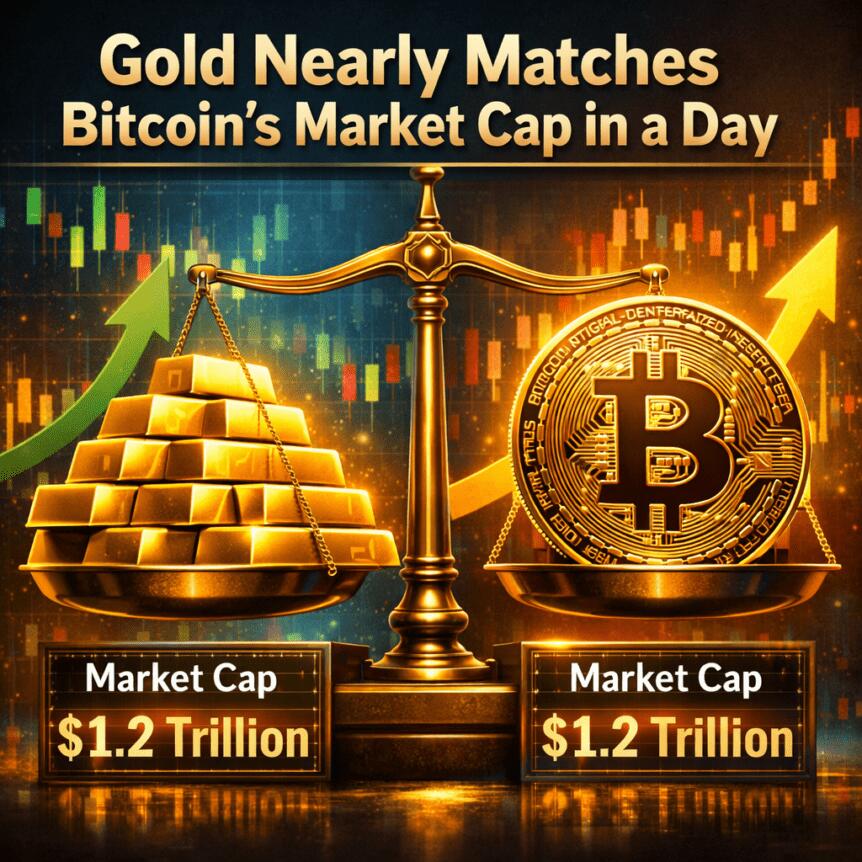
Bitcoin traded lower on Wednesday as gold advanced, lifting bullion sentiment and underscoring a widening divergence between precious metals and top cryptocurrencies. Gold surged past the $5,500 mark to a fresh record, pushing its market capitalization higher to roughly $38.77 trillion as some measures suggested the day’s gains approached the scale of Bitcoin’s own market footprint. Silver followed suit, rallying about 21.5% over the prior week to a valuation near $6.6 trillion, a move that widened its lead over Nvidia, the technology bellwether often cited as a proxy for market breadth.
The precious metals rally has been tied to a broad “debasement trade” thesis, with investors watching central-bank stimuli and fiscal expansion as drivers for hard assets. In contrast, Bitcoin has faced renewed headwinds since a crypto market crash in October that liquidated roughly $19 billion in positions, weighing on price performance in the near term. The narrative around Bitcoin’s role as a safe-haven asset has persisted, but the price action in the last several months has shown a more nuanced relationship with gold as macro dynamics evolve. The latest market moves come as investors weigh whether Bitcoin can sustain a rebound while traditional stores of value hold firm.
Before the October sell-off, sentiment had leaned toward the idea that Bitcoin and gold could function as countercyclical hedges during periods of fiscal irresponsibility and monetary expansion. That view has since been tested by a series of risk-off episodes that complicated the narrative for both assets. The five-year timeframe, in particular, highlights a notable performance gap: gold has risen about 173% over that span, while Bitcoin has climbed roughly 164%. This relative outperformance of gold over the medium term has shaped how investors view the “store of value” thesis for the crypto asset, even as many participants remain convinced of Bitcoin’s long-run potential.
Bitcoin could be undervalued, institutional investors say
In a development that injects a note of optimism into a cautious environment, a Coinbase survey released earlier this week found that 71% of 75 institutional investors believe Bitcoin is undervalued when priced in a range of roughly $85,000 to $95,000. The study also revealed a resilient commitment among institutions: about 80% indicated they would hold or add to their crypto positions in response to a hypothetical 10% decline in the broader crypto market, signaling conviction about Bitcoin’s longer-term role in diversified portfolios. The Coinbase data underscores a divergence between near-term price volatility and longer-term strategy among large players, suggesting that institutions continue to map an exposure path into an asset class they see as asymmetrically rewarding over time.
Bitcoin, gold sentiment on opposite ends of spectrum
The sentiment landscape around Bitcoin and gold has grown increasingly bifurcated. The Crypto Fear & Greed Index, which aggregates sentiment across the crypto market, sits at 26 out of 100 in the “Fear” zone, illustrating cautious positioning amid recent volatility. By contrast, sentiment around gold remains sharply positive, with the Fear & Greed Index for gold tracked by JM Bullion sitting at 99 out of 100, in the “Extreme Greed” territory. The divergence underlines how different risk premia and macro expectations are shaping flows into traditional safe-haven assets versus digital assets.
Key takeaways
- Gold’s daily surge propelled bullion to a fresh all‑time nominal high near $5,500 per ounce, lifting its overall market cap to about $38.77 trillion and signaling continued demand for hard assets amid expansionary policy expectations.
- Silver rallied about 21.5% over the past week, driving its market cap to around $6.6 trillion and widening the spread relative to Nvidia, the largest publicly traded company, illustrating a broad rotation into precious metals alongside equities.
- The five‑year comparison shows gold outperforming Bitcoin (173% vs 164%), reinforcing the narrative that traditional stores of value have maintained pricing discipline even as crypto markets wobble.
- A majority of institutional investors surveyed by Coinbase believe Bitcoin is undervalued in the $85k–$95k range, and roughly four in five would hold or add to crypto positions after a modest downturn, suggesting continued strategic interest from large capital allocators (EXCHANGE: COIN).
- The market exhibits a clear sentiment split: crypto fear remains elevated while gold shows extreme greed, highlighting divergent risk appetites and the different catalysts shaping each asset class.
Tickers mentioned: $BTC, $COIN, $NVDA
Sentiment: Neutral
Price impact: Negative. Bitcoin faced selling pressure in the session as gold led gains for risk-off assets, contrasting with the broad strength in bullion.
Trading idea (Not Financial Advice): Hold. The institutional appetite suggested by the Coinbase survey argues for a cautious, longer‑term exposure strategy rather than chasing near‑term moves.
Market context: The moves follow a period of macro uncertainty where gold’s role as a hedge remains pronounced even as crypto markets grapple with liquidity and sentiment shifts, potentially signaling a rotation in risk assets depending on policy developments and inflation expectations.
Why it matters
The divergence between gold and Bitcoin at a time of accelerating fiat expansion underscores a broader debate about the place of crypto within traditional portfolios. While bullion continues to attract demand as a trusted store of value in uncertain macro environments, Bitcoin’s trajectory suggests it remains tethered to risk sentiment and liquidity conditions that can amplify drawdowns in the short run. The Coinbase survey’s implication that institutions see intrinsic value in Bitcoin at higher price bands reinforces the notion that professional investors view the asset as a strategic, long‑horizon allocation rather than a quick trade for a bull run. This dynamic matters for users, builders, and investors who must calibrate expectations around volatility, liquidity, and eventual adoption curves for decentralized finance and digital asset custody infrastructures. The five‑year performance comparison—gold up 173% versus Bitcoin’s 164%—also highlights how traditional assets continue to command a premium in certain regimes, while crypto markets seek durable narrative pillars to sustain longer‑term upside.
As the ecosystem evolves, the ongoing dialogue around safe-haven attributes, institutional yields, and regulatory clarity will shape the next phase of asset allocation. The tension between the proven resilience of gold and the still‑uncertain but potentially transformative role of Bitcoin means markets could witness continued bifurcation in sentiment and performance across assets. For traders and investors, this environment argues for disciplined risk management, diversified exposure, and a clear view of each asset’s catalysts—whether policy shifts, ETF developments, or macro surprise events—that could tilt the balance in either direction.
What to watch next
- Next readings on Bitcoin’s price path in relation to macro moves and gold’s continued run; watch any shifts in risk sentiment over the coming days.
- Updates from institutional platforms and future surveys that test whether the undervaluation thesis for Bitcoin holds as macro conditions evolve.
- Regulatory developments and ETF flows that could reshape liquidity and price discovery in major crypto markets.
- Any corroborating data from market trackers and sentiment indices that might signal a shift in the gold–Bitcoin dynamic.
Sources & verification
- Gold price and market-cap data, including the $38.77 trillion figure and the all‑time high, as cited in market coverage referencing bullion dynamics and cross-asset comparisons (source material linked in the article).
- Silver rally of 21.5% and the $6.6 trillion market cap reference, with comparison to Nvidia’s market leadership in public markets (source material linked in the article).
- Coinbase institutional survey results showing 71% undervaluation view for Bitcoin in the $85k–$95k band and 80% readiness to hold or add on declines (https://cointelegraph.com/news/institutional-investors-say-bitcoin-undervalued-coinbase-survey).
- Crypto Fear & Greed Index readings around 26 (Fear) and JM Bullion’s Extreme Greed reading for gold (https://alternative.me/crypto/fear-and-greed-index/#google_vignette and https://www.jmbullion.com/fear-greed-index).
- Historical context on the October crypto crash and subsequent market dynamics (Cointelegraph articles linked in the narrative).
Market reaction and key details
Bitcoin’s latest price action comes amid a tug of war between crypto risk appetite and the enduring appeal of real‑money assets. While gold breached the psychologically important threshold of $5,500 per ounce, lifting its market cap toward historic highs, Bitcoin moved lower in the session, highlighting a shift in liquidity priorities as market participants reassess risk premia in a landscape shaped by central‑bank policy expectations and fiscal stimulus narratives. The juxtaposition of these trajectories is not merely a snapshot of one day’s moves; it reflects evolving investor judgments about what constitutes a reliable store of value, how much inflation hedging is discounted into asset prices, and where capital should flow when macro data and policy signals diverge.
Across the broader market, a 21.5% weekly surge in silver underlines the ongoing rotation into traditional hard assets, even as equities and technology stocks navigate their own cycles. The divergence from Nvidia, which remains symbolic of the broader tech rally’s health and risk tolerance, adds texture to the market’s instinct that not all hedges or inflation plays move in lockstep. For institutional participants, the Coinbase survey’s takeaway—namely, that a sizable majority view Bitcoin as undervalued in a high‑price band and remain inclined to hold or accumulate after a downturn—suggests a patient stance that could translate into steadier demand for larger crypto allocations over time.
In terms of sentiment, cryptoFear remains a factor, with a score in the fear zone, while gold’s sentiment gauges remain in extreme greed territory. This split reflects a market that still distinguishes between the distinct narratives driving each asset class: a crypto market seeking structural adoption and liquidity expansion, and a gold market riding a long‑running inflation/monetary policy thesis. The net effect is a market that could experience continued bifurcation, enabling cocooned pockets of opportunity for traders while investors maintain diversified exposure to both digital and physical stores of value.