HIVE Digital targets $100 million in private funding for data center and GPU compute
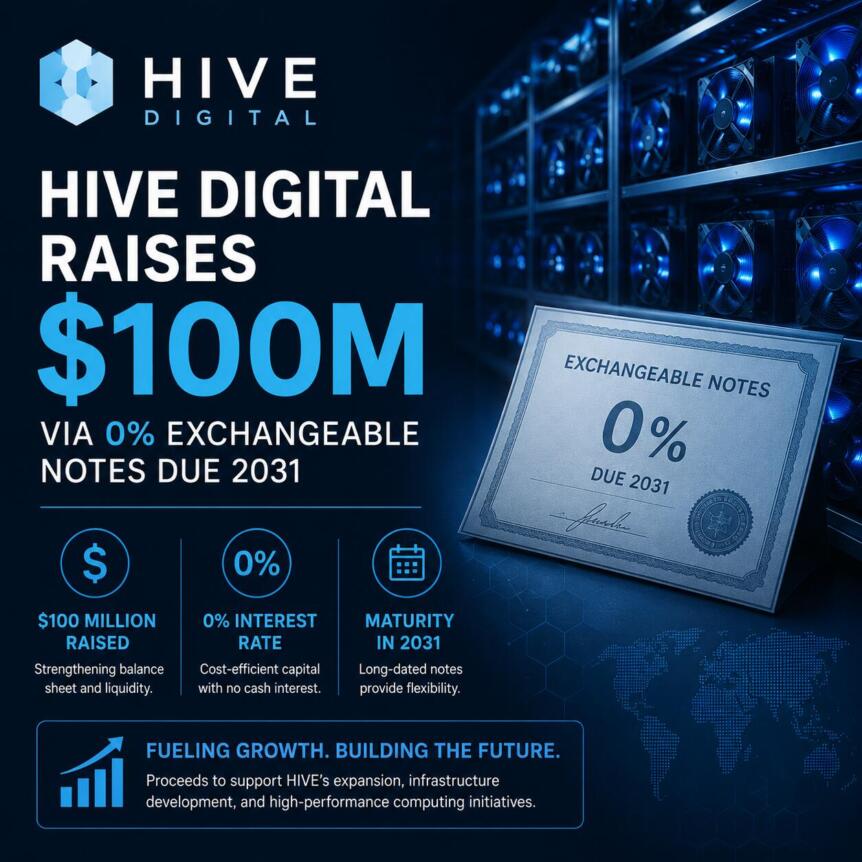
HIVE Digital Technologies, a crypto and high-performance computing infrastructure operator, said it plans to raise US$100 million through a private offering of 0% exchangeable senior notes due 2031. The company’s issuer, HIVE Bermuda 2026 Ltd., will offer the notes to qualified institutional buyers under Rule 144A, subject to market conditions.
The announcement comes as demand for additional compute capacity continues to intersect with digital asset infrastructure and AI-related workloads. For investors, the deal structure highlights how some crypto-linked infrastructure firms are using capital markets to fund large-scale data center builds and GPU-centric expansions while linking certain payoff mechanics to their equity.
Terms of the planned private offering
According to the company, the notes will have aggregate principal amount of US$100 million in the initial offering. It also expects the initial purchasers to be granted an option, exercisable within 13 days from and including the date the notes are first issued, to buy an additional up to US$15 million of notes.
The notes are described as “exchangeable under certain conditions.” The issuer intends to settle any exchange by paying cash, delivering common shares, or a combination of both, depending on the issuer’s election. The initial exchange rate and related terms will be set at the time of pricing.
The notes are scheduled for maturity in 2031 and the company said they will carry no regular interest and that the principal amount will not accrete. In practice, that zero-coupon feature means investors are not receiving periodic coupon payments, and the economics are instead concentrated in the exchange mechanics and the difference between issue pricing and maturity value, as determined at pricing.
HIVE said the notes will be general unsecured obligations of the issuer and that HIVE will provide a senior unsecured guarantee.
Where proceeds are expected to go
HIVE stated it intends to use net proceeds to support capital deployment through its operating subsidiaries. The company expects the funds may be used for general corporate purposes, capital investment, and data center development. It specifically referenced capital investment including the purchase of graphics processing units as part of the expansion plan.
The announcement also notes that the company intends to fund “capped call transactions” using cash on hand. It further indicated that a portion of the net proceeds could be used to reimburse HIVE for the cost of those transactions.
If the initial purchasers exercise the option to buy additional notes, HIVE said it would apply the additional proceeds in a similar manner, including for data center development and GPU-related capital investment, and may enter into additional capped call transactions.
Exchange-linked hedging and potential market effects
To manage dilution and cash-outcome risks associated with exchangeable securities, HIVE expects to enter into privately negotiated cash-settled capped call transactions with financial institutions. These transactions are intended to cover, subject to anti-dilution adjustments, the number of common shares that would underlie the notes if the option is not exercised.
The company said the capped call program is generally designed to reduce potential economic dilution upon exchange and to offset certain cash payments in excess of principal, subject to a cap.
HIVE also outlined a common feature of such financing structures: the counterparties may purchase shares and/or enter into derivatives around the pricing date and during subsequent periods, including any observation period related to exchanges. The company warned that this hedging activity could increase, or reduce the size of any decrease in, the market price of HIVE’s common shares or the notes, and could affect exchange outcomes for noteholders.
Why exchangeable notes matter for crypto and AI infrastructure companies
Infrastructure-focused crypto firms increasingly face a funding gap between rapid build-out cycles and the longer payback periods typical of data center investment. Traditional bank lending may not always match the capital intensity of power, cooling, and hardware procurement, particularly when expansion plans involve GPU fleets linked to AI workloads.
Exchangeable notes, with equity-linked settlement features, can be structured to shift part of the risk profile away from continuous cash interest payments, while still tying part of investor returns to equity price behavior. The zero-coupon and non-accreting principal structure can make headline interest expense less apparent, though investors still price in maturity economics and exchange parameters.
For public-market investors, a key near-term focus is how the capped call program and any counterparty hedging activity might influence share trading dynamics around pricing and potential exchange events later on. For equity holders, the long-term question is whether the data center and GPU capex financed through these notes translates into measurable operating growth.
HIVE did not provide timing beyond the expectation of a private offering and the 13-day option window. The company also said it is relying on an exemption under TSX rules for eligible interlisted issuers, and that the securities have not been registered under U.S. securities laws.
What to watch next
Investors will likely look for additional details at pricing, including the issue price, initial exchange rate, and final capped call terms. The company’s stated use of proceeds, particularly around data center development and GPU-related capital investment, will also be a central metric to monitor as it transitions from funding approvals into execution.
As with other exchangeable and convertible-adjacent instruments, the structure can affect both bondholder outcomes and equity dilution expectations, making the market reaction and subsequent trading behavior important signals for how investors view HIVE’s infrastructure roadmap.