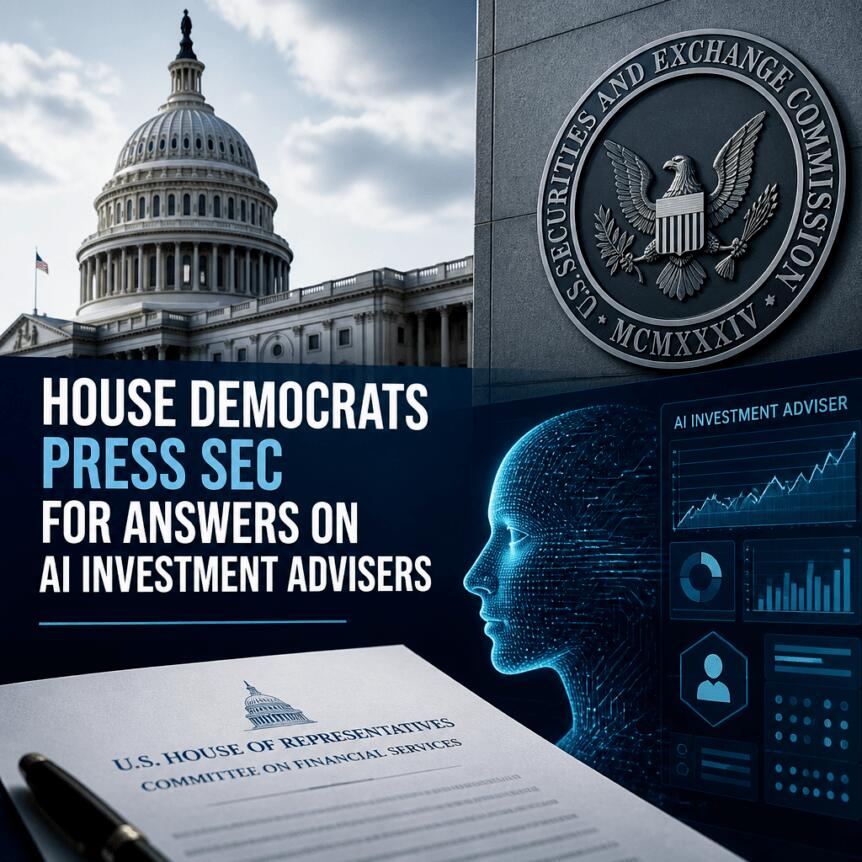
Democratic members of the US House have urged the Securities and Exchange Commission (SEC) to clarify how it regulates “agentic” AI trading tools sold to retail investors, arguing that current oversight leaves major gaps in investor protection and accountability.
In a letter dated Tuesday to SEC Chair Paul Atkins, Representatives led by Bill Foster and Brad Sherman warned that platforms offering AI trading agents raise questions ranging from broker-dealer duties to market integrity—especially as these tools may eventually expand beyond narrow use cases into additional financial products.
Key takeaways
- House Democrats asked the SEC for written answers on how it is overseeing AI trading agents used by retail investors.
- The lawmakers argue agentic tools can make “consequential investment decisions” while operating largely outside the securities regulatory framework.
- They highlighted disclosures that brokers may not control or audit AI outputs, calling this uncertainty for legal responsibility.
- The letter requests guidance on when an AI agent should register and what “guardrails or analysis” the SEC uses.
- Responses are due by July 31, alongside questions about whether the SEC has sufficient authority or needs Congress to act.
Why lawmakers are challenging the SEC’s approach
According to the letter cited by Foster’s office, the push is aimed at how regulators treat AI systems that operate with a degree of autonomy—presented to users as trading help rather than fully manual tools. The lawmakers said these platforms are increasingly popular, but they may not fit cleanly into existing frameworks meant to govern advice, suitability, and accountability.
Foster and Sherman described a mismatch between the scale of impact and the level of oversight. While the trading is “initially” expected to be limited, they warned there are signs agentic trading could broaden into markets and products such as options, cryptocurrency, event contracts, and futures.
That expansion matters because each of those product categories has its own regulatory and supervisory expectations. If AI agents begin advising or executing strategies across different instrument types, lawmakers are effectively asking whether SEC rules—and the SEC’s enforcement posture—will keep pace with changing functionality and risk.
AI trading agents, retail guidance, and the accountability problem
The letter also emphasizes the accountability challenge created by how some platforms market AI trading agents. In particular, lawmakers pointed to disclosures accompanying such tools, saying they indicate brokerage platforms can’t guarantee the accuracy or suitability of AI-generated outputs and may not control, monitor, or audit the agents.
Those disclaimers, the lawmakers wrote, “raise urgent questions” about how agentic trading tools are regulated and create legal uncertainty among brokers, AI developers, and retail investors. In practical terms, that uncertainty can make it harder to determine who is responsible if an AI-driven strategy harms a user—an issue that becomes more acute as these tools become integrated into mainstream apps.
Crypto users have shown early demand for similar “always-on” assistance, and the same idea has been spreading to retail traders in traditional equities who want help with strategy. The letter uses that momentum as context for why regulators should address guardrails now rather than waiting for broader adoption.
Coinbase as an example of mainstreaming agentic advice
The letter’s concerns land amid a wave of platform activity. Earlier this month, Coinbase introduced an AI agent integrated into its app, according to coverage from Cointelegraph. Coinbase described the tool as a Securities and Exchange Commission- and Commodity Futures Trading Commission-registered financial adviser designed to provide trade guidance.
That development highlights why lawmakers are pressing the SEC: if large consumer-facing platforms treat AI agents as adviser-like tools, the regulatory expectations typically associated with broker-dealers and investment advisers may need to apply in a clearer, more enforceable way—especially when agentic systems are positioned as operating beyond simple informational chat.
In the lawmakers’ framing, the core issue isn’t whether these tools can be beneficial—it is whether they are sufficiently supervised and governed when they are capable of driving decisions on behalf of retail investors.
What the SEC is being asked to answer by July 31
The letter requests written responses to a list of questions by July 31. While the full set of questions is not reproduced in the article, the demands highlighted include:
- What guardrails or analysis the SEC uses when evaluating AI trading agents.
- When an AI agent would need to register, and under what conditions.
- The extent of the SEC’s consultations with platforms regarding AI-enabled advisory and trading tools.
- Whether the SEC has the authority it needs to address the risks of AI trading agents—or whether congressional action would be required.
By setting deadlines and asking for written clarity, the lawmakers appear to be seeking more than general statements. They want a concrete explanation of how existing regulatory frameworks should apply to new forms of automated or semi-autonomous trading assistance.
Broader implications for crypto and other markets
Although the letter is addressed to the SEC, its warnings explicitly mention cryptocurrency and other instruments—suggesting the lawmakers view agentic AI trading as a cross-market issue rather than a narrow equities phenomenon.
If agentic systems gain traction across asset classes, readers should expect regulator attention to increasingly focus on whether AI tools are making decisions that look like advice, how suitability and disclosures are handled, and who bears responsibility when outputs go wrong. The SEC’s answers—due by July 31—could shape how platforms design AI agents, how they disclose limitations, and how compliance teams frame broker-dealer obligations.
For now, the key thing to watch is whether the SEC provides specific, operational guidance on registration, oversight, and accountability for agentic trading tools—and whether that guidance narrows the current uncertainty around responsibility among brokers, AI developers, and retail users.