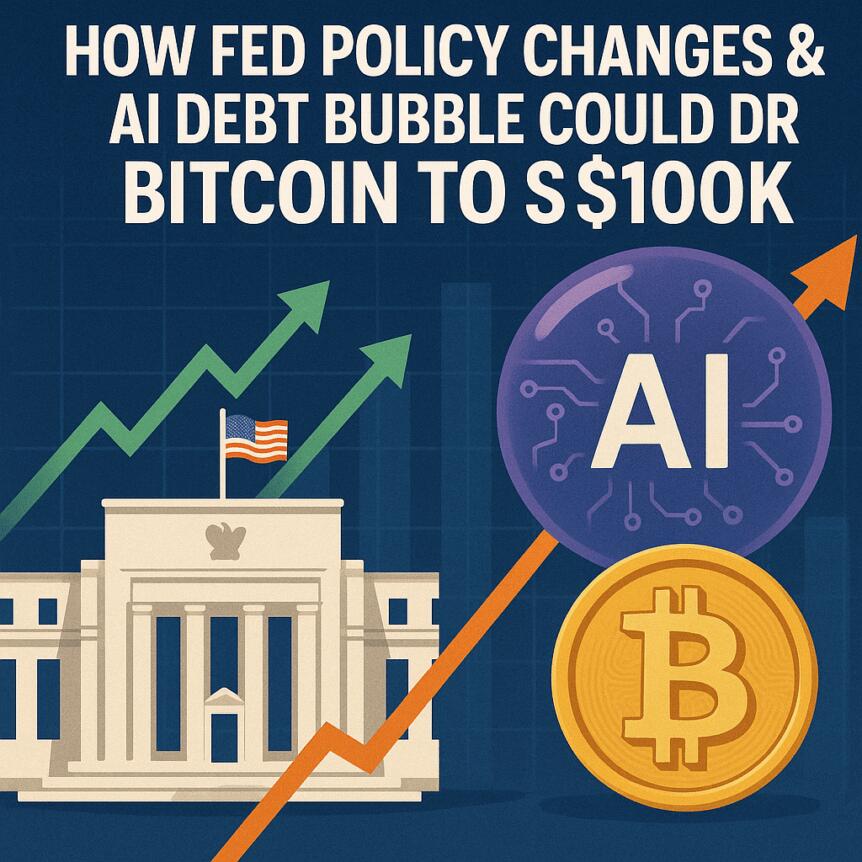
Federal Reserve Policy Shift Sparks Rally in Bitcoin Amid Rising Credit Risks
The U.S. Federal Reserve’s pivot away from quantitative tightening and the prospect of interest rate cuts are fostering increased liquidity in financial markets. Combined with mounting systemic risks in the tech sector, these developments are positioning Bitcoin for potential bullish momentum, possibly pushing it toward the important $100,000 level before year-end.
Key Takeaways
- The Federal Reserve’s shift from quantitative tightening is increasing market liquidity, reducing the appeal of fixed-income assets.
- Rising credit protection costs for major tech corporations, such as Oracle, signal growing financial stress, encouraging investors to consider alternative assets like Bitcoin.
- Market expectations of rate cuts are reinforced by the Fed’s recent balance sheet expansion and easing of liquidity drains.
- Concerns over high corporate debt, especially in the tech sector, are prompting a rotation into scarce assets such as cryptocurrencies.
Tickers mentioned: Oracle (NYSE: ORCL)
Sentiment: Bullish
Price impact: Positive. The combination of easing monetary policy and increasing systemic risks supports a bullish outlook for Bitcoin.
Market context: The convergence of monetary easing and rising credit risks is creating a fertile environment for Bitcoin to serve as a hedge and alternative asset class.
Market Dynamics and Broader Context
Bitcoin experienced a 4% decline last Friday to a low of $88,140, marking a 19% loss since November. Meanwhile, the S&P 500 remains within less than 1% of its all-time highs. This divergence suggests that Bitcoin may soon stage a strong rebound, driven by a significant shift in federal monetary policy and escalating credit market risks.
The Federal Reserve recently ended its balance sheet contraction—part of its quantitative tightening strategy—halting the withdrawal of liquidity from the system. Over the past six months, the balance sheet shrank by approximately $136 billion, but the recent pause is expected to reverse this trend. Market expectations of an imminent rate cut are high, with the CME FedWatch Tool indicating an 87% probability of lowering rates at the upcoming Federal Reserve meeting and full pricing of three reductions by September 2026.
Lower interest rates and expanding systemic liquidity have diminished the attractiveness of fixed-income investments. Bloomberg reports a record $8 trillion in U.S. money market funds, reflecting a shift away from bonds. This trend coincides with sharp increases in credit default swap premiums for some major tech firms, such as Oracle, which has $105 billion of debt, including leases. The cost to hedge Oracle’s debt against default has surged to levels unseen since 2009, illustrating rising financial stress in the sector.
According to reports, Oracle is betting heavily on revenue streams from OpenAI, seeking hundreds of billions of dollars, which raises concerns about overwhelming debt supply and market stability. Market strategists from institutions like Bank of America warn that steady interest rates could prolong economic slowdown risks, leading investors to view Bitcoin’s scarcity as a safe haven amidst deteriorating credit conditions.
In sum, the confluence of easing monetary policy, rising systemic risks, and cautious investor sentiment creates a strong foundation for Bitcoin’s upward trajectory, making a run toward the $100,000 threshold a real possibility in the coming months.