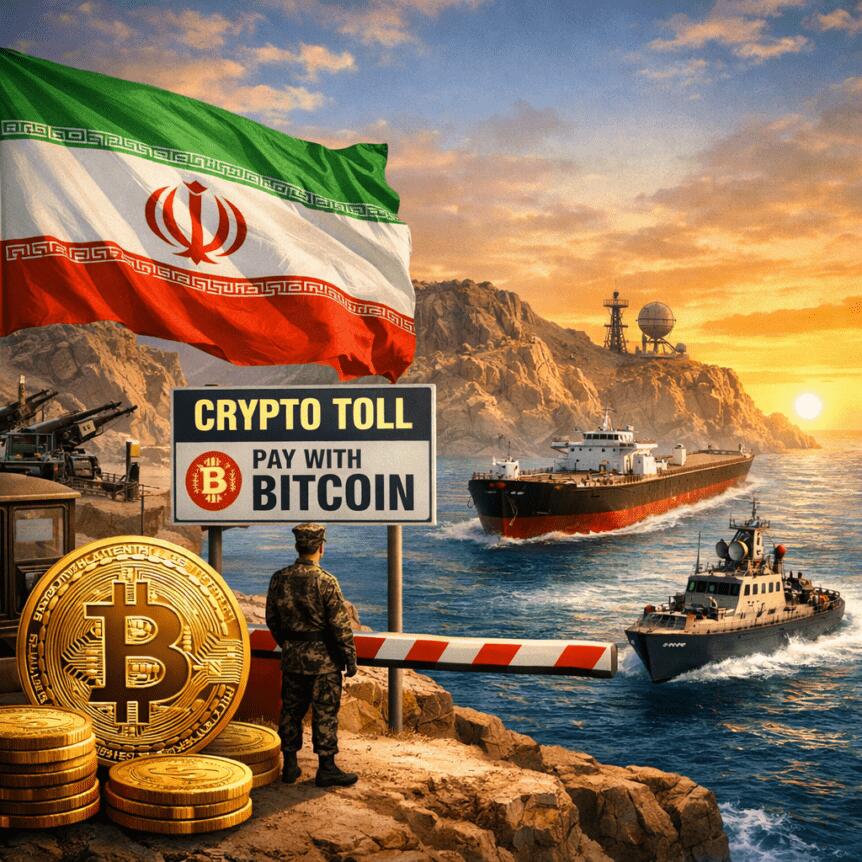
A Financial Times report this week outlined a provocative idea from Iran’s trade sector: charge ships transiting the Strait of Hormuz a tariff paid in Bitcoin. The plan would let empty oil tankers pass without charges, but other vessels would owe a levy of $1 per barrel, settled in BTC, over a two-week window and after an on-waterway assessment to verify the cargo isn’t weapons-related, according to Hamid Hosseini, spokesperson for Iran’s Oil, Gas and Petrochemical Products Exporters’ Union.
The story arrives as geopolitical tensions flare and markets react. On X (Truth Social), former U.S. President Donald Trump asserted that a two-week ceasefire with Iran would include the “complete, immediate, and safe opening of the Strait of Hormuz,” a claim that Iran’s state media later echoed by reporting a 10-point plan delivered to Washington as a precondition for any deal, including the continued control of the waterway and sanctions relief. The exact terms of any accord remain fluid, but the FT report highlights how crypto-enabled mechanisms could become part of broader political and economic signaling in a high-stakes standoff.
Geopolitical friction has already disrupted regional shipping and energy flows. After intensified U.S.–Israel–led strikes against Iranian targets in February and March, the Strait of Hormuz has seen shipments constrained and tensions rise, contributing to a rally in crude oil that briefly pushed prices above $100 per barrel. In crypto markets, Bitcoin likewise moved during the period of heightened volatility, trading in a wide range as traders priced in the risk backdrop.
Beyond current events, the narrative builds on prior evidence that Iran has leaned on crypto rails to navigate sanctions and currency pressures. Elliptic reported in January that Iran’s central bank had acquired roughly half a billion dollars’ worth of Tether USDt, a signal of the rial’s volatility driving demand for dollar-pegged stablecoins. Separately, TRM Labs has tracked large-scale crypto flows linked to Iran, estimating about $3.7 billion in total crypto activity from January through July 2025, a figure cited in coverage surrounding Iran’s evolving crypto footprint. For more context, see the reporting that referenced TRM Labs, and the Elliptic analysis linked to Iran’s stablecoin acquisitions.
Key takeaways
- Iran reportedly weighs a Bitcoin-based tariff for Strait of Hormuz transit, charging $1 per barrel for non-empty cargo while allowing empty tankers to pass without charges.
- Payments would be prompted within a two-week window, with vessels assessed individually to confirm cargo legitimacy and weapon-free status, per the union spokesperson cited by the Financial Times.
- The proposal comes amid ongoing geopolitical flare-ups and energy-market volatility, set against a backdrop of broader sanctions dynamics and potential relief talks.
- Longer-term context shows Iran’s crypto activity as part of sanctions navigation: Elliptic notes substantial USDT holdings, and TRM Labs records substantial inflows and flows related to Iranian crypto use (Jan–Jul 2025).
- Readers should watch how policymakers, shipping operators, and crypto market participants respond to the FT report and any subsequent official statements or regulatory clarifications.
Hormuz toll: a crypto twist on maritime economics
The Financial Times’ account centers on a regulatory pivot that would blend transport pricing with digital asset settlements. If implemented, the BTC-based toll model would apply a simple per-barrel tariff to shipments crossing the Hormuz route, aiming to consolidate revenue amid sanctions pressures and to test the practicality of crypto-as-fee mechanics in critical chokepoints. The proposal specifies that the tariff would be collected in Bitcoin, with the logistics package requiring ships to settle payments quickly—“a few seconds”—to minimize traceability and potential sanction enforcement risk, according to Hosseini’s description of the process observed by the union.
The plan’s two-week horizon aligns with a provisional, high-visibility window rather than a long-term price signal. Even as it surfaces as a potential policy experiment, the reporting underscores how crypto rails could be positioned as geopolitical tools—whether for financing logistics, signaling political intent, or pressuring opponents through new payment frictions. The FT piece stops short of confirming that such a policy will be adopted, but it illustrates the kinds of mechanisms policymakers are weighing in an era of sanctions and blockade-era finance.
Geopolitics and markets: energy, sanctions, and crypto co-movement
Market dynamics over the past several months have shown that energy disruptions and crypto volatility can move in tandem, albeit imperfectly. The period of heightened tension around Hormuz coincided with a spike in oil prices and a broad oscillation in Bitcoin’s price, reflecting traders’ attempts to navigate the intersection of real-world risk and on-chain liquidity. The possibility of crypto-enabled tolls adds a new dimension: it could introduce a measurable crypto flow that tracks shipping activity in a region that shapes global oil pricing and geopolitical risk appetites.
The Trump assertion about a potential ceasefire and Hormuz opening, though unconfirmed and contested in official channels, amplifies the sense that the Iran-US standoff remains a live, strategic story with tangible financial undercurrents. If a BTC-payment framework for Hormuz passes from concept to policy, it could become a focal point for how Western sanctions policy, shipping finance, and crypto settlements intersect in real-world commerce. Observers will be watching not only for official confirmations but also for how such a mechanism would be audited, taxed, and regulated across different jurisdictions.
Iran’s crypto footprint: sanctions, stability, and opacity
The broader crypto-adoption narrative in Iran isn’t new, but recent data points underscore its relevance to policy and markets. Elliptic’s analysis in early 2025 highlighted Iran’s sizable holdings of USDt, pointing to a deliberate use of stablecoins to stabilize liquidity amid currency pressures. Meanwhile, TRM Labs documented substantial Iranian crypto activity totaling several billions of dollars over the first half of the year, illustrating the scale at which digital assets flowed through or around conventional financial channels. These patterns don’t guarantee a specific policy outcome in Hormuz, but they do suggest that crypto channels are considered—from a fiscal and strategic standpoint—by actors navigating sanctions, currency depreciation, and access to global markets.
For investors, traders, and builders, the episode reinforces a few practical takeaways. First, crypto-based payments and settlement methods can enter political calculations in ways that affect cross-border logistics and risk premia. Second, the on-chain footprint of sanctioned economies remains an area of close scrutiny for analysts and enforcement agencies, with real implications for compliance, monitoring technology, and liquidity flows. Finally, the linkage between energy markets and crypto markets—with prices, volatility, and liquidity all in play—continues to shape risk management and hedging considerations for market participants.
As the situation unfolds, readers should watch for clearer official statements about any Hormuz-related policy and for data from shipping groups and energy markets that could either validate or debunk the feasibility of a BTC settlement regime. The evolving narrative also invites questions about international law, the enforceability of crypto-based tariffs, and how such experiments would interact with existing sanctions regimes and financial sanctions regimes across multiple jurisdictions.
The broader takeaway is that crypto assets are increasingly embedded in geopolitics, not just as speculative instruments but as functional components of policy signaling, logistics, and revenue streams. What comes next will likely hinge on how quickly authorities weigh in, how ship operators adapt to new payment rails, and whether any pilot evolves into a enforceable policy on Hormuz traffic.