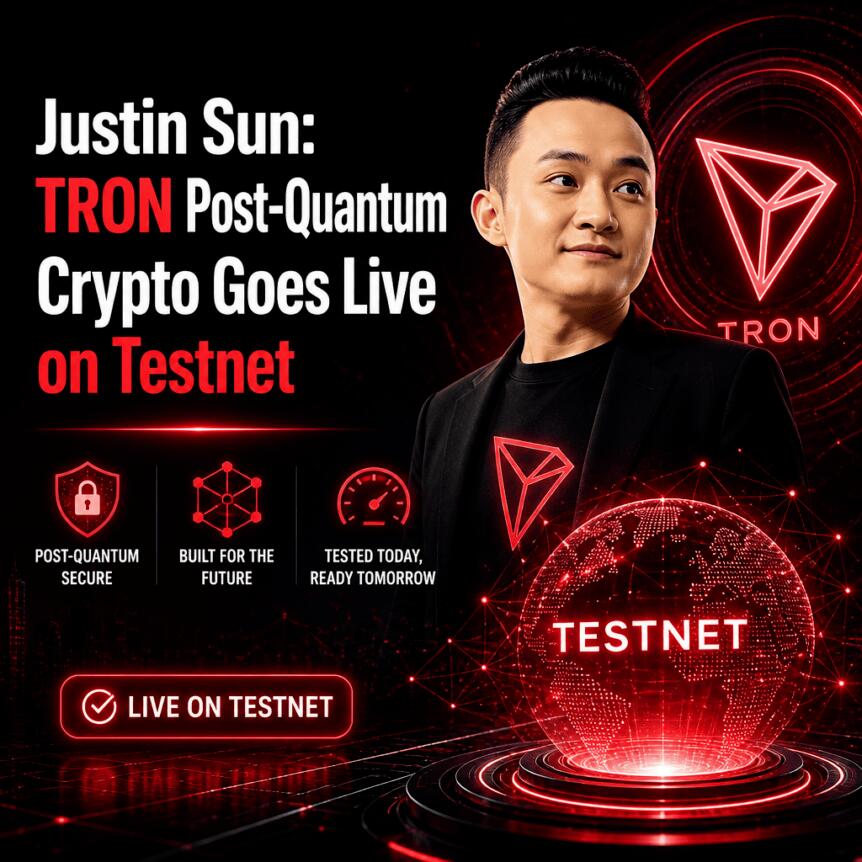
Tron founder Justin Sun says the network’s post-quantum cryptography work is already running on testnet, positioning TRON to move toward “quantum resistance” ahead of a looming industry milestone commonly referred to as “Q-Day.” Sun made the remarks in a Saturday post on X, adding that the team is monitoring progress in quantum computing and AI and is prepared to bring the technology to mainnet when ready.
The announcement arrives as other parts of the crypto ecosystem explore how to protect wallets and key material against a future where today’s encryption—particularly elliptic-curve cryptography used across major blockchains—could be undermined by sufficiently powerful quantum computers. In parallel, a security-focused proposal from AmericanFortress aims to strengthen wallet security against quantum threats without forcing users to move funds or change wallet addresses.
Key takeaways
- Justin Sun says TRON’s post-quantum cryptography is live on testnet, with mainnet deployment described as imminent “at any time” depending on readiness.
- Sun links TRON’s plan to being quantum-resistant before “Q-Day,” a term for when quantum capability may challenge current security standards.
- AmericanFortress’ approach, as reported on July 28, focuses on quantum-safe wallet protection while keeping existing wallet addresses unchanged.
- The AmericanFortress proposal is published as a technical paper on the Cryptography ePrint Archive, though it has not been peer-reviewed.
- Multiple ecosystem efforts—from Bitcoin-focused research funding to Ethereum and Algorand roadmaps—are converging on the need to upgrade cryptographic foundations.
TRON’s post-quantum cryptography enters testnet
Sun’s update frames TRON’s post-quantum cryptography effort as more than research: he said it is “now live on testnet.” In the same X post, he emphasized that the company is “closely tracking progress in quantum computing and AI” and that it is ready to deploy quantum resistance to mainnet when the conditions for security and engineering readiness are met.
For users, the main significance is the practical focus on protecting assets. Sun said TRON is committed to keeping user assets secure and suggested the chain could become one of the few major networks that is quantum-resistant before “Q-Day.” While “Q-Day” is not a precise event date in Sun’s message, the concept is widely used in crypto to describe a point where quantum systems may become capable of breaking the cryptographic assumptions underlying current public-key schemes.
The testnet step matters because it implies implementation work is underway beyond theoretical design. However, readers should still watch for details on what exactly is being tested (for example, how key operations are handled, how migration is planned, and what compatibility guarantees will look like for wallets and exchanges) as TRON moves from testnet to mainnet.
AmericanFortress proposes quantum-safe wallet protection without moving funds
Alongside Tron’s timeline, AmericanFortress—an organization focused on blockchain security—has outlined a cryptographic plan aimed at defending crypto wallets against future quantum attacks without requiring users to move funds, rotate keys, or change wallet addresses.
According to reporting by Cointelegraph on July 28, AmericanFortress’ method differs from many proposed post-quantum strategies by maintaining the use of existing wallet addresses while adding quantum-safe protection. The practical benefit of such an approach is obvious for everyday wallet holders and infrastructure providers: address stability could reduce operational overhead and avoid forced migration cycles that can complicate custody, accounting, and user support.
Still, the real-world feasibility of any “no address change” design depends on technical constraints—how protection is applied, what assumptions are made, and how it interacts with existing signing and verification processes. The proposal being published provides a path for developers to scrutinize those assumptions.
A technical paper on ePrint, not peer-reviewed
AmericanFortress published its proposal in a technical paper on the Cryptography ePrint Archive. The ePrint listing is available on the IACR archive, but the article notes that it had not yet been peer-reviewed at the time of publication.
For the crypto community, peer review is often treated as a quality checkpoint—especially for cryptographic proposals that could influence wallet security designs. Even without peer review, releasing a detailed draft gives researchers and engineers something concrete to test, analyze, and potentially build upon. As TRON and other networks progress, such proposals may help shape what “quantum resistance” looks like at the wallet level, not just at the chain level.
Why post-quantum efforts are accelerating across crypto
The push toward post-quantum cryptography has intensified because sufficiently powerful quantum computers may eventually threaten elliptic-curve cryptography. Many blockchain systems—Bitcoin, Ethereum, and numerous others—rely on elliptic-curve schemes to secure transactions and public-key identities. If quantum capabilities reach a threshold that enables effective decryption or key recovery attacks against these schemes, security assumptions would need to be updated.
The urgency has been reflected in multiple parallel initiatives mentioned in earlier reporting. Earlier this year, a Strategy-led consortium pledged $15 million to fund Bitcoin quantum security research. Separately, the Ethereum Foundation published a proposal outlining how accounts could be migrated to quantum-resistant cryptography. Algorand has also outlined plans to introduce quantum-resistant accounts by 2027.
Together, these efforts indicate that the industry is not simply studying quantum risk in the abstract; it’s trying to work out upgrade paths that can be deployed in production systems. The challenge is that migration in blockchain ecosystems is rarely straightforward: cryptographic changes must preserve usability, prevent fund loss, and remain compatible with existing wallets, exchanges, and contract ecosystems.
TRON’s announcement of a testnet implementation and AmericanFortress’ wallet-focused proposal highlight different angles of the same problem. Network-level resilience and user-level wallet protection may ultimately need to align, and investors and builders should pay attention to whether solutions emphasize migration-free user experience, compatibility with existing address formats, or robust replacement of cryptographic primitives.
Looking ahead, the most important signals to monitor are how quickly post-quantum features move from testnet drafts to mainnet-compatible releases, and what practical guarantees are offered for wallet behavior, custody operations, and signing verification—especially for approaches that promise to keep addresses unchanged. With quantum timelines still uncertain, the pace and clarity of implementation details will likely matter as much as the headline goal of being ready before “Q-Day.”