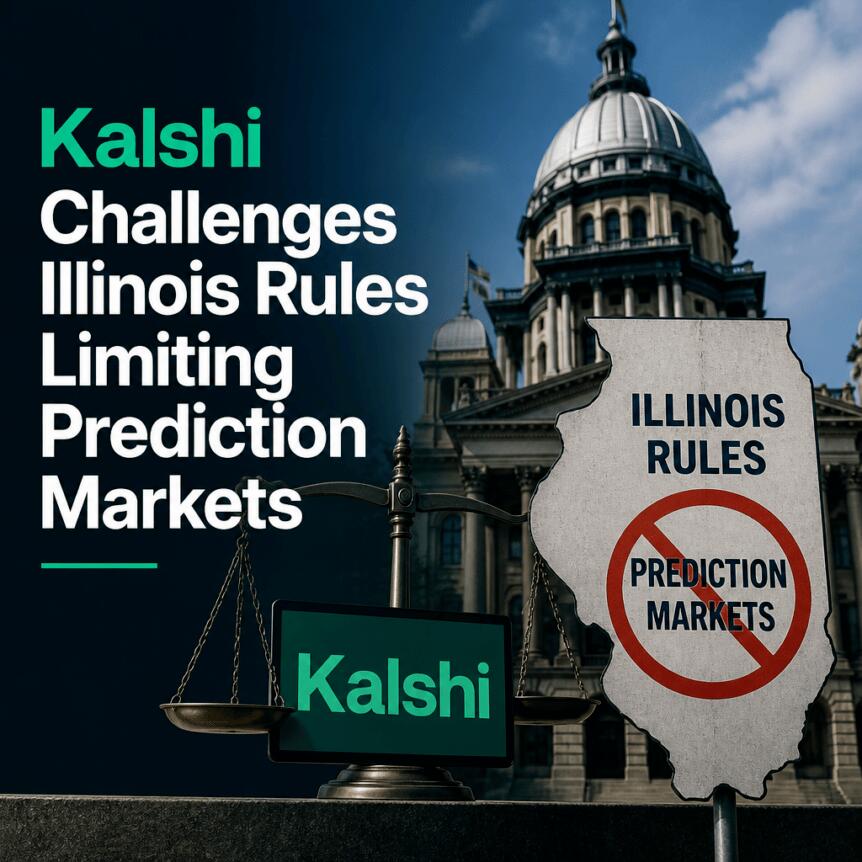
Prediction markets firm Kalshi has filed a lawsuit against Illinois state officials, arguing that newly enacted legislation in the state “expressly bans sports event contracts” on its platform unless Kalshi complies with a licensing regime. The company says the law conflicts with federal oversight of prediction markets and could force it to make operational changes that would be costly and ultimately unrecoverable.
In a Tuesday filing in the U.S. District Court for the Northern District of Illinois, Kalshi named Illinois Governor JB Pritzker, Attorney General Kwame Raoul, and other officials connected to the state’s gaming board. The complaint asserts that the measure signed last week—Illinois Senate Bill 3019—improperly intrudes on authority Kalshi says belongs to the U.S. Commodity Futures Trading Commission (CFTC) under federal law. Kalshi is seeking to block the statute from taking effect on July 1.
Key takeaways
- Kalshi alleges Illinois Senate Bill 3019 conflicts with federal CFTC authority over prediction markets, including event contracts.
- The company argues compliance would force it to stop offering sports event contracts in Illinois or face potentially unlawful enforcement.
- Kalshi claims the July 1 start date could cause “irreparable harm,” including non-recoverable technical and compliance costs.
- The case adds to an ongoing federal-versus-state jurisdiction dispute over prediction markets and whether they fall under commodities rules.
- Legal experts cited in earlier coverage say these fights may ultimately reach the U.S. Supreme Court.
Illinois law brings prediction markets under sports betting rules
Illinois’ SB 3019 was signed as part of the state budget package for fiscal year 2027, according to earlier reporting by Cointelegraph. Among other provisions, the package included a 0.2% tax on crypto transactions, which drew significant criticism from parts of the industry.
The central issue for Kalshi is how SB 3019 changes the state’s definition of an “exchange wager.” The bill amends that definition to include “an agreement, contract, transaction, or swap” that is offered, traded, or executed on a prediction market tied to a sporting contest or event. Kalshi argues this effectively subjects prediction market companies to the same kind of regulatory framework applied to sports betting operators.
In its complaint, Kalshi contends that the state legislation violates federal requirements and infringes on the CFTC’s claimed role in regulating event contracts on prediction platforms. The company’s filing describes a scenario in which following the new Illinois rules could place Kalshi in conflict with what it characterizes as the CFTC’s “uniformity requirements.”
Kalshi warns of costly compliance hurdles and enforcement risk
Kalshi’s lawsuit frames the timing and practical implications as urgent. The company says it would be “irreparably harmed” when SB 3019 takes effect on July 1 if it is required to comply.
According to the complaint, Kalshi would face a difficult choice: either stop offering its sports event contracts in Illinois to meet the new state licensing and regulatory requirements, or attempt to continue but implement complex systems to restrict access to Illinois. Kalshi argues that building and operating such technology would be expensive, and it asserts that those costs would not be recoverable even if it ultimately prevails in the lawsuit.
The filing also highlights enforcement risk. Kalshi states it cannot simply ignore the state law because an Illinois enforcement action could expose the company to criminal penalties. “Irreparable harm” in this context is tied not just to immediate business restrictions, but also to compliance engineering, operational complexity, and the legal peril of being out of step with either federal or state frameworks.
A continuing jurisdiction fight: CFTC vs. state gaming regulators
This lawsuit is part of a broader dispute that has repeatedly surfaced across U.S. jurisdictions: whether prediction markets that trade on sports outcomes are primarily regulated as commodities under the Commodity Exchange Act—or instead should be governed through state-by-state sports betting rules.
Kalshi’s complaint centers on the CFTC’s position. The filing notes the regulator’s claim that it has exclusive authority over the relevant companies because Kalshi’s “event contracts” are “swaps” within the CFTC’s jurisdiction. The CFTC has pursued legal action against state authorities that, in its view, have moved beyond their role by restricting prediction market offerings.
Earlier coverage by Cointelegraph described CFTC lawsuits aimed at state governments following prediction market laws in places such as Kentucky. In those cases, the pattern has been consistent: state gaming officials assert that prediction market contracts tied to sports outcomes should be treated like sports betting products under state frameworks, while the CFTC argues that federal commodities rules control the market structure and offerings.
Illinois’ new approach, by tying prediction market activity tied to sports events to the definition of an “exchange wager,” is expected to intensify the same federal-state tension. Kalshi’s filing suggests that the state’s method of regulation—licensing and restrictions aligned with sports wagering—collides with federal claims of uniformity and CFTC jurisdiction.
What happens next, and why the outcome matters
Experts have previously suggested that the recurring jurisdictional battles could eventually end up before the U.S. Supreme Court, given the opposing legal theories coming from federal regulators and state gaming officials. Earlier Cointelegraph reporting on the legal trajectory of Kalshi’s dispute highlighted that possibility, particularly as courts grapple with how prediction markets should be classified.
For investors, traders, and the companies building prediction market infrastructure, the stakes are practical and immediate. If more states follow Illinois’ model, platforms could face a patchwork of licensing requirements and access restrictions—while the CFTC continues to argue for a federal, uniform regulatory approach. The legal outcome will likely influence whether the U.S. prediction market landscape can scale with consistent rules or remains fragmented by state-by-state compliance burdens.
Readers should watch SB 3019’s implementation status alongside court responses to Kalshi’s claims of “irreparable harm,” because early rulings on whether the statute can be enforced—or must be paused—could set an important precedent for other jurisdictions preparing to regulate sports-linked prediction markets.