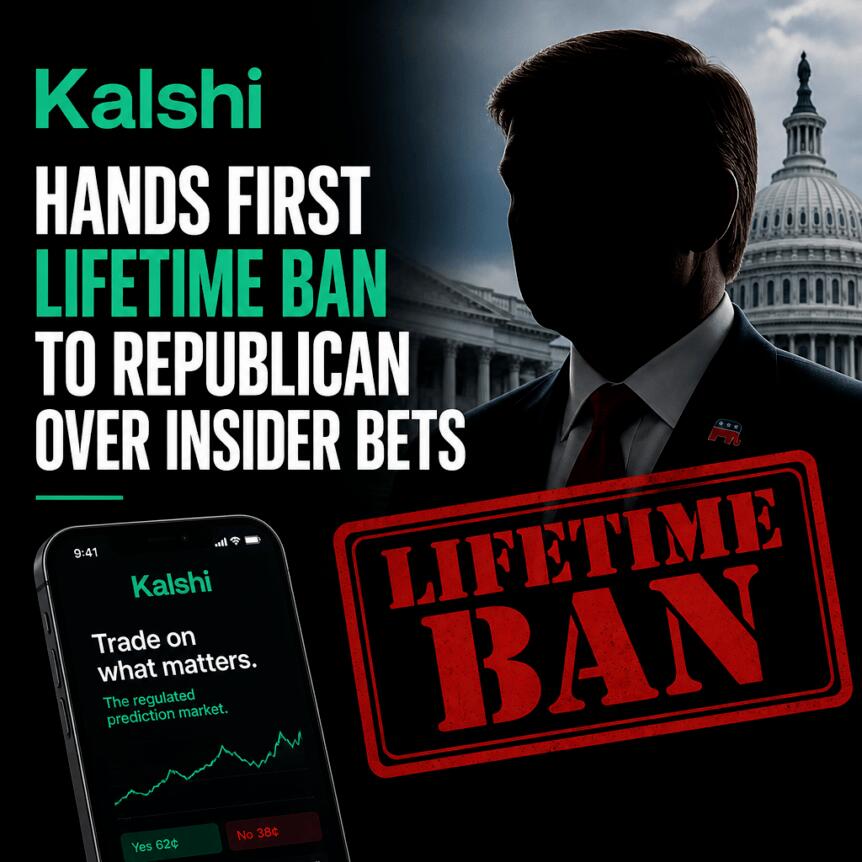
Prediction market platform Kalshi says it has permanently barred two US political candidates from trading on its event contracts after compliance investigations found activity that Kalshi described as violating rules against insider influence. The actions follow a broader wave of scrutiny directed at prediction markets, including investigations tied to potential manipulation of politically sensitive markets.
In separate settlement notices announced Friday, Kalshi’s compliance team reported that it imposed a lifetime suspension and a $71,356 penalty on former Republican congressman George Santos, while Laurie Buckhout—also a Republican candidate—received a three-year trading suspension plus a $2,590 penalty. Both cases relate to contracts that Kalshi says could be influenced by the candidates’ own actions.
Key takeaways
- Kalshi reports it permanently suspended George Santos from trading on its prediction market platform and imposed a $71,356 penalty.
- Kalshi reports it suspended Laurie Buckhout for three years and imposed a $2,590 penalty.
- Both actions were tied to Kalshi findings that each person traded in markets connected to events in which they had decision-making influence, which Kalshi says its rules prohibit.
- The disciplinary steps come as prediction markets remain in the crosshairs of US state and federal regulators debating jurisdiction and market-manipulation risk.
- As of Tuesday, Kalshi still listed election-related event contracts tied to Buckhout’s North Carolina race.
Why Kalshi took action
Kalshi framed both settlements around a core compliance principle: its market rules prohibit trading by anyone who can influence the outcome of the underlying event tied to a contract. In the platform’s rules, Kalshi states that if a trader is a decision maker—or has any direct or indirect influence, “no matter the scale and importance of the influence”—on the outcome of an underlying event, the trader is prohibited from entering trades on markets for those contracts.
According to Kalshi’s disclosures, Buckhout violated this restriction by trading around event contracts connected to her own political race. Kalshi said Buckhout announced her candidacy in North Carolina’s 1st congressional district and that she was subsequently added as an option for a contract tied to the outcome of the congressional election.
For Santos, Kalshi said its investigation found he engaged in trading activity in certain markets related to his attendance at the State of the Union address in February 2026—again, a scenario Kalshi characterized as falling under its prohibition on trading when the trader can influence the underlying event.
Penalties, suspensions, and what Kalshi said about cooperation
Kalshi’s compliance department reported the settlements in two documents published with its regulatory notices. For Santos, Kalshi said the disciplinary action took the form of a permanent suspension from trading on Kalshi markets, accompanied by a $71,356 penalty. For Buckhout, Kalshi reported a three-year suspension and a $2,590 penalty.
Kalshi’s notices also included differing language about cooperation. In Buckhout’s case, Kalshi stated that she “cooperated with the inquiry” and agreed to the three-year trading ban and penalty. In Santos’ case, Kalshi did not similarly state that he cooperated with its investigation, leaving an important procedural detail unaddressed in the company’s public notice.
These measures are notable because they represent one of the first lifetime bans Kalshi has imposed since the platform’s launch in 2021, according to the article’s framing. For participants who trade on event contracts, the message from Kalshi’s compliance team is that the company intends to treat “influence” broadly—especially when the underlying event is tied to a person’s public role or political activity.
Prediction markets face escalating political and regulatory scrutiny
The Kalshi actions arrive at a moment when prediction market platforms are under intensified review from both state and federal lawmakers. The underlying concern is not simply whether markets are speculative, but whether certain contracts are vulnerable to manipulation when insiders can affect outcomes.
Earlier this year, the issue was highlighted by federal action involving Kalshi-tied event contracts. According to the article, President Donald Trump’s teleprompter operator, Gabriel Perez, was fined $172,000 by US regulators after trading event contracts on Kalshi related to Trump’s speeches. That case underscores how regulatory attention can focus on politically linked markets—particularly where traders may have privileged access or ability to impact the event that drives settlement.
More broadly, Kalshi and other prediction market platforms—including Polymarket—have faced lawsuits brought by individual state gaming authorities alleging that the platforms facilitate illegal betting on sporting events. At the same time, the chair of the US Commodity Futures Trading Commission (CFTC), Michael Selig, has argued that the CFTC has “exclusive jurisdiction” over prediction markets and has said the agency will take legal action against states that challenge that position.
Last month, the CFTC invoked emergency authority in response to New York’s attempt to block Kalshi from offering contracts tied to sports, elections, and other events, according to the cited coverage. This ongoing jurisdictional dispute is part of the larger fight over how US regulators classify prediction markets and who has the authority to regulate them.
Where the candidates stand after the settlement
Kalshi’s sanctions are tied to trading behavior, but they also intersect with ongoing political campaigns. The notices indicate Buckhout remains a Republican candidate for North Carolina’s 1st congressional district in the 2026 midterm elections, while Santos was previously expelled from Congress in December 2023 amid fraud allegations.
After Kalshi’s settlement was announced, Santos said on X that Kalshi was an “unserious company.” Buckhout, according to reported comments, characterized her actions as a “dumb mistake.” While those reactions provide political context, what matters for traders and users is Kalshi’s clear enforcement of its own rules against trading while influencing underlying event outcomes.
Importantly for market participants, Kalshi still lists event contracts tied to the outcome of Buckhout’s North Carolina race. As of Tuesday, the platform reportedly showed Democratic incumbent Don Davis at a 63% chance versus Buckhout at 41%—meaning the settlement does not appear to have removed the election market itself, only restricted Buckhout’s trading access.
Readers should watch how Kalshi continues to handle conflicts of interest in politically linked contracts, and whether regulators—especially the CFTC—treat these enforcement actions as evidence that prediction markets need stronger compliance guardrails or as support for the company’s broader regulatory stance. The next signals to monitor are additional disciplinary notices and any new court activity that could reshape how prediction markets are governed in the US.