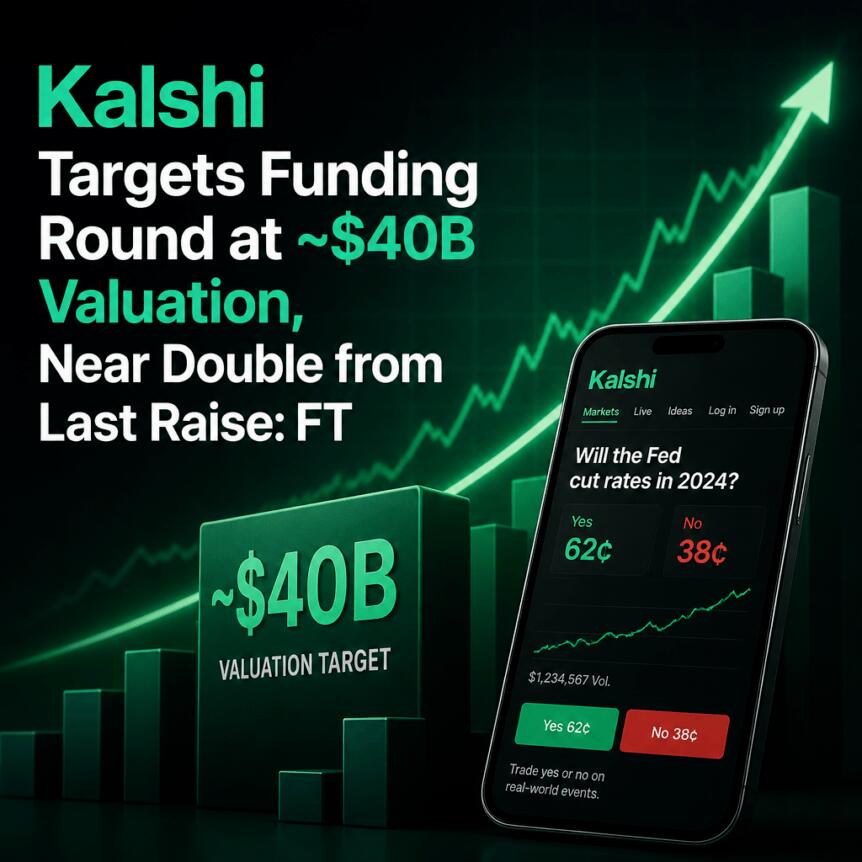
US-based prediction market platform Kalshi is reportedly in talks for a new fundraising round that could value the company at $40 billion—nearly double its $22 billion valuation from a prior financing in May. The Financial Times, citing people familiar with the matter, said the round could be closed as soon as the third quarter of this year.
If the valuation target is reached, Kalshi’s market value would surge sharply in under twelve months, highlighting how quickly investor attention has shifted toward platforms that let users trade on real-world outcomes. The rapid repricing also sets up a more direct competitive comparison with other prediction venues, particularly Polymarket.
Key takeaways
- Kalshi is reportedly seeking a new funding round at a $40 billion valuation, up from $22 billion in May.
- The Financial Times says the round could close as early as the third quarter, pending negotiations.
- Kalshi’s latest financing in May was a $1 billion Series F led by Coatue Management, with participation from multiple major investors.
- Trading activity data cited by Token Terminal shows Kalshi widening the gap over Polymarket in recent months.
- Prediction markets in the US remain under legal pressure, with states and federal regulators clashing over how these contracts should be classified and overseen.
From $22 billion to $40 billion: why the valuation jump matters
Kalshi most recently raised capital via a $1 billion Series F that closed in May. According to the report referenced in the source coverage, the round was led by Coatue Management and included participation from Andreessen Horowitz, Sequoia Capital, Morgan Stanley, and Ark Invest.
That May funding capped a rapid run-up in valuation. Kalshi’s $22 billion valuation in May was reportedly double its $11 billion valuation from December and more than four times its $5 billion valuation in October. In other words, the company has already demonstrated an ability to reset investor expectations within short time spans.
The proposed $40 billion valuation would effectively extend that momentum, implying an even steeper compounding of investor confidence. For market participants, the fundraising storyline is more than corporate finance—larger valuations typically correlate with greater resources for product expansion, partnerships, and regulatory navigation, all of which can influence liquidity and user experience.
What the latest round could signal for prediction-market competition
Valuation milestones are one way to track the sector’s growth, but liquidity and trading velocity are harder signals for how users are actually adopting these platforms.
The source cites Token Terminal data indicating that Kalshi’s monthly notional trading volume reached $17.9 billion as of May, compared with Polymarket’s $7.1 billion. This follows a reported shift in dominance between the two platforms around September last year, when Kalshi partnered with Robinhood to let users trade outcomes of NFL and college football games.
Polymarket had been the clearest leader in trading volume through much of 2024, but the competitive dynamic has reportedly reversed and kept widening over the last nine months. Traders typically follow volume and liquidity, so these numbers can translate into better execution, narrower spreads, and deeper markets—factors that can reinforce network effects for whichever platform remains on top.
If Kalshi is able to secure a large round at the reported level, it may also accelerate the broader pattern of consolidation in prediction-market attention: funds can support more frequent contract listings, improved tooling for event grading, and further integrations that expand the addressable user base.
Momentum draws big tech and mainstream exchanges
The surge in prediction markets has reportedly extended beyond crypto-native circles. The source notes that social media and technology interest has increased alongside the sector’s mainstreaming.
According to the New York Times, Meta CEO Mark Zuckerberg directed staff to build a prediction markets mobile app—described as “Arena”—framed as a challenge to platforms like Kalshi and Polymarket. While such reporting does not confirm launch timelines or product details, it reinforces the view that prediction markets are increasingly seen as a consumer-facing product category rather than a purely niche trading venue.
At the same time, traditional market operators are entering the space. The source reports that Cboe Global Markets launched a new prediction-market platform called Cboe Predicts with binary contracts tied to the S&P 500. This matters because mainstream exchange participation can change expectations for market integrity, participant protections, and potentially the regulatory posture of how contracts are offered to users.
Legal uncertainty: states vs. the CFTC
Despite the growing attention, prediction markets in the United States continue to face legal scrutiny. The source highlights an ongoing dispute over whether event-linked contracts—especially those tied to sports—should be treated as sports betting regulated by state gaming authorities.
Kentucky was the latest state to take action, suing five prediction market platforms last week, including Kalshi and Polymarket, alleging they are “operating unlicensed and illegal sports betting and gambling platforms.”
At the federal level, the US Commodity Futures Trading Commission (CFTC) has argued that it holds exclusive authority over prediction markets and that the platforms operate under CFTC registration. The source further notes that the CFTC has sued state authorities, including Kentucky, to try to prevent states from policing these platforms.
This legal tension is not only a compliance risk for existing operators—it is also a constraint on how fast the category can scale. Investors and users will likely watch for clearer enforcement patterns: whether courts lean toward federal preemption, whether states succeed in carving out additional boundaries, and how platforms adapt contract structures, marketing, and geography.
The fundraising news, in that context, reads as a bet that Kalshi can grow while navigating (or eventually benefiting from) the regulatory direction the courts and regulators choose.
Closing perspective
As Kalshi negotiates a reported $40 billion valuation, the bigger question for the market is whether the company’s growth story can keep outpacing the regulatory friction facing the entire prediction-market category—especially as more mainstream companies and exchanges test the waters.