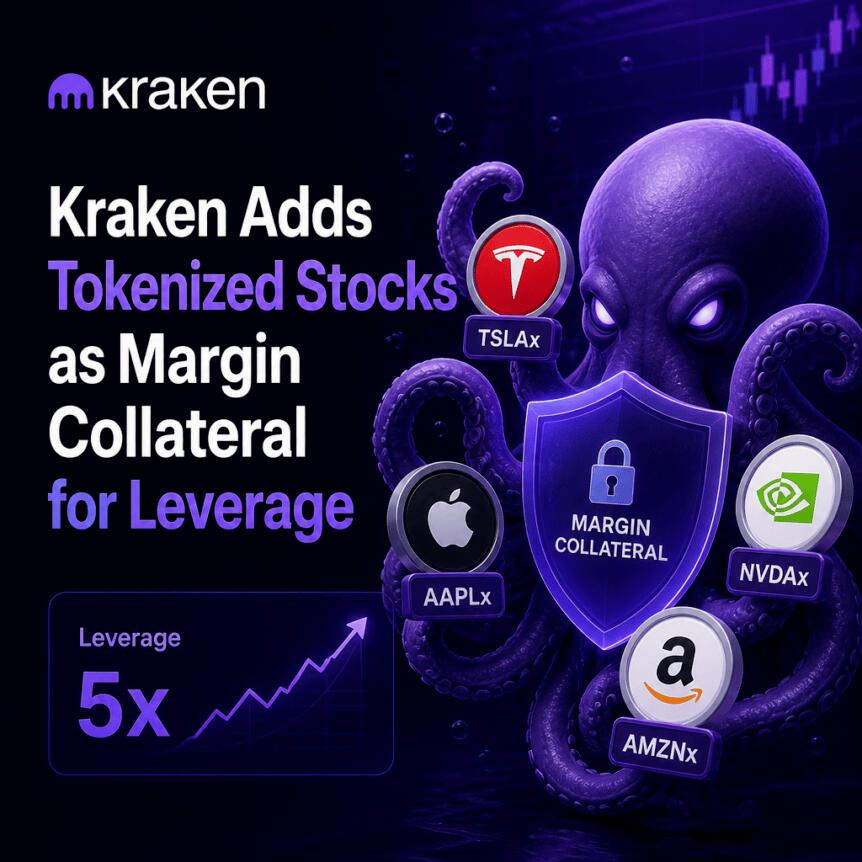
Crypto exchange Kraken has started accepting select tokenized stocks and exchange-traded funds (ETFs) as collateral for futures and margin trading. The change is designed to let eligible users open leveraged positions without first selling the tokenized assets they already hold.
Kraken’s initial rollout supports 10 tokenized instruments, including tokenized shares of major US technology companies such as Apple, Nvidia, and Tesla, alongside tokenized ETF and strategy-related products such as Strategy, the SPDR S&P 500 ETF, and Invesco QQQ Trust.
Key takeaways
- Kraken will accept tokenized stocks and ETFs as margin and futures collateral for eligible clients.
- The initial list includes Apple, Nvidia, Tesla, Strategy, the SPDR S&P 500 ETF, and Invesco QQQ Trust, among others.
- Assets receive collateral haircuts that reduce their effective lending value, with broad ETFs discounted by 10% and certain higher-volatility names discounted by 30%.
- Collateral limits vary by asset type, including up to $1 million for broad-market ETFs and up to $250,000 for most individual stocks.
- Support is limited to eligible clients outside the United States, with different collateral rules depending on the jurisdiction.
How Kraken will treat tokenized collateral
Kraken says each eligible tokenized asset is subject to a collateral “haircut,” a risk-based adjustment that lowers the amount it can contribute to a user’s borrowing power. In the exchange’s rollout, broad-market ETFs receive the lowest haircut at 10%, while more volatile stocks—including Strategy and Robinhood—are discounted by 30%.
Alongside haircuts, Kraken also sets collateral caps per asset. Broad-market ETFs are limited to up to $1 million in collateral value, while most individual stocks are capped at $250,000. Kraken also applies lower caps to tokenized gold and Circle shares, which it places at $100,000.
Importantly for active traders, Kraken notes that both collateral limits and haircuts will be reviewed periodically and remain subject to change.
Which tokenized assets are included at launch
The feature initially covers 10 tokenized stocks and ETFs. The list named by Kraken includes tokenized Apple, Nvidia, and Tesla, as well as tokenized Strategy. It also includes tokenized broad-market exposure such as the SPDR S&P 500 ETF and Invesco QQQ Trust.
Beyond these examples, Kraken’s announcement indicates that some higher-volatility holdings are assigned larger discounts. In particular, the exchange cited a 30% haircut for Strategy and Robinhood, illustrating how collateral treatment may differ materially even within single-stock collateral categories.
Regional access and venue-specific support
Kraken restricts the service to eligible clients outside the United States. The exchange further differentiates where each use case is available.
Kraken states that tokenized stocks can be used as collateral for futures trading in the European Economic Area. For margin trading, Kraken says tokenized collateral support applies in other eligible jurisdictions outside the EEA.
For users, this means they may need to check both their residency and the specific product they intend to trade—futures collateral rules may not mirror margin collateral rules across regions.
Why this fits the push for tokenized assets in mainstream finance
Kraken’s move aligns with a broader industry trend: converting traditionally held financial instruments into tokenized formats that can plug into crypto-native trading, settlement, and financing workflows. In recent months, multiple market participants have focused on expanding the utility of tokenized real-world assets (RWAs) beyond simple custody or spot trading—particularly by making them eligible collateral in regulated-style market infrastructure.
Earlier this year, Franklin Templeton and Binance launched a program that allows institutions to use tokenized money market fund shares as trading collateral while the underlying assets remain in regulated off-exchange custody. BlackRock’s tokenized US Treasury fund, BUIDL, is also described as accepted collateral on Binance, as well as on Crypto.com and Deribit.
Other examples highlight how tokenization is being tested at the level of market operations. Earlier this week, Tradeweb reportedly executed what it said was the first real-time purchase and sale of a tokenized US Treasury settled against tokenized cash on the Canton Network. Taken together, these developments point to experimentation not just with new assets, but with how those assets move through financial plumbing.
RWA.xyz estimates that tokenized real-world assets have grown to roughly $32.6 billion in distributed value, while tokenized stocks rose to about $2 billion from roughly $381 million a year earlier. While these totals don’t measure trading volume alone, they offer a sense of how much tokenized equity exposure has expanded over the past year—making exchanges’ collateral policies more consequential as tokenized products multiply.
What to watch next
With Kraken saying haircuts and collateral limits will be reviewed over time, traders using tokenized stock and ETF collateral should monitor future updates to the eligible asset list and any changes to discount rates. The next key question is whether Kraken expands eligibility beyond the initial 10 instruments and how collateral treatment evolves as tokenized stock and ETF liquidity develops.