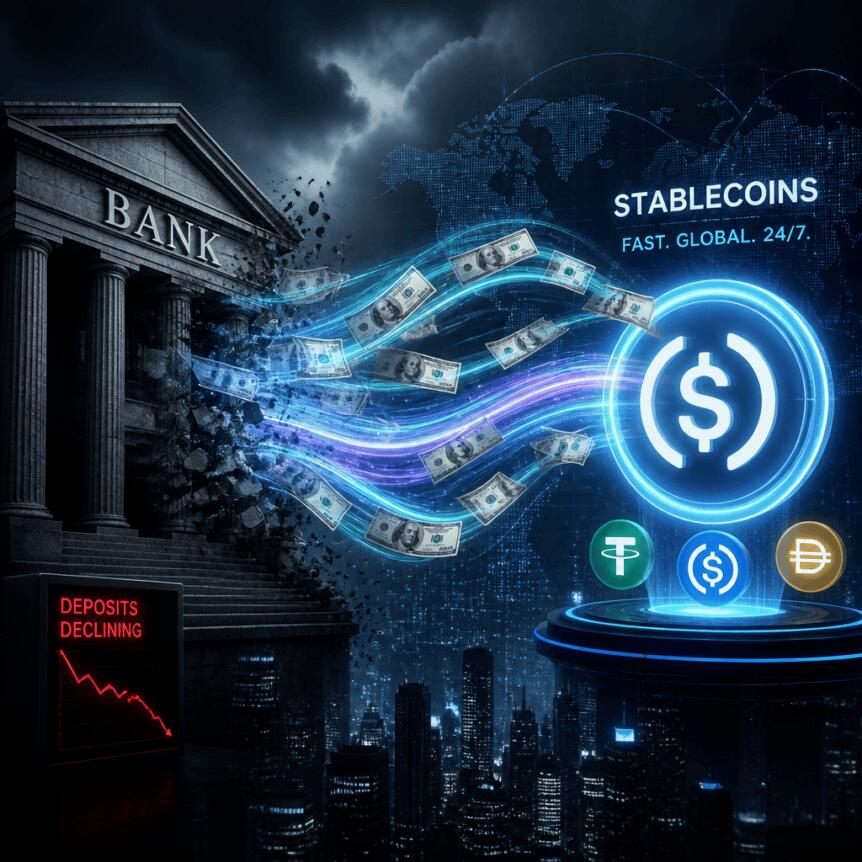
Stablecoins promise to move value across borders with near-instant settlement, operating around the clock and bypassing much of the legacy infrastructure that slows international transfers. But the question of whether stablecoins ultimately displace banks—or simply reroute how capital moves—depends on how quickly and where money shifts when demand rises or reserves come under stress.
Recent commentary and research highlight a dual reality: stablecoin use can build over time as more people seek dollar-denominated value, yet it can also trigger rapid, “software-speed” disruptions when redemption pressure hits. Regulators, meanwhile, are grappling with how stablecoin reserve requirements interact with traditional banking liquidity.
Key takeaways
- Stablecoin adoption can evolve gradually through “currency substitution,” potentially weakening deposit bases and monetary transmission over months or years.
- A faster risk channel exists: if reserves are strained or depegs occur, capital can move quickly into and out of stablecoins within hours, not weeks.
- Research cited by the Bank for International Settlements suggests stablecoin demand for dollar exposure can spill into FX markets and affect local currencies—especially when financial intermediaries are already under strain.
- Under EU rules tied to MiCA, issuers must hold a minimum portion of reserves in bank deposits, which can amplify liquidity-mismatch concerns during redemptions.
- Some stablecoin payments may function mainly as a faster settlement rail that converts back to fiat, meaning the near-term displacement could be “thinner” correspondent layers rather than banks themselves.
Two dynamics: slow substitution and fast shocks
Anthony Vassallo, director of crypto at Silicon Valley Bank before it failed in March 2023 and later operating as part of First Citizens Bank, argues that stablecoin competition will show up in two time horizons.
“Two clocks matter. One is slow: currency substitution, deposit erosion, and weakening policy transmission building over months or years. One is fast: a depeg, issuer shock, or banking event that can move capital at software speed within hours.”
The European Central Bank has warned that reserve structures may intensify stress if large stablecoin holdings are backed by assets sitting in bank deposits. In its view, heavy redemptions could create cascading withdrawals—an outcome the ECB links to a liquidity mismatch: stablecoins can settle continuously, while the banking system that holds reserves is subject to traditional settlement timelines.
That concern was tested during the March 2023 period when USD Coin briefly lost its dollar peg after disclosures that a portion of Circle’s reserves were held at Silicon Valley Bank. The episode turned a banking failure into a stablecoin crisis almost overnight, and it also prompted authorities to step in to guarantee deposits. Vassallo’s “slow clock” concept suggests other effects may be less dramatic but still consequential as they accumulate without a single headline event.
Dollar demand grows—sometimes under pressure
Stablecoin activity is often tied to broader dollarization dynamics, especially in economies facing currency instability. In July 2026, the Bank for International Settlements reviewed stablecoin flows alongside conventional foreign currency deposits across 130 economies. The BIS found that both measures tend to rise during periods of currency pressure and during banking or sovereign crises, while stablecoin flows appeared less constrained by capital controls.
That pattern supports the idea that, when people want out of a weakening local currency, stablecoins can provide a dollar-linked alternative that governments may find harder to restrict.
A separate report described in the article from Sphere Labs and SVB frames stablecoin demand as strongly connected to demand for dollar exposure in markets such as Argentina, Nigeria, and Turkey. It points to Argentina as an example where, according to the report, 94% of crypto bought with pesos was in stablecoins. For Turkey, it cites a figure of roughly $38 billion worth of lira swapped for stablecoins over a year.
Arnold Lee, chief executive of Sphere Labs, characterizes adoption as fundamentally a “dollar story” shaped by access barriers to traditional banking. He told Magazine that the critical variable is how different countries manage the transition.
“Most of these economies are going to keep moving toward dollars […] What I spend my time on is the manner of it, because a country that manages the shift and one that gets overtaken by it end up in very different places.”
FX spillovers and the reserve question under MiCA
Stablecoin demand does not remain confined to crypto markets. A BIS study published in March (as referenced in the article) examined stablecoin flows and spillovers into foreign exchange markets. It looked at four major USD-pegged stablecoins across 27 fiat currencies between 2021 and 2025, finding that increased demand for dollar stablecoins could contribute downward pressure on local currencies and make dollars more expensive to access via FX swaps—effects that were stronger when financial intermediaries were already under strain.
Lee also links the mechanism to monetary transmission: when citizens in high-inflation economies shift from local currency into digital dollars, deposit bases can erode and central banks may find it harder to respond quickly to tightening conditions.
These dynamics feed directly into how regulators think about stablecoin reserves. Under the EU’s Markets in Crypto Assets (MiCA) framework, stablecoin issuers are required to hold at least 30% of reserves in bank deposits; for certain asset-referenced tokens (ARTs), the threshold can rise to 60%. The article notes that the European System of Central Banks has proposed shifting away from fixed percentages toward requirements based on how quickly reserve assets can be made available.
That approach responds to the ECB’s liquidity-mismatch concern: if redemptions spike, the banking system must be able to meet outflows without triggering instability. Tether’s CEO Paolo Ardoino has previously warned about the dangers of MiCA’s approach, calling it “very dangerous when it comes to stablecoins.”
In practice, the money movement can run both ways. Stablecoin issuance and redemption both rely on traditional channels where reserve assets ultimately sit, meaning the same architecture can create pressure during large inflows into stablecoins and during redemptions back into fiat. Technology enables rapid settlement, but the timing and resilience of reserve access determine how quickly stresses can propagate.
What might actually be displaced: correspondent rails, not instant bank removal
Despite the attention around dollarization and systemic risk, the article argues that stablecoins are not simply replacing the banking system wholesale. Instead, they often work as an intermediate settlement instrument that ends in dollars held in the traditional financial system.
Pankaj Bengani, former executive at Block and co-founder of stablecoin payments company MELD, told Cointelegraph that close to half of MELD’s B2B stablecoin “offramp” volume is in North America. He described the customer base as including importers, exporters, technology firms, e-commerce marketplaces, payment companies, and fintechs.
According to Bengani, many corporate users convert back to fiat immediately after a transaction settles and are not taking a crypto position. In his framing, stablecoins are used as a settlement rail instead of relying exclusively on the banking networks and correspondent relationships that historically facilitate cross-border transfers.
He emphasized that the biggest flows are cross-border commercial payments where businesses earn or hold dollars but suppliers and employees need local currency. Supplier payments account for close to a third of business use, while invoice settlement is roughly a quarter.
That distinction matters for how readers interpret “displacement.” If stablecoins primarily alter the friction inside payment plumbing—reducing the need for multiple intermediary steps—then the most visible change may be a thinner correspondent layer rather than the removal of banks. Bengani argued that stablecoin rails won’t replace SWIFT overnight, and that banks remain important for custody, compliance, liquidity, and local settlement.
Watching what changes next
Investors and builders should monitor how reserve rules evolve in Europe—particularly whether requirements become more responsive to liquidity timing—and whether FX spillovers from stablecoin demand intensify during periods when financial intermediaries are already under stress. The “two clocks” framing suggests the biggest surprises could come not only from adoption rates, but from how quickly redemption behavior can turn banking liquidity into a fast-moving risk.