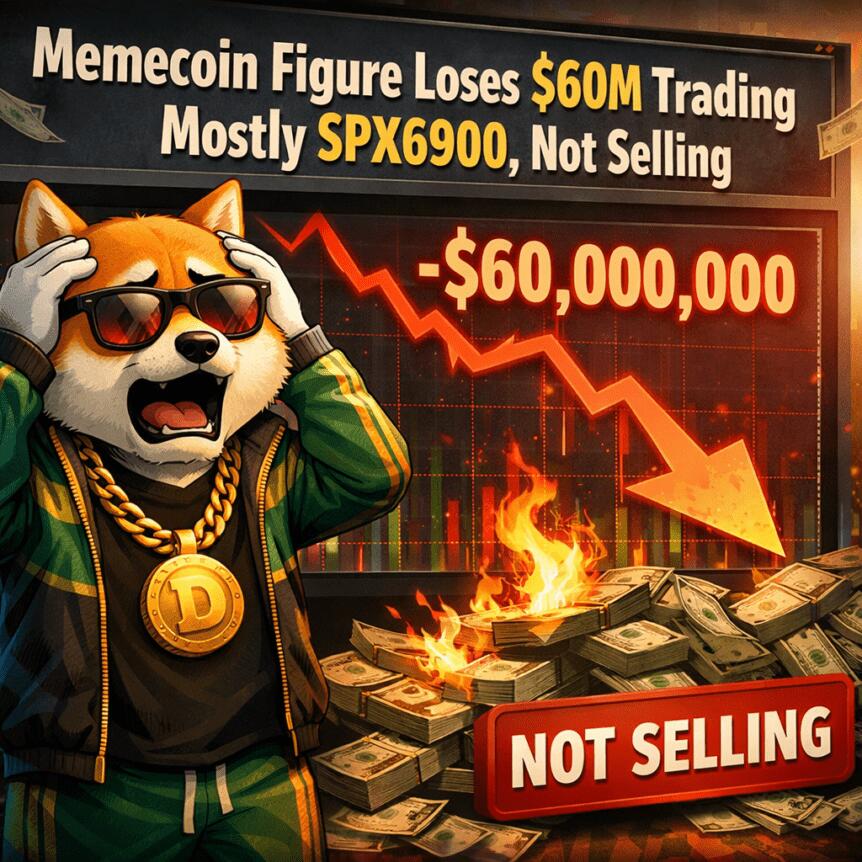
Murad Mahmudov, the crypto trader widely known online as the “Memecoin Messiah,” has endured a brutal nine-month stretch, wiping almost $60 million from his bets. Yet he remains bullish on SPX6900, a memecoin that aspires to outpace the S&P 500 and redefine memecoin economics.
Key takeaways:
- Mahmudov argues SPX6900 could grow the market cap of the token to $1 trillion—from roughly $250 million today—an extraordinary, 400,000% rise.
- On the technical front, SPX6900’s three-day chart points to a potential further decline of about 20% in the coming weeks.
- Public portfolio data shows a heavy concentration in SPX6900, with the Muststopmurad wallet holding about 29.964 million SPX (roughly $7.8 million), about 96% of the publicly tracked portfolio value.
- Despite steep losses, there have been no meaningful sales of SPX6900 or other major positions, according to DropsTab, suggesting the trader has not yet realized losses beyond the unrealized figure.
- The broader memecoin sector remains battered, with a large share of projects inactive and exit liquidity in some names showing limited real trading activity.
SPX6900 on a bold trajectory, or a fragile setup?
In a post circulated on X, Mahmudov asserted that SPX6900, a memecoin’s bid to overtake the S&P 500 in market presence, could surge to a $1 trillion market capitalization from its current roughly $250 million valuation—a jump of about 400,000%. The claim frames SPX6900 as a long-term bet on a narrative shift within the memecoin space, one that hinges on mass adoption and liquidity enhancements to propel a token past a traditional stock index in perceived value.
By contrast, the marketplace for memecoins has faced a brutal environment. SPX and other memecoins have tracked a broader retreat in the sector, with prices and on-chain liquidity deteriorating as traders reassess risk capital. Bitcoin remains the sole cryptocurrency to have reached a $1 trillion market cap in historical precedent, underscoring how extraordinary such a SPX6900 thesis would be in ordinary market conditions.
Concentration risk and unrealized losses
Public wallet analytics place Mahmudov’s SPX6900 exposure at the core of his tracked holdings. Arkham Intelligence flags the trader’s wallets under the entity “Muststopmurad,” and current data show approximately 29.964 million SPX held—valued at about $7.79 million. This single line item accounts for roughly 96% of the total tracked portfolio, estimated near $8.1 million.
The magnitude of the drawdown is stark. At a peak in July of the previous year, the same holdings carried an implied value of around $67 million. The ensuing correction has produced an unrealized loss near $60 million as the memecoin sector retraced more than 80% from its highs. The heavy tilt toward SPX6900 illustrates a classic high-conviction, high-risk position where outsized gains are possible but gains can evaporate rapidly in a sentiment-driven market.
Despite the paper losses, Mahmudov’s on-chain footprint shows no clear exit from these bets. DropsTab, a portfolio-tracking service that aggregates public wallets, indicates no material sales of SPX6900 or his other major positions. The platform records realized profits and losses on the tracked holdings as zero, suggesting the decline has come largely from price moves rather than realized dispositions. The portfolio, by this accounting, still shows more than $6.22 million in unrealized gains across its positions, indicating a complex mix of upside exposure that the trader has not yet cashed in—or chosen not to crystallize.
Exit liquidity and the broader memecoin backdrop
The memory-heavy, supply-sensitive dynamics of memecoins are also reflected in on-chain liquidity metrics. Market data show that several memecoin names—such as RETARDMAXX, HONK, and CHAD—struggle to attract meaningful liquidity. On Solana-based pairs, RETARDMAXX displayed around $44,000 in liquidity with only six transactions and modest daily volume, while CHAD showed roughly $842 in liquidity with no trades or new makers recorded in the same window. HONK’s pair registered just $1 in liquidity and no activity, underscoring the fragility of exit liquidity for some of these tokens in stressed markets.
Such liquidity gaps matter for holders who may wish to monetize losses or trim risk, particularly when a narrative previously supported by hype but now confronted with waning enthusiasm. In a market where a majority of new tokens fail to find steady demand, the ability to realize gains—or even limit losses—depends on the existence of durable liquidity pools and active buyers. CoinGecko’s January tracking highlighted the fragility of the broader memecoin set, reporting that 53.2% of all cryptocurrencies tracked since 2021 were inactive, with 11.6 million token failures recorded in 2025 alone that disproportionately affected memecoins. This backdrop helps explain why even sizable unrealized gains on a single position may struggle to translate into liquidity if the market lacks buyers willing to step in at meaningful levels.
Technical setup: a potential continuation of downside in SPX6900
From a chart perspective, the SPX6900 price action on a three-day horizon appears to be breaking down from a rising wedge pattern. A breakdown beneath support near the $0.26 level has already been triggered, with the price trading below the 20-, 50-, and 100-period exponential moving averages, a configuration that often signals a continuation of the downtrend in the near term. If the pattern plays out as the setup suggests, a measured move could take SPX6900 toward the $0.205 area—roughly 20% below current levels. Such a move would have implications for Mahmudov’s portfolio, potentially shaving another $1.5 million or more from the SPX stake, depending on the token’s price action and any accompanying shifts in liquidity.
Beyond the mechanics of the chart, the risk for concentrated memecoin bets remains structural. The memecoin sector’s volatility has historically outpaced broader crypto markets, with narrative-coupled demand driving extreme swings in both directions. For Mahmudov, the question is whether the SPX6900 thesis can withstand a test of time and liquidity, or if the current trend portends further writedowns before a credible inflection—if one ever arrives—materializes.
As of now, Mahmudov’s public posture suggests a patience-based stance rather than a willingness to harvest losses. The combination of a grandiose market-cap target, a highly concentrated position, and a market environment that has punished many memecoins for thin liquidity presents a case study in risk management rather than conventional investing wisdom. For observers, the ongoing question is whether SPX6900 can deliver on its promised scale or if the token’s path will remain a cautionary tale about the limits of meme-driven valuation in a crowded, unforgiving market.
What to watch next: productizing a memecoin’s ascent into mainstream liquidity remains the central hurdle. If SPX6900 can attract meaningful exchange listings, deeper liquidity, and broader investor interest, the thesis could gain traction. If not, the focus will shift to risk controls around highly concentrated portfolios and the practicalities of exiting positions in a market where exit liquidity is uneven at best.