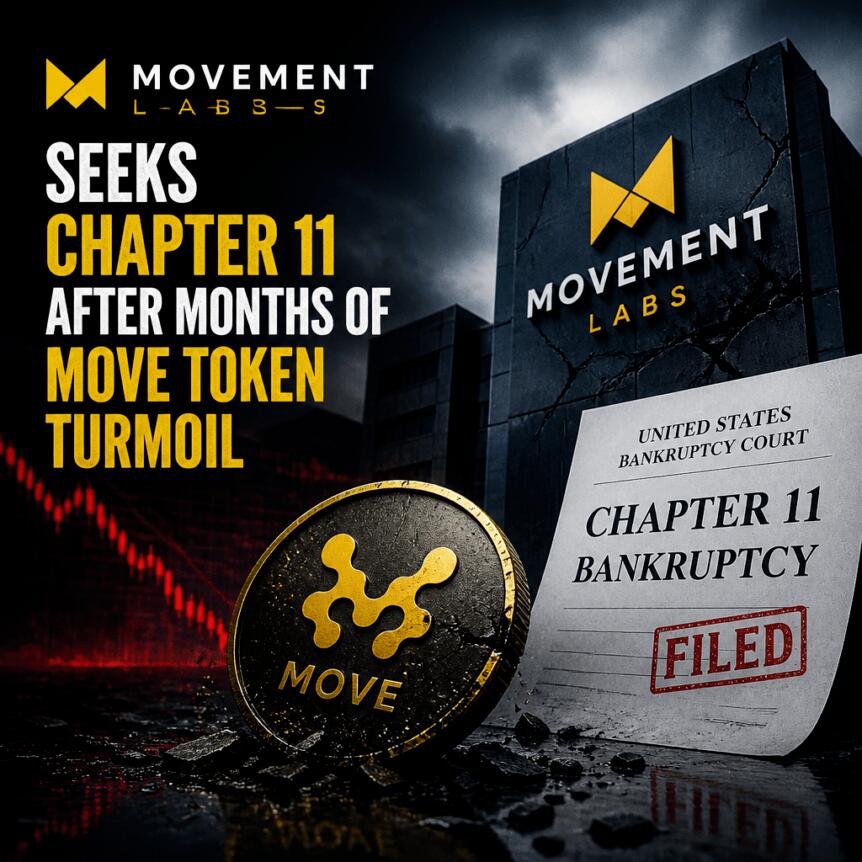
Movement Labs, the team behind the Movement Ethereum layer-2 network, has filed for Chapter 11 bankruptcy protection in the United States, according to court records. The filing places the company under court supervision as it restructures following a series of controversies around the launch of the MOVE token and subsequent corporate disruptions.
The petition was submitted on July 15 in the U.S. Bankruptcy Court for the District of Delaware under Subchapter V, a streamlined reorganization route available to qualifying small businesses. If approved, Subchapter V can allow a business to continue operating while it works toward a plan for creditors.
Key takeaways
- Movement Labs filed Chapter 11 under Subchapter V on July 15, with operations continuing during restructuring under court oversight.
- The court approved interim measures including retention of bank accounts/cash management and permission to pursue debtor-in-possession financing.
- Creditors have until Sept. 14 to submit claims related to the bankruptcy.
- Move Industries CEO Torab Torabi says the bankruptcy is limited to Movement Labs, while Move Industries continues operating normally.
- The move comes after months of fallout tied to MOVE’s launch, a market-making dispute, and exchange delistings that contributed to a major decline in token value.
Chapter 11 filing under Subchapter V
Court documents show that Movement Labs, Inc. sought Chapter 11 protection on July 15 using Subchapter V, which is designed to streamline reorganizations for certain small businesses. That status is significant for stakeholders because it can change the pace and structure of the restructuring process compared with a traditional Chapter 11 case.
Following the filing, the court granted interim requests that allow Movement Labs to maintain its bank accounts and cash management systems. The court also approved the company’s ability to obtain debtor-in-possession (DIP) financing, a common mechanism in Chapter 11 cases that helps fund operations while a debtor reorganizes.
For creditors and counterparties, timing matters. The court set a claims deadline of Sept. 14, giving parties a defined window to file claims tied to Movement Labs’ bankruptcy.
Move Industries says it is not covered
After the bankruptcy filing became public, Move Industries CEO Torab Torabi addressed the situation on X. According to Torabi’s statement, the Chapter 11 filing applies only to Movement Labs.
Torabi also said Move Industries—an entity that took over development and operations of the Movement ecosystem from Movement Labs in December 2025—continues to operate normally.
The distinction is important to users and developers because it suggests the broader ecosystem stewardship may not be directly suspended by Movement Labs’ restructuring. However, readers should still watch for how responsibilities, funding, and contractual relationships between the entities are handled during the bankruptcy process.
Earlier coverage from Movement’s community materials indicates the handoff occurred as part of a broader operational transition. Torabi’s post points to that separation as a reason investors should not automatically assume the entire Movement network is winding down.
Market-making controversy and exchange action preceded the filing
Movement Labs’ bankruptcy arrives after months of turmoil surrounding the MOVE token launch and a controversial market-making agreement. Cointelegraph previously reported that Movement Labs suspended co-founder Rushi Manche in May 2025 in connection with a deal he helped broker with Web3Port.
According to that earlier reporting, the market maker received 66 million MOVE—about 5% of the token’s supply—and later sold the holdings. The arrangement drew scrutiny after it reportedly exerted significant downward pressure on the token price, and an independent investigation was launched.
Cointelegraph also reported that Coinbase suspended MOVE trading later in May 2025 after determining the token no longer met its listing standards, with the market-making review ongoing at the time.
Those steps—suspension of a co-founder, ongoing investigation, and an exchange delisting—formed a damaging sequence that affected both market confidence and liquidity. A Chapter 11 filing typically signals that the financial and operational strain from such disruptions can no longer be contained internally.
Token collapse underscores the pressure on the project
The filing is occurring against a backdrop of a steep decline in MOVE’s market value. Cointelegraph’s source material notes that MOVE has fallen by more than 94% over the past year to roughly $0.01. While token price alone is not proof of bankruptcy, it often reflects a wider loss of trust, reduced trading activity, and potentially diminished revenue for token-linked business operations.
For market participants, the deeper implication is less about the immediate price reaction and more about what bankruptcy means for governance, funding, and stakeholder claims. In restructurings like this, creditors may seek repayment through settlement terms or equity arrangements depending on the company’s assets and liabilities—details that typically emerge gradually as the case proceeds.
What to watch next
Movement Labs’ restructuring plan and DIP financing terms will likely be the next decisive signals for investors and ecosystem participants. Readers should also monitor whether the separation from Move Industries remains operational in practice—especially around access to resources, continuity of development, and how any claims tied to past token-related controversies are handled.