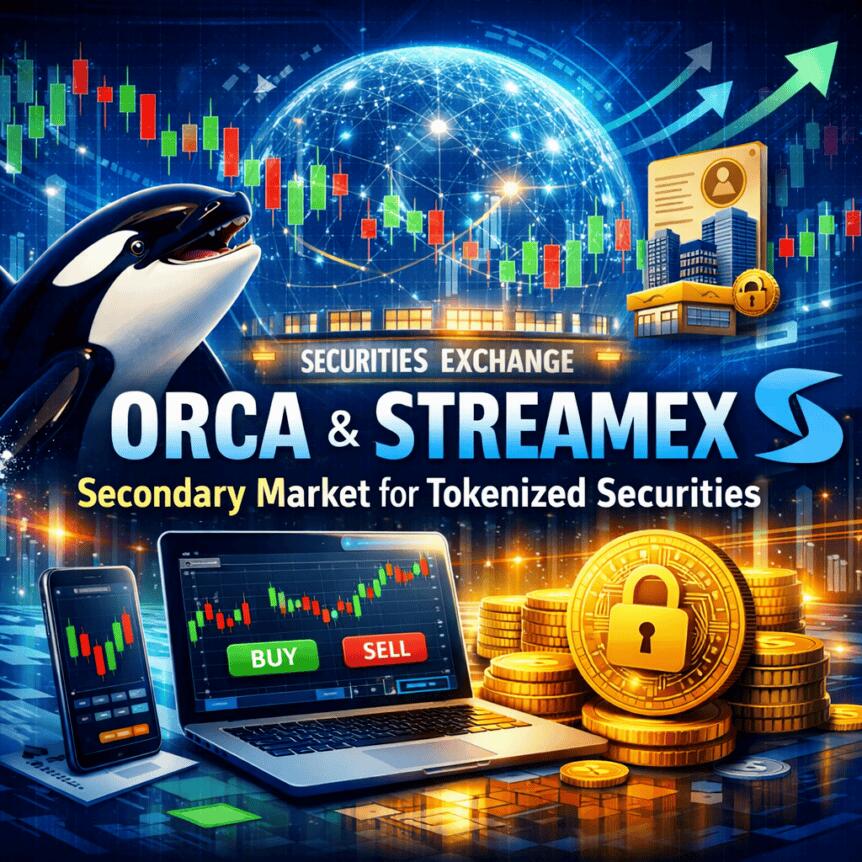
Tokenized-assets platform Streamex is unveiling a Solana-based marketplace for trading regulated, tokenized assets in a partnership with Orca, a decentralized exchange built on Solana. The new trading layer will let verified accredited investors buy and sell Streamex’s yield-bearing, gold-backed GLDY token through regulated on-chain pools that operate 24/7, with identity and accreditation controls locking access to approved participants.
Under the arrangement, Streamex and Orca emphasize that neither firm acts as a broker or intermediary for secondary-market resales. Instead, trading occurs in permissioned liquidity pools on Orca’s automated market maker (AMM) framework, with investor wallets held in a temporary freeze until KYC and accreditation checks are completed. Eligibility data is updated on-chain in real time to ensure only approved investors can participate, a model designed to balance liquidity with regulatory compliance for a tokenized commodity asset.
The GLDY token is described as yield-bearing and gold-backed, tying on-chain income streams to a physical-asset anchor. Orca notes its AMM infrastructure has processed more than $500 billion in cumulative trading volume since launch, a statistic the partners view as a potential blueprint for tokenized variants spanning stocks, bonds, real estate and other commodities.
The collaboration arrives amid a broader push to establish regulated rails for tokenized traditional assets, and follows a wave of regulatory activity in the United States and beyond. Earlier this month, the U.S. Securities and Exchange Commission approved Nasdaq’s pilot to allow tokenized stocks and exchange-traded funds to trade alongside their conventional counterparts on the same exchange, sharing order books, tickers and shareholder rights in the pilot phase. Participation is initially limited to eligible investors and securities tied to the Russell 1000 index and select ETFs.
The momentum around tokenized securities infrastructure extends beyond Nasdaq. In March, the New York Stock Exchange signed an agreement with Securitize to develop infrastructure for tokenized stocks and ETFs tied to Intercontinental Exchange’s planned digital trading platform. Separately, Centrifuge has signaled plans to bring tokenized Treasurys, private-credit products and AAA-rated collateralized loan obligations to the Monad blockchain for broader lending, collateral and secondary-market activity.
Market data from RWA.xyz places the tokenized real-world-asset (RWA) market at roughly $34 billion, with Treasury- and commodity-backed products among the largest segments. The ongoing expansion of tokenized assets aligns with growing regulatory clarity and investor access, even as participants stress the importance of robust on-chain compliance and custody frameworks.
Key takeaways
- Streamex and Orca launch a Solana-based, permissioned marketplace to trade the GLDY gold-backed token for accredited investors, with identity checks enforcing access.
- Trading happens in on-chain liquidity pools, where investor wallets are frozen until KYC and accreditation verification are completed; eligibility is updated on-chain in real time.
- Orca’s AMM platform has processed over $500 billion in cumulative volume since inception, reinforcing Solana-based liquidity capacity for tokenized assets.
- The move occurs against a backdrop of regulatory progress, including Nasdaq’s tokenized-trading pilot approved by the SEC and NYSE’s tokenization collaboration with Securitize.
- Market data indicates a growing tokenized-RWA landscape, with roughly $34 billion in assets tokenized to date, highlighting potential expansion into stocks, bonds and other traditional assets.
Regulatory rails and the tokenization wave
The Streamex–Orca initiative sits at the intersection of product innovation and regulatory development. The SEC’s approval of Nasdaq’s pilot signals a willingness to test tokenized securities within existing market structures, potentially allowing tokenized instruments to share order books and shareholder rights with traditional shares. The pilot remains selective, focusing initially on securities linked to the Russell 1000 and a subset of ETFs, but it underscores a broader industry trend toward on-chain settlement and regulated access for sophisticated investors.
Meanwhile, the NYSE’s engagement with Securitize points to ongoing collaboration between legacy exchanges and tokenization platforms to extend digital rails to a wider range of assets, including those tied to Intercontinental Exchange’s planned digital trading ecosystem. These developments collectively illustrate a market-wide push to bridge conventional financial assets with blockchain-based trading and settlement.
Industry participants stress that successful tokenization hinges on more than on-chain liquidity; robust identity verification, risk controls, and custodial safeguards are essential to meet institutional demands. In that context, the Streamex–Orca model—where eligibility data is verified on-chain before trading access is granted—represents a pragmatic approach to coupling liquidity with compliance.
RWA-based platforms and providers like Centrifuge are also expanding the scope of tokenized assets beyond commodities and simple securities, aiming to include tokenized Treasurys and structured credit. The broader market is watching how these rails perform under real-market conditions, how custody and settlement timelines compare with traditional markets, and how retail and accredited-investor demand evolve as more assets come online.
For readers tracking market development, the current wave of tokenized-asset activity suggests more pilots and launches are likely in the near term. The GLDY experiment could become a reference point for future permissioned liquidity pools, particularly if it demonstrates strong liquidity, compliance integrity and efficient on-chain eligibility updates in a regulated setting.
As the ecosystem matures, observers will want to monitor how widely these regulated tokenization rails are adopted across asset classes, how they handle cross-border participants, and what risk-management standards emerge to complement on-chain trading and settlement.
Further reading on the rapid expansion of tokenized real-world assets and related regulatory context can be found in industry coverage and research notes, including analyses of the tokenized-RWA market growth and regulatory milestones cited above.
What remains uncertain is the pace at which these rails will achieve broad participation beyond accredited investors, and how traditional custodians and counterparties will integrate with on-chain liquidity. Yet the signals from Streamex, Orca and the broader regulatory landscape point to a period of meaningful evolution for tokenized finance, where access-controlled markets could complement existing exchanges rather than replace them.