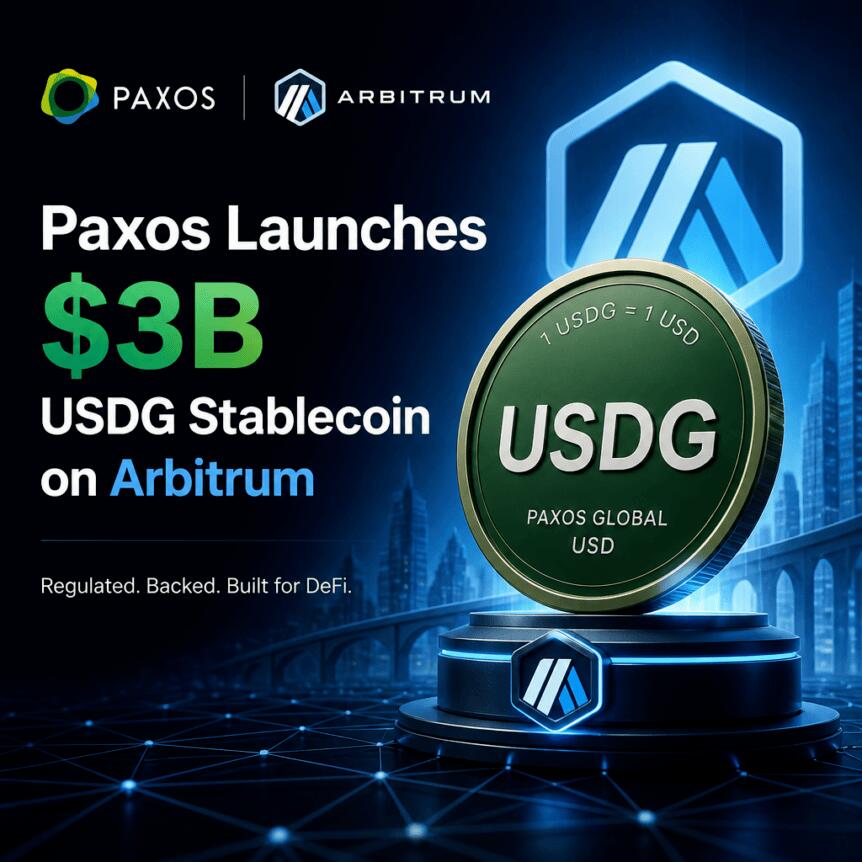
Paxos’ Global Dollar stablecoin, USDG, has begun issuing on Arbitrum, expanding the stablecoin’s footprint as Arbitrum positions itself as a settlement and tokenization platform for onchain finance.
According to an announcement shared with Cointelegraph, USDG is now natively issued on Arbitrum One and integrated with DeFi protocols including Fluid, Morpho, GMX, and Maple. Kraken will handle deposits and withdrawals, while Stargate will support transfers between Arbitrum and other blockchains.
Key takeaways
- USDG is now issued on Arbitrum One, with DeFi integrations spanning Fluid, Morpho, GMX, and Maple.
- Transfers across networks will be supported via Stargate, while Kraken will manage deposit and withdrawal rails.
- An ArbitrumDAO proposal would earmark 100 million ARB for incentives tied to USDG adoption and growth.
- Arbitrum will share in rewards generated by USDG activity through the Global Dollar Network partnership.
- Arbitrum already holds about $4 billion in stablecoins, and USDG is reported as the seventh-largest stablecoin by market capitalization.
USDG expands to Arbitrum alongside DeFi integrations
The Arbitrum launch connects Paxos’ stablecoin distribution with a growing ecosystem of onchain financial products. As stated in the announcement, USDG is issued on Arbitrum One and immediately integrates with multiple DeFi platforms, indicating an intent to make the stablecoin usable across lending and trading workflows rather than limiting it to payments-only use cases.
Support for cross-chain movement is also a crucial part of the rollout. With Stargate enabling transfers between Arbitrum and other networks, users and liquidity providers can route USDG to where demand exists, potentially lowering friction for arbitrage and portfolio allocation strategies.
Operationally, Kraken’s role as the deposit and withdrawal partner matters for market participants because it reinforces USDG’s on/off-ramp infrastructure. The more reliably a stablecoin can be minted and redeemed, the more practical it becomes for traders, borrowers, and institutions that need predictable access to liquidity.
ArbitrumDAO proposal signals a push to accelerate USDG adoption
Beyond the technical rollout, the announcement references an ArbitrumDAO proposal aimed at making USDG growth a strategic objective. The proposal includes adding 100 million ARB to an incentive program designed to increase stablecoin adoption, while also calling for the deployment of Arbitrum treasury assets to support USDG liquidity.
The proposal further suggests a support pathway for businesses integrating USDG: those projects could apply to the Arbitrum Foundation for assistance. In other words, Arbitrum is not only adding USDG to its chain; it is attempting to address the typical bottlenecks that slow stablecoin distribution—liquidity availability, partner incentives, and integration resources.
For investors and builders watching Arbitrum’s direction, these governance-linked measures are notable because they explicitly tie ecosystem spending to stablecoin usage. If the incentives succeed, Arbitrum could see more stablecoin-based activity—trading volume, lending demand, and other onchain financial flows—that strengthens its positioning in tokenization and regulated asset narratives.
What the stablecoin numbers suggest for Arbitrum
Arbitrum’s stablecoin environment already appears substantial. The Arbitrum Foundation reports that about $4 billion in stablecoins are held on the network. Separately, DeFiLlama data cited in the announcement places USDG among the larger stablecoins by market capitalization, ranking it seventh with roughly $3.09 billion in circulation.
The same data points note that most of USDG’s supply is concentrated on X Layer, Robinhood Chain, and Solana. With Arbitrum now included, the key question becomes whether USDG liquidity distribution expands across chains—or whether Arbitrum mainly captures incremental usage rather than shifting existing supply.
Arbitrum’s role as a Global Dollar Network partner adds another layer. The announcement says Arbitrum will receive rewards generated by USDG activity on the network, with proceeds directed toward adoption and ecosystem development. That revenue-sharing structure could help align incentives between the stablecoin issuer’s distribution strategy and Arbitrum’s longer-term effort to attract more tokenized finance activity.
Broader tokenization push: from Arbitrum L2 to financial infrastructure
USDG’s launch on Arbitrum arrives during a broader push to expand beyond crypto-native applications and toward infrastructure for tokenized real-world assets. The article notes Robinhood Chain as a prominent example of that direction. Cointelegraph previously reported that Robinhood Chain launched its public mainnet in July, following a public testnet that debuted in February. The network is built using Arbitrum and targets tokenized real-world and digital assets, including features such as 24/7 trading, lending markets, and perpetual futures exchanges.
Standard Chartered has also pointed to the economics of this strategy. In earlier reporting, the bank said Robinhood Chain could signal a shift in Arbitrum’s economics, given that Arbitrum would receive 10% of net protocol revenue generated by companies building on its infrastructure. Standard Chartered’s forecast, as referenced in the announcement, also links tokenization growth with potential long-term valuation outcomes for ARB and expects tokenized assets could reach $4 trillion by the end of 2028.
While USDG issuance alone does not guarantee those macro outcomes, stablecoins are a core ingredient of tokenized financial products. Lending markets, derivatives, and trading venues often rely on stablecoin liquidity to settle positions and manage risk. Bringing a large USDG supply base into Arbitrum’s settlement layer could therefore reinforce the network’s bid to serve as a hub for onchain finance—especially as tokenization efforts multiply across L2s and application-specific chains.
Next, market participants will likely focus on whether Arbitrum attracts sustained USDG-based activity beyond initial integrations—particularly liquidity depth on trading and lending venues—and whether the ArbitrumDAO incentive and treasury measures translate into measurable growth in stablecoin usage. The distribution of USDG supply across networks may be the clearest signal of how quickly Arbitrum can convert infrastructure upgrades into durable adoption.