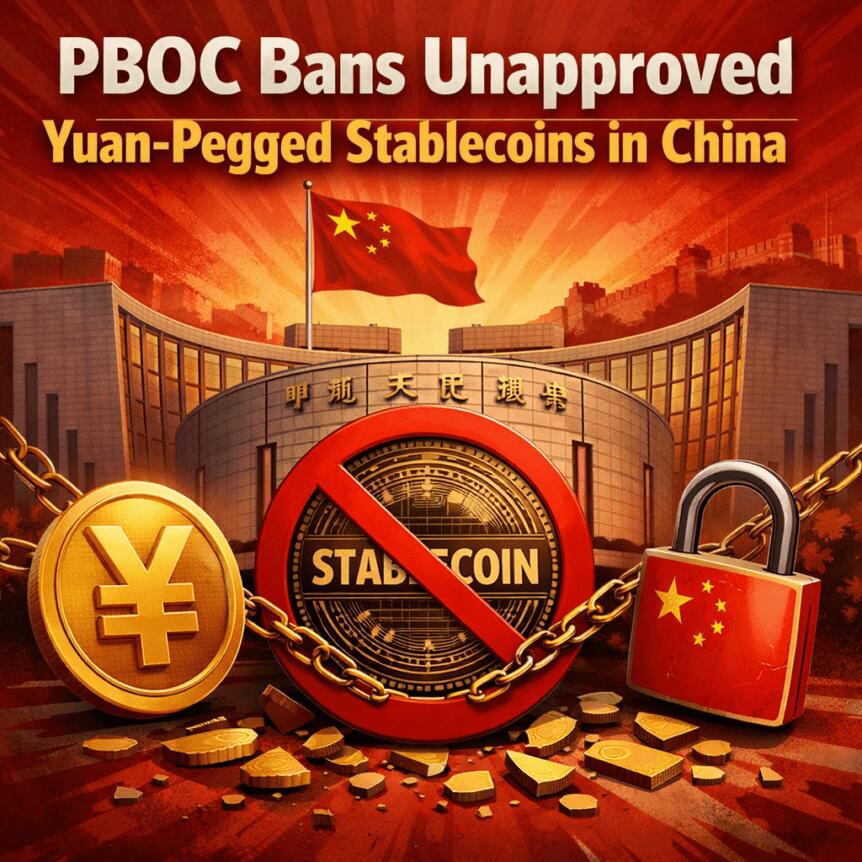
The People’s Bank of China (PBOC) and seven regulatory agencies issued a joint statement on Friday prohibiting the unapproved issuance of Renminbi-pegged stablecoins and tokenized real-world assets (RWAs). The directive applies to both onshore and offshore issuers, underscoring Beijing’s intent to keep financial instrumentation closely aligned with state policy while continuing to push the domestic CBDC ecosystem forward. The announcement, signed by the PBOC alongside the Ministry of Industry and Information Technology and the China Securities Regulatory Commission, reiterates a posture that private crypto activities remain outside the formal financial system unless they receive explicit clearance. A translated version of the statement framed the policy as a guardrail against stablecoins that imitate fiat currency functions during circulation and use.
“Stablecoins pegged to fiat currencies perform some of the functions of fiat currencies in disguise during circulation and use. No unit or individual at home or abroad may issue RMB-linked stablecoins without the consent of relevant departments.”
Winston Ma, an adjunct professor at New York University (NYU) Law School and a former Managing Director at CIC, China’s sovereign wealth fund, weighed in on the development, indicating the ban covers both onshore and offshore RMB variants. He noted that the policy applies to CNH and CNY alike, reflecting a comprehensive approach to RMB-related markets. CNH, the offshore version of the yuan, is designed to maintain currency flexibility in international markets while preserving capital controls, Ma explained.
The overarching narrative here is clear: Beijing intends to quarantine speculative crypto activity from the formal financial system even as it accelerates the broader rollout of e-CNY, the sovereign CBDC managed by state authorities. The policy positions digital yuan usage as the preferred channel for digital financial innovation while signaling a hard boundary against RMB-pegged instruments that could replicate traditional money-like functions outside of official oversight.
The move comes on the heels of China’s broader digital currency strategy. Just ahead of the announcement, officials approved commercial banks to share interest with clients holding the digital yuan, a development designed to make the CBDC more attractive to investors and everyday users alike. This aligns with a consistente trajectory: expand the practical utility of the digital yuan while constraining parallel ecosystems that could siphon demand or create regulatory ambiguity.
Within the policy landscape, China has repeatedly signaled a preference for harnessing digital currency tools under state supervision. A more permissive stance toward yuan-backed private tokens would complicate capital controls and challenge risks management frameworks, while the digital yuan remains a controlled instrument for domestic monetary policy and financial stability. The new directive reinforces the idea that the regime will tolerate innovation only within the boundaries of regulatory approval and centralized oversight.
Chinese government briefly considered yuan-pegged stables, but focused on CBDC instead
Earlier reporting in August 2025 suggested that China’s leadership was weighing a potential pivot toward allowing private companies to issue yuan-pegged stablecoins to facilitate global currency usage. Those discussions, however, did not translate into policy change. By September that year, regulators moved to pause or halt stablecoin trials until further notice, indicating that the government remained wary of private instruments that could undermine monetary sovereignty or complicate enforcement. The sequence illustrates a careful balancing act: while China explores financial innovation, it remains disciplined about the channels through which that innovation can reach the broader market.
In a broader context, China has shown a consistent preference for the centralized digital yuan over private stablecoins. The January 2026 policy to allow interest payments on digital yuan wallets is part of a long-run strategy to elevate the CBDC’s appeal and to test new incentive structures within a tightly regulated framework. The shift mirrors ongoing debates in other major economies about how to reconcile crypto innovation with financial stability and national monetary sovereignty, but China’s approach remains notably centralized and policy-driven.
In parallel coverage, the digital yuan story has been a recurring theme in the crypto-policy discourse, with broader examinations of CBDCs and their implications for cross-border payments and domestic finance. The conversations around stablecoins, RWAs, and the CBDC ecosystem continue to be closely watched as regulators in Beijing refine the balance between innovation and oversight.
Market context
The cross-currents in China’s crypto policy reflect a broader, global tension between digital asset innovation and regulatory control. The latest ban reinforces a risk-off stance toward private tokens and tokenized assets within a framework designed to preserve financial stability while promoting the government’s CBDC agenda. Investors and project developers watching RMB-linked instruments will likely reassess their onshore and offshore strategies in light of the explicit permission regime now underscored by multiple ministries and commissions.
Why it matters
For market participants, the joint statement clarifies that the Chinese authorities intend to keep RMB-related financial engineering firmly under state supervision. This has direct implications for any entity seeking to issue stablecoins pegged to the Renminbi or to tokenize real-world assets in a way that could bypass regulatory channels. The onshore/offshore consistency implied by the ban signals a regime-wide approach—no loopholes for RMB-backed tokens operating in the gray zones of global finance.
For issuers and platforms, the development serves as a clear reminder that regulatory clearance is a prerequisite for RMB-linked products. The alignment among the PBOC, MIIT, and CSRC indicates a shared risk assessment across monetary policy, information technology, and securities oversight. As China’s CBDC ecosystem matures, providers will likely pivot toward products and services anchored in the official digital yuan rather than those that attempt to replicate fiat-like functionality through private tokens.
From a policy perspective, the episode underscores Beijing’s dual posture: promote digital currency adoption domestically, while limiting the permissibility of private tokens that could complicate capital controls or blur the lines between currency and asset. The tension between innovation and sovereignty remains a defining feature of the Chinese crypto regulatory landscape and may shape global attitudes toward RMB-linked financial instruments and tokenized assets in the near term.
What to watch next
- Whether the regulators issue further guidance on RMB-linked tokens and tokenized RWAs, including definitions of what constitutes an “unapproved” issuance and potential penalties.
- Any enforcement actions against noncompliant issuers, both domestic and foreign, that attempt to issue RMB-linked instruments without consent.
- The ongoing rollout and uptake of the digital yuan wallet, particularly any changes to interest-bearing features or user incentives.
- Reactions from financial institutions, stablecoin operators, and tokenized-RWA platforms regarding the enforceability of the ban and its implications for cross-border activity.
- Regulatory developments related to CNH cross-border use and how offshore RMB markets will adapt to the policy, given the policy’s emphasis on RMB-related markets across borders.
Sources & verification
- Official statement: People’s Bank of China and seven agencies joint release (PBOC site) – https://www.pbc.gov.cn/tiaofasi/144941/3581332/2026020619591971323/index.html
- Overview of China’s digital yuan
- What are CBDCs? A beginner’s guide to central bank digital currencies
- China digital yuan pressure on US stablecoins
- China tech giants halt Hong Kong stablecoin plans
- China digital yuan interest wallets 2026
- China considering yuan-backed stablecoins global currency usage
Introduction
The People’s Bank of China (PBOC) and seven major regulators issued a joint directive on Friday that bars the unapproved issuance of Renminbi-pegged stablecoins and tokenized real-world assets (RWAs). The measure targets both domestic and international issuers, signaling Beijing’s intent to curb private, crypto-style instruments in favor of tightly controlled monetary tools. The statement—co-signed by the PBOC, the Ministry of Industry and Information Technology, and the China Securities Regulatory Commission—frames RMB-linked stablecoins as devices that mimic fiat currency during circulation unless they secure explicit authorization. A translated section of the release emphasizes that no unit or individual may issue RMB-linked stablecoins without the consent of relevant departments.
Why it matters – The long arc of China’s digital finance policy
The policy is not an isolated move; it fits within a multi-year effort to keep speculative crypto activity outside of the formal financial system while promoting the digital yuan’s broader adoption. In this context, China’s approach is to constrain private tokens that could bypass capital controls or undermine monetary policy, even as it experiments with CBDC-based financial tools. The announcement arrived alongside other developments, including a 2026 push to offer interest on digital yuan wallets, designed to make the CBDC more attractive to users and investors alike. The stance also reflects a broader regional and global debate about how CBDCs will interact with private stablecoins and tokenized assets in a rapidly evolving digital economy.
The commentary from Winston Ma, an adjunct professor at NYU Law, underscores the breadth of the enforcement scope. He notes that the ban spans onshore and offshore RMB variants (CNH and CNY), reinforcing a centralized policy that seeks to keep RMB-related markets within a clearly defined regulatory perimeter. The policy’s emphasis on consent and authorization echoes long-standing Chinese priorities: maintain currency sovereignty, assure financial stability, and accelerate the domestic CBDC agenda without inviting parallel private infrastructures that could complicate policy transmission or risk management.
Looking ahead, the policy invites a clearer delineation of which digital assets and tokenized products may proceed under regulatory oversight. It also suggests that the ongoing policy dialogue around the digital yuan, CBDCs, and tokenized RWAs will continue to shape the global crypto regulatory landscape, affecting how international players approach RMB-linked products and cross-border digital finance in the years to come.
In the coming months, observers will watch for explicit enforcement guidelines, any adjustments to CBDC wallet incentives, and the extent to which offshore RMB markets adapt to a more stringent regime. The balance Beijing seeks—between innovation and control—will likely influence both domestic fintech deployments and cross-border financial engineering involving RMB-denominated instruments.