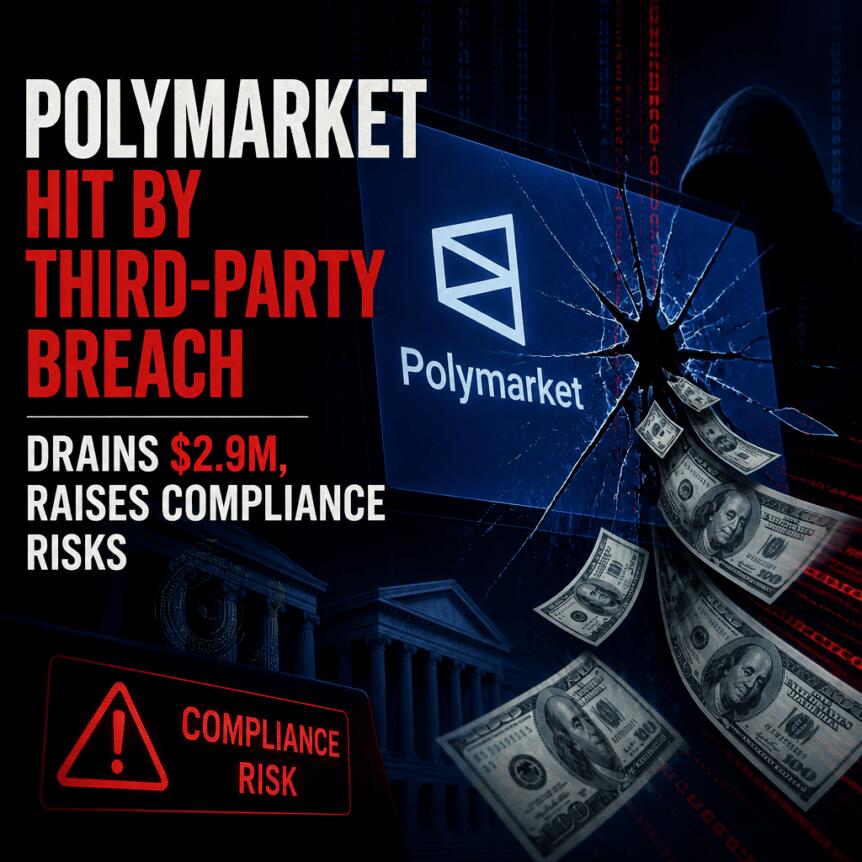
Polymarket says a third-party vendor compromise discovered on Thursday enabled attackers to inject malicious code into its website interface, leading to a phishing campaign that targeted multiple users. According to blockchain analyst Specter, the injected script was used to drain an estimated $2.94 million from at least 11 Polymarket wallets.
Polymarket stated that the incident has been contained and that the compromised dependency has been removed. The platform also said affected users will receive full refunds. Cointelegraph contacted Polymarket for comment but did not receive a response before publication.
Key takeaways
- Polymarket reported a third-party vendor compromise that allowed attackers to inject a malicious script into its frontend.
- Analyst Specter linked the malicious code to phishing activity, estimating losses of about $2.94 million across at least 11 user wallets.
- Polymarket said the issue has been contained, a dependency has been removed, and users will be fully refunded.
- Blockchain security reporting data indicates the incident fits within a high volume of crypto breaches in the quarter.
- Separately, DefiLlama data shows private key compromise remains the dominant cause of reported exploit losses over the last 30 days.
Frontend compromise and phishing-driven wallet losses
The Polymarket incident centers on a supply-chain style failure rather than a direct smart contract exploit. Specter said the malicious script appeared to enable a phishing attack that redirected or induced users into compromising credentials or authorizations, culminating in unauthorized asset movement from user wallets.
In practice, this type of front-end compromise can be especially damaging for institutions and compliance teams because it shifts the risk profile away from on-chain mechanics alone. Even where contracts are unchanged, malicious web-layer code can manipulate user behavior, compromise session-related security assumptions, or trick users into signing harmful transactions. For regulated entities that integrate with or route user access to crypto services, incidents like this highlight the need for tighter vendor governance and continuous integrity controls over externally served dependencies.
Polymarket’s response suggests the affected component was identified and removed after discovery. Its commitment to fully refund users also raises operational and policy considerations: while refunds may mitigate user harm, they do not automatically address whether the underlying controls—such as third-party software update processes, dependency monitoring, and incident response playbooks—were sufficient to prevent reoccurrence.
DefiLlama breach reporting underscores a pattern of recurring exploit methods
The Polymarket case arrives as crypto security incident reporting remains elevated. DefiLlama data places the event within a broader timeline: the third quarter’s second quarter-to-date statistics indicate the quarter had its most-hacked period by incident count, according to Cointelegraph’s reference to DefiLlama and its reporting on Q2.
DefiLlama also reports that June saw reported crypto exploit losses of $74.9 million across 29 incidents, exceeding May’s $60.5 million total but remaining well below April’s $644 million peak.
Among the largest June incidents were a $36 million Humanity Protocol exploit, a $4.7 million Secret Network bridge exploit, two separate Aztec exploits valued at $2.1 million each, and a $1.7 million bridge exploit tied to Taiko. While each exploit involves different technical pathways, they collectively reinforce a key compliance reality: incident frequency and magnitude continue to stress operational risk management across exchanges, wallets, and service providers with protocol-level exposure.
DefiLlama’s breakdown of losses over the past 30 days points to private key compromise as the most common leading vector, accounting for 43% of reported exploit losses. Fake proof exploits made up 10%, and reverse MEV honeypots accounted for 8%. For risk teams, these categories matter because they indicate whether controls should prioritize key management, signature/authorization integrity, or transaction routing safeguards for automated systems and integrators.
Private key history at Polymarket highlights multiple threat surfaces
About a month before the reported Polymarket frontend incident, the prediction market disclosed an additional exploit traced to a six-year-old private key used for internal top-up operations. Cointelegraph previously reported that Polymarket said contracts and user funds remained safe in that earlier case and that all permissions associated with the compromised key were revoked.
Taken together, the two events underscore that Polymarket—or any crypto service with on-chain and off-chain touchpoints—can face multiple, distinct threat surfaces: backend key management for operational processes, and web-delivered dependencies for user-facing interactions. For institutional stakeholders, the combination can complicate assurance: even when one control area is remediated (for example, permissions revoked after a key issue), a separate control plane—like third-party dependency integrity—can still introduce new risk.
Polymarket’s scale also implies higher stakes for incident governance. DefiLlama reports that the platform holds more than $450 million in total value locked, up from $112 million a year ago.
Regulatory and compliance implications for crypto firms and integrators
Although Polymarket operates in a market with evolving regulation, incidents of this nature feed directly into compliance expectations for crypto businesses. Under frameworks such as the EU’s Markets in Crypto-Assets regulation (MiCA), firms are expected to meet governance and operational resilience obligations, while AML/CFT requirements under applicable regimes typically extend to “know your customer” processes and the protection of user funds. Supply-chain compromise and phishing-driven theft also raise questions for regulated counterparties about how customer asset protection claims are substantiated in practice.
For exchanges, wallet providers, payment processors, and institutional service providers, vendor-linked incidents may trigger additional internal review under third-party risk management policies. Common areas include: the lifecycle management of dependencies, auditability of frontend build and deployment pipelines, incident detection and containment procedures, and the adequacy of refund or restitution policies. Even if the theft originates outside on-chain code, user harms can still translate into regulatory scrutiny about consumer protection, disclosures, and operational risk controls.
Cross-border differences in enforcement priorities can further complicate response. In the United States, where crypto enforcement actions have frequently addressed security, consumer protection, and alleged failures in compliance controls, and where federal agencies coordinate through legal processes and subpoenas, a frontend-driven phishing incident can still be framed as a failure to maintain reasonable safeguards. Separately, AML/KYC obligations do not prevent phishing, but they can affect how stolen funds are identified, how affected users are supported, and how suspicious activity is triaged.
For institutional compliance monitoring, the most actionable element is the incident pattern itself: third-party compromise leading to user deception, alongside persistent exploit vectors such as key compromise. These themes suggest that governance should cover both technical controls (key management, permissioning, transaction integrity) and administrative controls (vendor oversight, software supply-chain assurance, and documented response measures).
Closing perspective
Polymarket says the compromised dependency has been removed and that affected users will be refunded. The next phase will likely involve detailed post-incident validation of the compromised supply chain, verification of residual exposure across its frontend delivery stack, and continued alignment of technical controls with the compliance expectations institutions apply to customer protection and operational resilience. Security incident reporting will remain a key reference point for assessing whether this case reflects a broader systemic risk pattern or an isolated vendor failure.