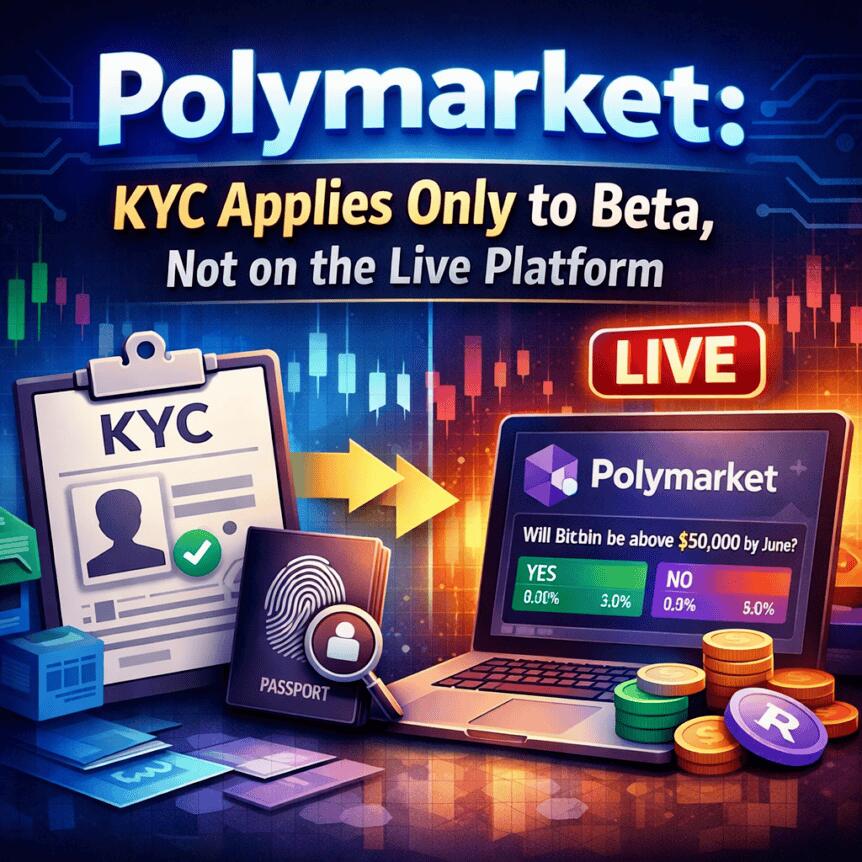
Polymarket has moved to ease a wave of regulatory uncertainty around its service by clarifying its stance on identity checks. The platform’s vice president of engineering, Josh Stevens, said there will be no mandatory KYC (Know Your Customer) requirements for the core Polymarket.com platform. Instead, a new beta product will require KYC access only during its early testing phase, after which no KYC will be required to use the main site.
The clarification follows a report from The Information that Polymarket had considered imposing user verification amid mounting regulatory scrutiny. Stevens reaffirmed the distinction: identity checks are tied specifically to early access for a separate beta product, not to the established prediction market that underpins Polymarket’s main offering.
Cointelegraph contacted Polymarket and Stevens for further comment but did not receive an immediate response. For context, the company has been navigating a broader regulatory landscape that has included widening geoblocking and cross-border access restrictions in several jurisdictions.
Key takeaways
- Polymarket states no KYC will be required for its main platform; KYC will only apply to a beta product during its early access phase.
- Stevens cautioned that this beta-related identity check is not an indicator of a broader shift away from pseudonymous trading on Polymarket’s core market.
- The clarification comes amid reporting that regulatory pressure has prompted discussions around user verification and platform access.
- Regulatory restrictions are expanding, with dozens of geographies outlined in Polymarket’s access controls and several jurisdictions taking action against prediction-market platforms.
- Policy and market dynamics point to a fragile balance between global access to prediction markets and the regulators’ focus on licensing and consumer protection.
KYC clarification amid regulatory pressures
The core message from Polymarket comes directly from Stevens’ X (formerly Twitter) posts, where he said the beta product would require KYC only for early access and that no KYC would be added to the existing Polymarket.com platform as part of this launch. He later emphasized that these identity checks are tied to a new beta product’s early access, not to a broader move away from pseudonymous participation on the main market.
The report from The Information had suggested that Polymarket had considered mandatory user verification in response to regulatory scrutiny. While multiple outlets have explored the regulatory implications for crypto-linked prediction markets, Polymarket’s stance here appears designed to prevent a blanket shift away from its current model while still enabling a controlled trial of a new product with identity checks.
Markets and users are watching how this will be implemented in practice. The beta will be accessible to a select group of users, with Stevens signaling that the approach is experimental and isolated from the platform’s ongoing, non-beta operations.
Geoblocking and the evolving regulatory backdrop
Polymarket’s stance arrives as the platform contends with expanding access restrictions in several jurisdictions. A Cointelegraph report noted that Polymarket had restricted access in dozens of jurisdictions, with some regions blocking new orders while others only permitting closing positions. The evolving geoblocking landscape underscores the tension between global reach and local regulatory regimes.
In April, Brazil moved to block Polymarket and other prediction platforms, among 27 services, in what authorities described as actions against unlicensed gambling activity. Spain’s gambling regulator followed suit in May, blocking local users from Polymarket and Kalshi as it pursued investigations into unlicensed gaming activity.
Despite these regulatory frictions, Polymarket has not halted expansion efforts. Reports from April suggested dialogue with the U.S. Commodity Futures Trading Commission (CFTC) about a broader relaunch in the United States, while May coverage indicated ongoing interest in entering Japan, despite the country’s strict gambling laws.
The dynamic illustrates a wider pattern in which prediction-market platforms face a patchwork of national rules, some of which permit limited participation while others impose outright bans or licensing requirements. For investors and users, the key question is whether access constraints—and any future KYC requirements—will erode liquidity or alter the platform’s competitive landscape.
Implications for users, investors, and builders
From a user perspective, the distinction between a beta-access KYC requirement and a non-KYC core platform matters. Beta participants may gain early exposure to new features or risk controls, but access will be limited. For the broader user base, Polymarket’s public, pseudonymous trading model remains a potential differentiator in a sector where regulators are increasingly scrutinizing online gambling and prediction-market activities.
For investors and platform builders, the situation highlights several critical considerations. First, regulatory alignment remains a moving target, with regional actions potentially changing the feasibility of cross-border participation. Second, any future product iterations that incorporate identity checks could set a precedent for other prediction-market operators seeking regulatory legitimacy, while simultaneously risking reduced user anonymity and participation in certain markets.
Finally, the ongoing talks and market rumors about a possible U.S. relaunch with regulatory clarity from the CFTC, alongside interest in markets such as Japan, signal a strategic pivot toward compliance-driven expansion. Yet the path remains uncertain, given the patchwork nature of global regulation and the persistent questions around licensing, consumer protection, and enforcement in different jurisdictions.
Analysts will be watching not only the technical rollout of the beta but also how Polymarket negotiates the balance between user privacy, regulatory expectations, and the demand for faster, more accessible forecasting markets. As jurisdictions continue to shape the boundaries of permissible activity, the platform’s ability to sustain liquidity and user trust will hinge on transparent governance and clear, enforceable rules.
Readers should monitor updates from Polymarket’s leadership, regulatory developments in key markets, and any formal statements about beta access criteria, licensing steps, or changes to the main platform’s KYC posture as the year progresses.