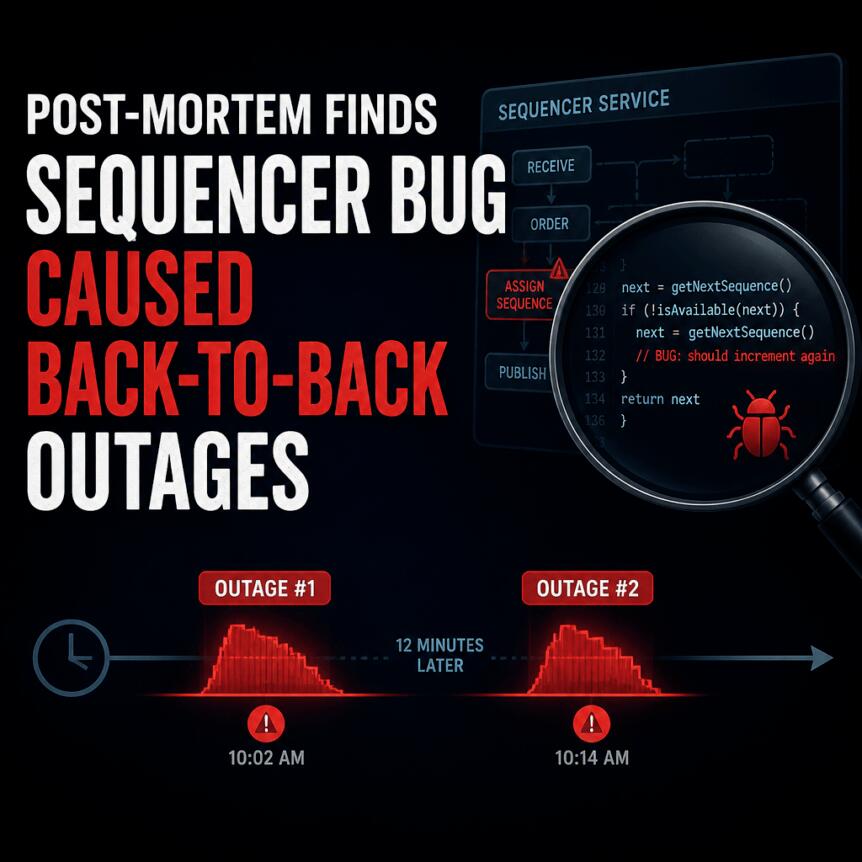
Coinbase’s Base layer-2 network faced two block production outages last week, and a post-mortem published by the Base engineering team attributes both incidents to a bug in the chain’s sequencer block-building logic.
According to the report, the problem allowed “stale journal state” to persist after a transaction validation failure—meaning the system did not properly clear account and storage slot data after an invalid transaction failed during execution. Because Base uses a single sequencer, the defect had system-wide consequences.
Key takeaways
- Base’s post-mortem says a sequencer bug caused “stale journal state” to remain after an execution failure, contributing to two outages.
- Both incidents stopped new layer-2 block production; sequencer and validator nodes could not move forward past the invalid block until recovery steps completed.
- The engineering team applied a patch to update journal state correctly during execution.
- Mitigation took longer than planned, partly due to unrelated infrastructure conditions, and a follow-on “race condition” after a system reset delayed full recovery for the second outage.
- Base says it will strengthen testing through “fuzz testing” and work toward “graceful recovery” to avoid manual validator restarts in future incidents.
What went wrong in Base’s sequencer
In its Saturday post-mortem, the Base engineering team described how the system handled an invalid transaction received by the block builder. The transaction failed during execution “as expected,” the team said—but the sequencer did not clear the journal state associated with the accounts and storage slots that had been accessed.
That lingering state, the report explains, stemmed from sequencer logic that built blocks while leaving “stale journal state” intact. In typical operation, clearing or rolling back intermediate state is essential to ensure subsequent blocks are constructed from a clean execution context. Here, the failure to do so prevented normal progression.
Two outages, tied to the same failure path
Base mainnet suffered two separate block production outages on Thursday and Friday, according to the post-mortem. The first incident lasted 116 minutes, while the second was shorter at 20 minutes.
In both events, the practical outcome was the same: a complete halt in new layer-2 block creation. The sequencer and validator nodes were unable to progress past the invalid block until sequencing was restored, effectively freezing the chain’s ability to finalize new blocks.
The team implemented a fix by patching the sequencers so journal state is properly updated during execution. However, the report notes that the time required to mitigate the problem exceeded expectations “due to infrastructure conditions unrelated to the original bug.” That distinction matters for operators and builders watching for operational reliability, because it suggests the initial logic flaw was not the only factor affecting service restoration.
A follow-on “race condition” delayed full recovery
The post-mortem also points to additional complexity after a system reset. It states that a “race condition” occurred during recovery, which prevented the sequencers from catching up after the restart—contributing to the second outage.
This kind of sequencing delay is particularly important for layer-2 chains that rely on correct synchronization between components. Even after patching the underlying logic, if the system cannot re-align its execution pipeline cleanly, validators may remain blocked waiting for proper sequencer outputs. Base’s report indicates this is what happened in the follow-up period.
Sequencer centralization raises the stakes
Base is designed with a single sequencer, as the post-mortem and the team’s public communications emphasize. That architecture makes the sequencer a critical dependency: when the sequencer stalls or encounters a logic failure, the chain’s block production can stop.
This is not a theoretical risk. The report notes that outages tied to sequencer behavior have also affected other layer-2 networks, including Arbitrum, OP Mainnet, and zkSync Era. With Base, the single-sequencer model means a bug in block construction logic can become immediately visible to users across the network.
What Base plans to change next
Looking ahead, the engineering team outlined two forward-looking measures aimed at reducing the odds of similar incidents and improving recovery speed.
First, it plans to improve protocol “fuzz testing,” a technique that tests systems by generating large volumes of random, malformed, or unexpected inputs. For blockchain execution and sequencing code paths—where edge cases can trigger state inconsistencies—fuzzing is often used to uncover failure modes that normal testing may miss.
Second, the team intends to build “graceful recovery,” aiming to prevent validators from requiring manual restarts during future incidents. The operational goal is straightforward: even when something goes wrong, systems should return to service without extended human intervention or prolonged uncertainty.
Base has seen similar issues before
This week’s outages follow earlier sequencer-related disruptions on Base. The post-mortem indicates Base stopped producing blocks for 17 minutes in September 2024 and for around half an hour in August 2025—another reminder that sequencer reliability remains an ongoing focus area for the network.
In terms of scale, Base is described as the second-largest layer-2 network by total value secured, which is just under $11 billion, according to L2beat’s data. For investors and users, that positioning increases the significance of uptime and recovery mechanics: disruptions may affect activity and settlement on the network, especially during periods when other infrastructure remains stable.
As Base rolls out its planned testing and recovery improvements, the next key signal to watch is whether the fixes reduce both the likelihood of state-related sequencing failures and the time needed to fully recover after resets—particularly if future incidents still surface around tricky execution-state edge cases.